

Car Door Lock Repair: How to Fix It and What It Costs

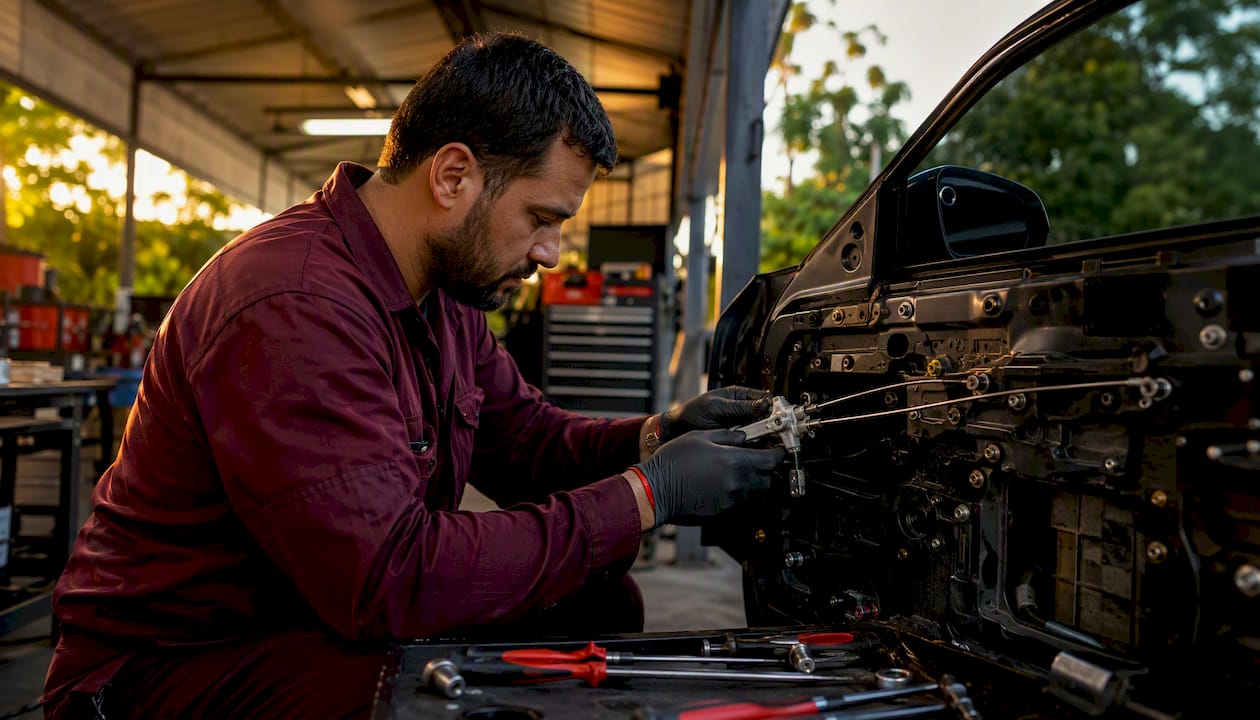
You can handle some car door lock repairs yourself — lubrication, a stuck cylinder, or a single failed actuator are all reasonable DIY jobs. But if multiple doors stop working after a fuse check, or you see signs of forced entry, call a professional. Attempting electrical or Body Control Module (BCM) repairs without diagnostic tools usually makes things worse and more expensive.
Quick cost reference:
Minor DIY fixes (lubricant, cleaning): low cost
Single-door DIY part replacement or professional repair: moderate cost
Multi-door actuator failure or BCM-related work: higher cost
Fastest first checks to run right now:
Try your spare key in the door cylinder
Replace the key fob battery (CR2032 in most vehicles)
Check the fuse box for a blown door lock fuse
Press your ear to the door and press the lock button — a buzzing sound points to a weak actuator; silence points to a fuse or BCM issue
Pro Tip: Before pulling any panels, do the listening test at every door. A buzzing noise confirms the actuator is receiving power but failing mechanically. No sound at all usually means the problem is upstream — fuse, wiring, or BCM.
Table of Contents
What does car door lock repair actually cost?
Understanding the price split between parts and labor helps you decide whether to DIY or book a pro before you spend a dollar.
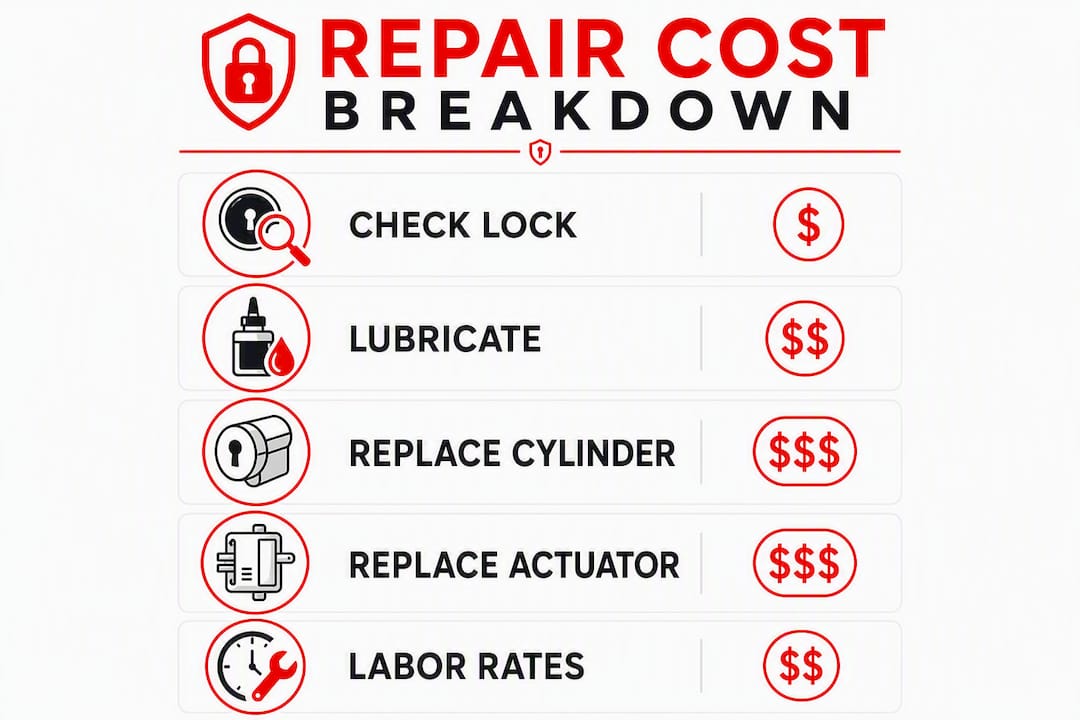
Part / Service | Typical Part Cost | Typical Labor Time |
Spray lubricant (graphite or silicone) | relatively low cost | short duration |
Fuse replacement | low cost | very short duration |
Lock cylinder replacement | moderate cost | moderate duration per door |
Door lock actuator replacement | moderate cost | moderate duration per door |
Linkage realignment or replacement | moderate cost | short duration |
BCM diagnosis and repair | higher cost | longer duration |
Emergency mobile lockout call | moderate cost | about an hour on-site |
Labor rates at a shop typically run $80–$150 per hour depending on your area and whether the vehicle needs panel removal. Actuator jobs on vehicles with complex door panels — think luxury SUVs or vehicles with integrated speaker grilles — take longer and cost more. BCM or wiring diagnosis adds diagnostic tool time on top of repair time, which is why those jobs push past $400 quickly.
Emergency mobile callouts carry a service fee on top of parts and labor. That fee covers the technician’s travel and after-hours availability, and it is usually worth it if you are stranded. Scheduling a non-emergency appointment at a shop almost always saves $50–$100 compared to a same-day mobile call.
Key cost driver: whether your vehicle requires full door panel removal or has access plugs on the door jamb. Vehicles with access plugs let a technician reach the cylinder retaining clip or actuator connector without stripping the entire interior panel, cutting labor time significantly.
How do you know what’s wrong with your car door lock?
Common symptoms of door lock failure fall into three clear categories: mechanical, electrical, and user-side issues. Identifying which category you are dealing with takes less than ten minutes.
Common symptoms and what they usually indicate:
Buzzing noise when pressing the lock button: The actuator is receiving power but the motor is failing. This is a mechanical actuator fault.
Key turns but the lock doesn’t move: Broken linkage or a disconnected cylinder. A failed connection between the cylinder and the latch is one of the most common causes.
Fob works on some doors but not others: Single-door actuator failure or a damaged door module.
No response from fob or master switch on any door: Blown fuse, dead fob battery, or a BCM fault.
Intermittent locking: Actuator wear, wiring flexing at the door boot, or a worn master switch are the usual culprits.
Run this diagnostic sequence in order:
Try the spare key in the door cylinder. If it works, your fob or fob battery is the problem.
Replace the key fob battery. Most vehicles use a CR2032; pop the fob open and check.
Check the fuse box. Your owner’s manual shows the door lock fuse location. A blown fuse is a $2 fix.
Do the listening test. Press your ear against each door and press the lock button. Note which doors buzz and which are silent.
Test the master switch. If the driver’s door switch does nothing but the passenger switch works, the master switch or driver’s door module may be faulty.
Visually inspect the door jamb and cylinder for corrosion, bent hardware, or signs of forced entry.
Pro Tip: A stepwise troubleshooting approach isolates the fault layer by layer. Never skip the fuse check — a $2 fuse is the most common fix technicians find after a customer has already spent an hour troubleshooting.
Safety note when checking fuses: Turn the ignition off before opening the fuse box. Use the fuse puller included in most fuse boxes rather than metal pliers, which can short adjacent circuits.
Step-by-step DIY repairs for common vehicle door locking problems
Three jobs are genuinely manageable for a careful car owner: lubricating a stuck cylinder, replacing a lock cylinder, and swapping a single actuator. Here is how to do each one safely.
Tools you will need:
Small socket set (8mm–14mm range covers most door hardware)
Torx bit set (T20, T25, T30 are common on door panels)
Plastic panel trim tools (never use a flathead screwdriver — it cracks clips)
Needle-nose pliers
Multimeter
Graphite or silicone spray lubricant
Electrical contact cleaner
Replacement actuator or cylinder matched to your year, make, and model
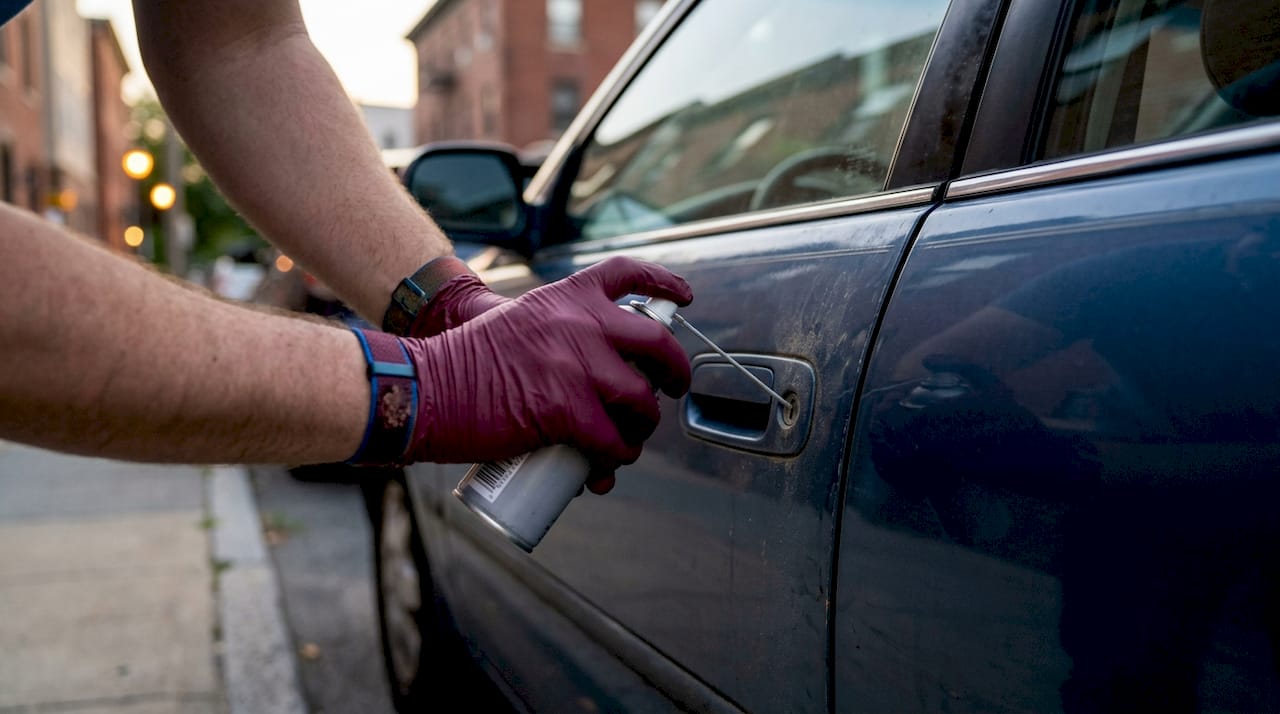
Job 1: Lubricating a stuck lock cylinder
Insert your key and work it gently back and forth without forcing it.
Spray graphite lubricant directly into the keyway. Avoid WD-40 — it attracts dust and gums up tumblers over time.
Insert and remove the key several times to distribute the lubricant.
Test the lock from inside and outside.
This fix takes under 15 minutes and costs a low amount. If the cylinder still binds after lubrication, the tumblers are worn and the cylinder needs replacement.
Job 2: Replacing a lock cylinder
Many vehicles have small access plugs on the door jamb that provide direct access to the retaining clip, avoiding full panel removal entirely. Check your door jamb before assuming you need to strip the panel.
Open the door and locate the access plug on the door jamb edge.
Remove the plug with a small flathead tool and look for the retaining clip behind it.
Insert the key, turn it to the release position, and press the retaining clip to slide the cylinder out.
Slide the new cylinder in, confirm the clip seats, and test with the key.
If your vehicle requires panel removal, remove the door handle bezel screws, pop the panel clips with a plastic trim tool starting at the bottom corners, and lift the panel up off the window channel. Support the panel — do not let it hang by the wiring harness.
Important: A new cylinder requires rekeying if you want it to accept your existing ignition key. Skipping this step leaves you with two different keys for door and ignition. A locksmith can rekey the new cylinder to match your existing key on-site.
Job 3: Replacing a door lock actuator
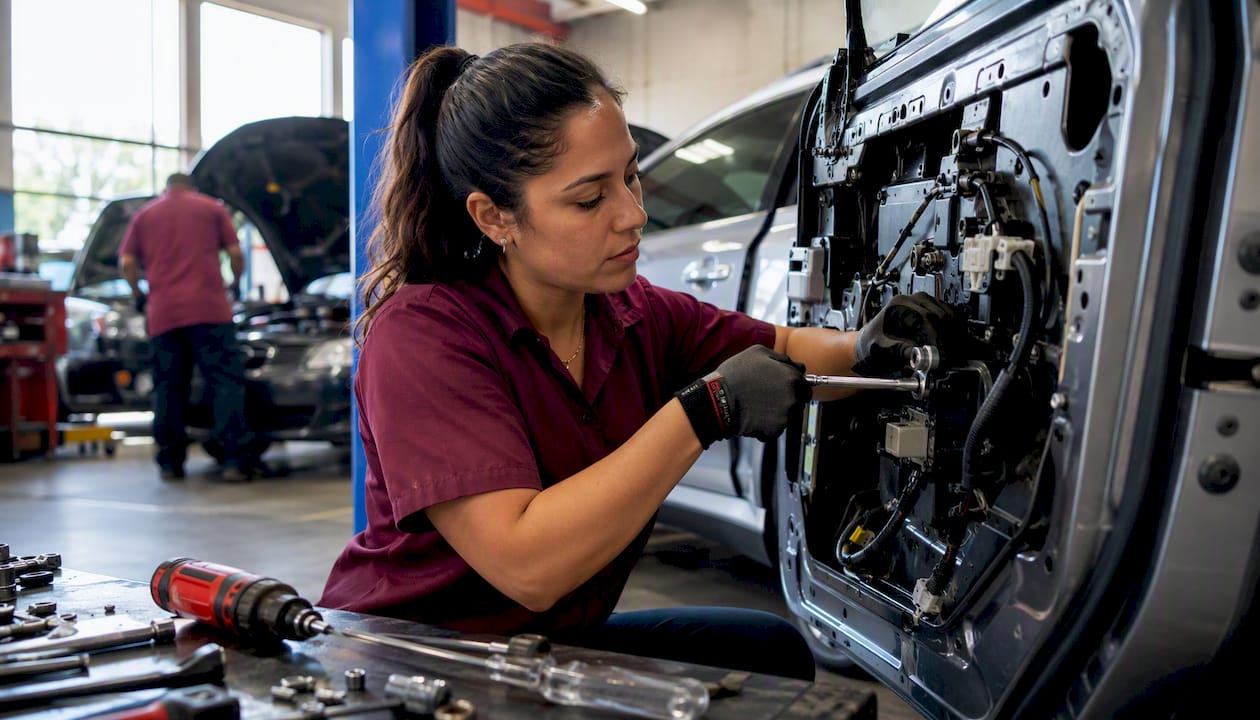
Most door lock actuators are integrated into the door latch assembly, so you are often replacing the latch unit as a whole.
Remove the door panel using the trim tool and socket set.
Disconnect the window glass support rod if it obstructs access, and tape the glass in the up position.
Unplug the actuator electrical connector and test voltage at the connector with a multimeter while pressing the lock button. Voltage present but no movement confirms actuator failure.
Remove the bolts holding the latch assembly to the door frame (usually 2–3 bolts).
Disconnect the linkage rods from the latch and remove the assembly.
Install the new latch/actuator, reconnect the linkage rods, bolt the assembly in, and plug in the connector.
Test before reinstalling the panel.
Pro Tip: On most vehicles, the driver’s door actuator acts as the “master.” If only the driver’s door fails while all other doors respond normally, test the driver’s door actuator first — it is the most likely single point of failure in a master-slave system.
Stop and call a pro if: you find damaged wiring in the door boot (the rubber grommet between door and body), if the multimeter shows no voltage at the connector, or if removing the panel creates a second fault like a broken clip or damaged harness.
When should you call a professional instead of DIYing?
Some vehicle door locking problems are beyond what a careful DIY repair can safely address. Recognizing those situations early saves you money and prevents security gaps.
Red flags that mean call a pro now:
Evidence of forced entry: bent door frame, damaged cylinder, or scratches around the keyway
Multiple doors failing simultaneously after fuse checks pass
No voltage at the actuator connector despite a good fuse (wiring or BCM fault)
Broken glass or bent door hardware from an accident or break-in
You need key reprogramming or a new ignition cylinder matched to your door locks
Before you call, have this information ready:
Vehicle VIN (on the dashboard near the windshield)
Year, make, and model
Whether you have a spare key and whether it works
Description of symptoms: which doors, what sounds, when it started
What you have already checked: fob battery, fuse, listening test results
Questions to ask the locksmith or shop:
Do you carry replacement actuators for my specific model, or will you need to order parts?
Do you offer on-site mobile service, or does the vehicle need to come to the shop?
What warranty do you provide on parts and labor?
What is the estimated labor time for this repair?
Mobile vs. shop: A mobile locksmith handles most mechanical jobs — cylinder replacement, actuator swaps, key duplication, and fob programming — right at your location. A shop visit is preferable when the repair requires a scan tool for BCM codes, alignment of multiple door modules, or access to a parts inventory for less common vehicles.
What does a professional locksmith or mechanic actually do?
Professional lock repair follows a consistent diagnostic workflow before any parts are ordered or replaced.
Confirm the symptom by testing the fob, spare key, and master switch.
Check fuses and power at the actuator connector with a multimeter.
Access the door via the jamb plug when available, or remove the panel.
Test the actuator directly. If voltage is present and the actuator does not move, it is replaced.
Scan for BCM or door-module fault codes using an OBD-II scanner when electrical symptoms are present across multiple doors.
Repair or replace the specific failed component: actuator, cylinder, linkage rod, or wiring in the door boot.
Professional car lock repair services typically disassemble the lock mechanism, clean obstructions, replace worn pins or springs, lubricate moving parts, and only replace the full lock assembly when necessary. Full replacement is reserved for severe corrosion, forced-entry damage, or irreversible mechanical wear.
Lock change services can include ignition lock cylinder replacement, door lock replacement, trunk lock changes, and key fob reprogramming, delivered on-site or at a shop depending on the provider and the job complexity.
Pricing drivers:
OEM parts cost more than aftermarket but typically carry better fit and longer warranties
Panel removal difficulty varies significantly by vehicle — a truck door takes less time than a luxury sedan with integrated electronics
Mobile callout fees add $50–$150 to any job
Key reprogramming or rekeying adds $30–$100 depending on the vehicle’s security system
On warranties: Always confirm before authorizing work. A reputable shop or locksmith offers at least a 90-day warranty on labor and a manufacturer’s warranty on parts. Get it in writing.
Locksmithfromiami: a trusted local option for Miami-area drivers
If your diagnostics point to a problem beyond a simple lubrication or fuse fix, Locksmithfromiami (Progressive Locksmith Cerrajero) provides mobile auto locksmith services across Miami and the Homestead, FL area, available 24/7.
What they handle for car door lock problems:
On-site actuator and lock cylinder replacement
Key duplication and key/fob programming
Emergency lockout response with fast mobile dispatch
Rekeying new cylinders to match your existing ignition key
When to contact them: After you have run the quick checks (spare key, fob battery, fuse, listening test) and the problem persists. Or immediately, if there is forced-entry damage or you are stranded and cannot get into your vehicle.
What to have ready when you call:
Your VIN and vehicle year, make, and model
Whether your spare key works
A brief description of symptoms and what you have already tested
Pro Tip: Telling the technician exactly which doors fail, what sounds you hear, and what you have already checked cuts diagnostic time significantly. A prepared caller gets faster service and a more accurate quote.
Locksmithfromiami’s local locksmith coverage in south Miami means a technician can typically reach you faster than a general auto shop can schedule an appointment.
Key Takeaways
Most car door lock failures come down to a few fixable causes — and knowing which one you are dealing with determines whether a $5 fuse or a professional visit is the right next step.
Point | Details |
Start with free checks | Try your spare key, replace the fob battery, and check the door lock fuse before spending anything. |
DIY cost range | Minor fixes run $0–$40; a single-door actuator or cylinder replacement typically costs a moderate amount per door, depending on your vehicle and whether panel removal is needed. |
Know when to stop | Electrical faults, BCM codes, or forced-entry damage require a professional with diagnostic tools. |
Rekeying matters | Replacing a lock cylinder without rekeying leaves you with two different keys for door and ignition. |
Locksmithfromiami | Provides 24/7 mobile car door lock repair across Miami and Homestead, FL, including actuator swaps, cylinder replacement, and key programming. |
What technicians actually see in the field
Most car owners who call a locksmith have already spent an hour on the wrong fix. The single most common pattern: someone replaces the key fob battery, decides the fob is fine, and then assumes the actuator is dead — without ever checking the fuse. A $2 fuse fix becomes a $150 service call because the fuse box was skipped.
The second thing worth saying plainly: mechanical symptoms often hide electrical causes. A door that buzzes but does not lock feels like a dead actuator. Sometimes it is. But wiring that flexes and cracks inside the door boot — the rubber grommet between the door and the body — can produce the exact same symptom. A multimeter test at the connector tells you which one you are dealing with in about 60 seconds.
On cylinder replacements specifically: the rekeying step is the one most DIYers skip. Replacing a cylinder without rekeying it to your ignition key is a real security and convenience problem. You end up carrying two keys for one car, and if you ever lose one, you have a partial lockout situation. When you bring the old cylinder to a locksmith before installing the new one, they can often cut the new cylinder to match your existing key on the spot.
One more field note: if you are removing a door panel, photograph the linkage rod positions before disconnecting anything. Reassembly is where most DIY jobs go wrong, and a photo taken before disassembly takes 10 seconds and saves 30 minutes of guessing.
Fast, reliable car door lock help from Locksmithfromiami
Stranded with a door that will not open, or staring at a lock that worked yesterday and does nothing today? Locksmithfromiami gives Miami-area drivers a direct line to a mobile technician who carries the parts and tools to handle most car lockout situations and lock repairs on-site, without a tow or a shop appointment.

The service covers actuator replacement, cylinder swaps, key duplication, and fob programming — all delivered at your location, any time of day. Before you call, have your VIN, vehicle year and model, and a quick description of what you have already tested. That information lets the technician arrive with the right parts and give you an accurate quote before any work starts.
For shop-level diagnostics — BCM scans, wiring repairs, or multi-door module work — the Locksmithfromiami workshop is equipped for jobs that require more than a mobile kit. Call or visit the service page to get a mobile technician dispatched or to book a workshop appointment.
Recommended
Comments