

Car Key Programming: DIY vs Pro Guide for Car Owners

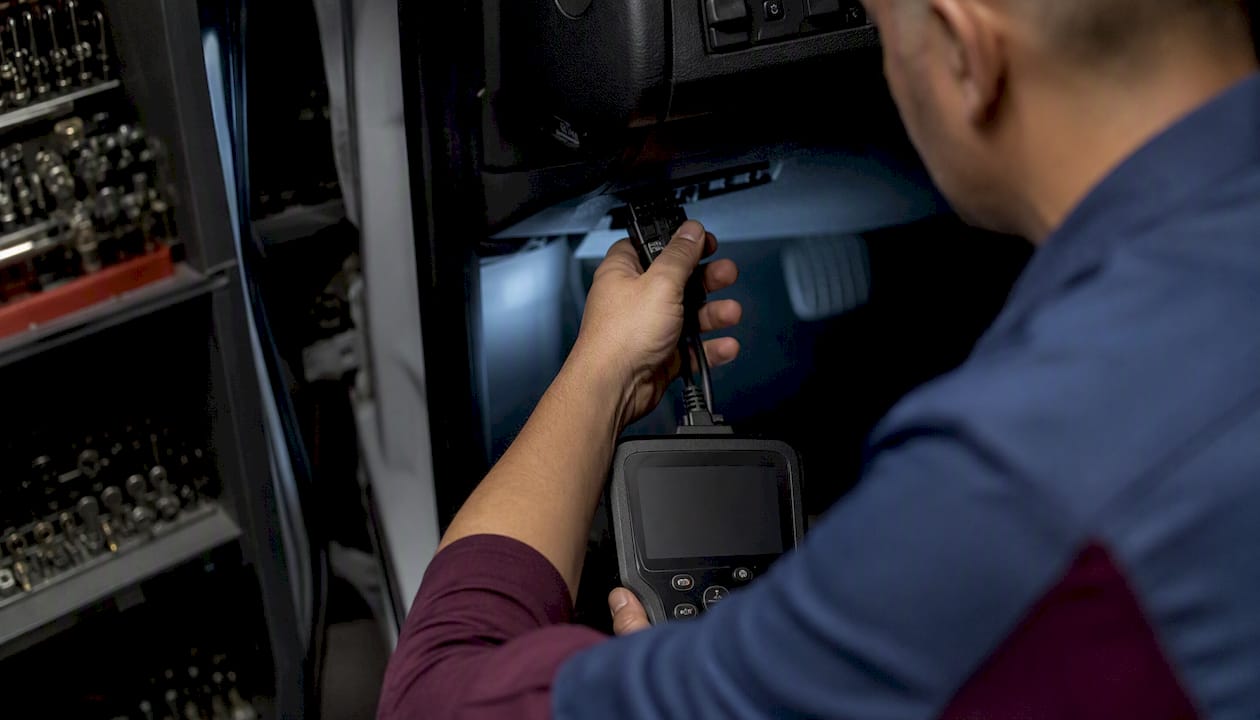
Most car owners can handle simple key fob resyncs and add-a-key jobs on their own, provided they have at least one working key and their vehicle supports on-board programming (OBP). If you’ve lost all your keys, drive a European luxury vehicle, or own a push-button smart key car, you’ll need a professional with OBD diagnostic equipment or, in some cases, NASTF VSP authorization to access OEM security data.
Here’s the quick breakdown:
DIY-friendly: Adding a second key when you already have one working key, resyncing a fob after a battery swap, basic transponder programming on OBP-capable vehicles (many Fords, GMs, Chryslers from the late 1990s through mid-2010s)
Needs an OBD tool: Most post-2015 vehicles, immobilizer pairing on Japanese and Korean makes, any job requiring VIN-specific security seed/key generation
Needs a pro: All-keys-lost (AKL) scenarios, encrypted European luxury platforms (BMW, Mercedes, Audi, Porsche), failed DIY attempts that triggered an ECU lockout, smart proximity keys on most modern vehicles
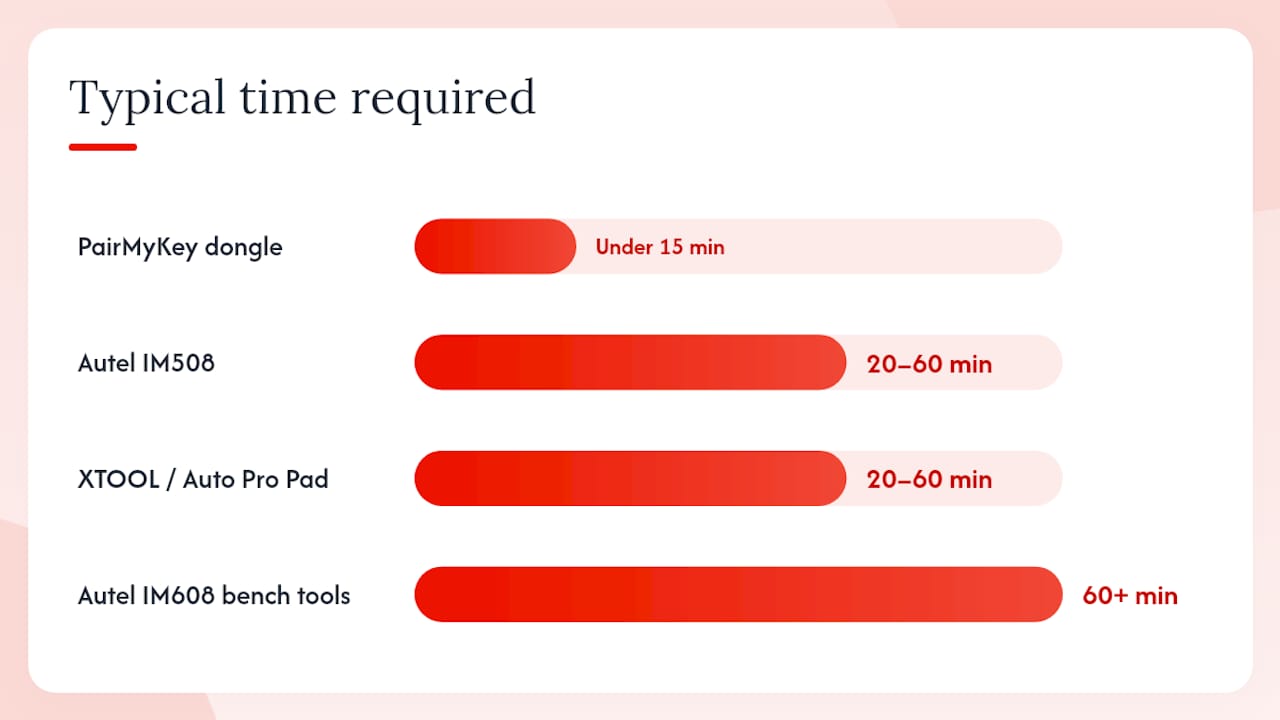
Typical U.S. costs for basic add-key jobs at a mobile locksmith are lower than dealer prices and can be significantly less expensive than premium dealer quotes, especially for all-keys-lost (AKL) jobs on luxury European vehicles. Consumer OBD dongles like PairMyKey can cut that cost significantly for compatible vehicles, with programming times under 15 minutes.
If your situation is DIY-eligible, jump to the on-board programming section below. If you’re not sure, or if you’ve already tried once and hit an error, call a certified automotive locksmith before attempting anything else.
Pro Tip: Before buying any tool or attempting any sequence, confirm your exact year, make, model, and trim on the tool’s VIN compatibility checker. A mismatch wastes money and can lock your ECU.
Table of Contents
How does car key programming actually work?
Car key programming is the process of pairing a key’s electronic credentials to your vehicle’s immobilizer control unit. A cut blade alone won’t start most vehicles built after the late 1990s. Cutting and programming are two separate jobs, and skipping the second one leaves you with a key that fits the lock but won’t turn the engine on.
The three key types you’ll encounter
Transponder keys carry a small RFID chip in the plastic head. When you insert the key, the car’s immobilizer sends a radio signal to the chip; the chip responds with a code. If the code matches, the engine starts. No match, no start.
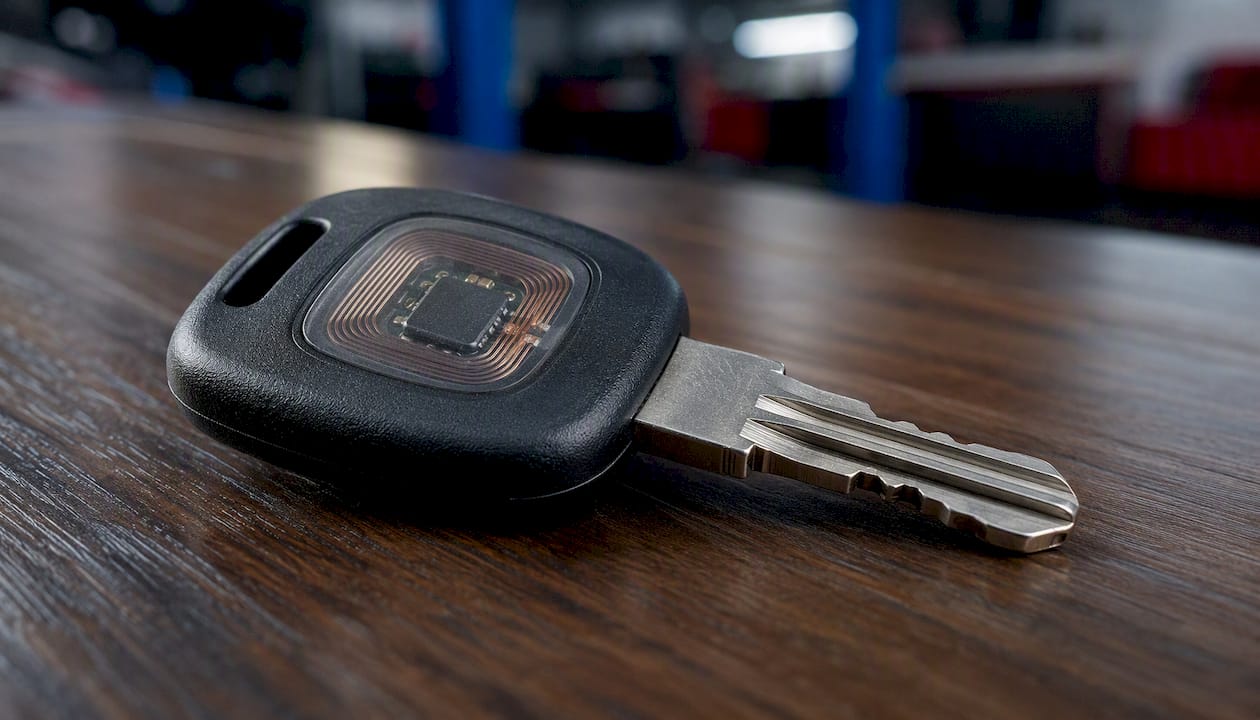
Remote/key fob keys combine a transponder chip with a radio-frequency remote for door locks. The remote side uses a rolling code that must be synchronized to the car’s body control module. The transponder side still needs its own separate pairing.
Smart proximity keys (push-button start vehicles) communicate continuously with the car via encrypted two-way radio. They require the most complex programming, often involving multiple control modules, and rarely support DIY methods.
When can you program a car key yourself?
On-board programming is genuinely accessible for many car owners, but the window is narrower than most YouTube videos suggest. It works when all three conditions are met: you have at least one fully functional key, your specific year/make/model/trim supports OBP, and you follow the exact sequence from the owner’s manual or a verified source like programyourremote.com.
Red flags that mean DIY will fail
You have no working key at all (AKL scenario).
Your car has a push-button start or a proximity fob with no physical key blade.
The vehicle is a European luxury make (BMW, Mercedes-Benz, Audi, Volkswagen, Porsche, Volvo).
You already attempted a sequence and the car showed an immobilizer warning light.
Your owner’s manual has no programming sequence listed.
Guessing sequences is the single most dangerous thing you can do. Entering incorrect codes repeatedly can trigger a security lockout that freezes the immobilizer for 30 minutes to several hours, and on some platforms, a hard lockout requires a dealer-level reset. Step-by-step fob programming guides are useful for confirmed OBP vehicles, but they are not a substitute for verifying compatibility first.
Pro Tip: Check your owner’s manual under “keys” or “remote transmitter” before searching online. Manufacturer sequences are the only ones guaranteed not to trigger a lockout on your specific vehicle.
What OBD dongles and key programmer tools should you consider?
The consumer and professional tool market breaks into three tiers. Knowing which tier fits your situation saves you from overspending on a professional tool you can’t use or underspending on a consumer dongle that doesn’t support your car.
Consumer app-driven dongles
PairMyKey is the clearest example of this category: an OBD dongle paired with a mobile app that walks you through programming in under 15 minutes for compatible vehicles. It uses a per-use token model, with additional uses available for purchase. The appeal is simplicity; the limitation is coverage. It works well for mainstream U.S. makes within its supported range, but it won’t handle AKL jobs or European luxury platforms.
Batteries Plus occupies a related space as a retail option: in-store key fob cutting and programming at prices that can run roughly 50% less than dealer pricing for many common fobs, with same-day service at most locations. It’s not a DIY tool, but it’s a practical middle ground between dealer pricing and a full mobile locksmith call.
Mid-tier handheld programmers
Autel’s IM508 and IM608 are the most widely recognized names in this category. The IM508 handles the majority of mainstream U.S. and Asian makes with a guided interface; the IM608 adds EEPROM and key generation capabilities for more complex jobs. XTOOL and Auto Pro Pad target similar markets with competitive coverage and are popular among independent shops and mobile locksmiths. These tools carry purchase prices in the hundreds to low thousands of dollars, making them practical for professionals or serious enthusiasts who will use them repeatedly.
Specialist bench and EEPROM tools
Xhorse, Lonsdor, and OBDSTAR are names you’ll see in trade discussions about high-security platforms. These tools, along with the Autel IM608 Pro, handle bench reads, EEPROM writes, and direct ECU work. They are not consumer products. The learning curve is steep, and a mistake at this level can require a dealer module replacement.
Tool / Service | Coverage | Ease of Use | Lost-Key (AKL) | Cost Model | Typical Time |
PairMyKey dongle | Mainstream U.S. makes (check VIN) | App-guided, very simple | No | Per-use token | Under 15 min |
Batteries Plus in-store | Common fobs, many makes | Staff-assisted | Limited | Per-service fee | Same day |
Autel IM508 | Broad U.S./Asian coverage | Guided menu, moderate | Yes (most makes) | One-time purchase + updates | 20–60 min |
XTOOL / Auto Pro Pad | Broad, competitive with Autel | Guided menu, moderate | Yes | One-time purchase + updates | 20–60 min |
Autel IM608 / bench tools | Near-universal, incl. European | Complex, pro-level | Yes, incl. luxury | High purchase + per-job tokens | varies, often 60+ min |
Pro Tip: Always run a VIN compatibility check on the tool manufacturer’s website before purchasing. Coverage lists change with firmware updates, and a tool that worked on your neighbor’s Honda may not support your specific trim.
When should you call a locksmith or dealer?
Some jobs are simply outside what any consumer tool or OBP sequence can handle. Knowing when to stop and call a professional saves you from a far more expensive repair.
Scenarios that require a pro
European luxury platforms: — BMW, Mercedes-Benz, Audi, Porsche, and Volvo often require NASTF VSP credentials for lawful OEM data access. Using unsupported generic tools on these systems risks ECU lockouts that only a dealer can reverse.
Mobile locksmith vs. dealer: which is faster and cheaper?
Mobile locksmiths commonly complete add-key programming on-site in 20–60 minutes for mainstream vehicles and typically charge less than dealers for the same job. Dealers have the advantage when OEM-only authorization is strictly required or when a warranty repair is involved.
Job Type | Typical U.S. Cost Range | Typical Time | Best Provider |
Fob resync / battery reset | up to $50 | 5–15 min | DIY or retail |
Add-key (transponder, 1 working key) | $50–$150 | 20–60 min | Mobile locksmith |
Smart key programming | $150–$250 | 30–60 min | Mobile locksmith or dealer |
AKL, mainstream make | $150–$250 | 20–60 min | Mobile locksmith |
AKL, European luxury | typically higher than $250 | varies, often 60+ min | Dealer or specialist locksmith |
What documentation you’ll need
Any reputable locksmith or dealer will ask for proof of ownership before programming a key. Have these ready:
Government-issued photo ID
Vehicle title or current registration
Proof of insurance (some shops request this)
This is standard fraud prevention, not an inconvenience. A shop that programs a key without verifying ownership is a shop you don’t want working on your car.
How to use an OBD programmer: the step-by-step flow
This sequence applies to most handheld OBD programmers and app-driven dongles. Exact prompts vary by device, but the underlying flow is consistent.
Before you start
Confirm VIN compatibility on the tool’s website
Have your working key (if required by the tool)
Charge your phone or tablet to at least 50%
Verify the tool’s firmware is current and any required tokens are loaded
Check the car battery voltage (12.4V or higher; low voltage causes mid-programming failures)
Apply the parking brake and close all windows
The programming sequence
Plug the OBD dongle or programmer into the OBD-II port (under the dash, driver’s side).
Turn the ignition to the ON position without starting the engine, or follow the device’s specific prompt (some tools require the engine running briefly first).
Open the app or tool menu and select your vehicle’s year, make, model, and trim. Enter the VIN when prompted.
Select “Add Key” or “Program Key” from the function menu. Choose “All-Keys-Lost” only if you have no working key.
Follow the on-screen steps exactly. The tool will communicate with the immobilizer, retrieve or generate a security seed, and write the new key’s credentials. Do not interrupt this process.
Wait for the confirmation message. Most tools display a green checkmark or “Programming Successful” screen.
Test immediately: attempt an engine start with the new key, test all remote functions (lock, unlock, trunk), and confirm the original key still works if you used the “add” function.
After programming
Test every key you own, not just the new one
Confirm door lock/unlock remotes work from at least 20 feet away
Note the key count in your records (some vehicles cap the number of programmed keys)
Common errors and first steps
“Incorrect VIN” or “Vehicle not supported”: — Double-check trim level; some tools distinguish between base and premium trims.
Troubleshooting common problems and staying on the right side of the law
Quick triage checklist
Before calling anyone, run through these in order:
Car battery at 12.4V or higher? (A weak battery is the most common cause of mid-programming failures.)
Key fob battery fresh? (CR2032 or equivalent, replaced within the last year.)
Correct blank key purchased? (Confirm part number against your VIN, not just make/model.)
Tool firmware updated and token balance confirmed?
Ignition ON steps followed in exact sequence?
If all five check out and the job still fails, the issue is likely vehicle-side (immobilizer fault, ECU lockout, or a security restriction requiring OEM access). That’s the point to stop and call a pro.
Common failure modes
Sync failure is the most frequent issue on OBP jobs. It usually means the sequence was interrupted or the timing was off. One careful retry is reasonable; more than two attempts without a confirmed cause is not.
ECU lockout happens when the immobilizer receives too many failed authentication attempts. Some systems lock for 30 minutes; others require a dealer scan tool to clear. Do not keep trying.
Token or authorization errors on OBD tools mean the per-job online credential wasn’t purchased or the server connection dropped mid-job. Reload the token and confirm your internet connection before retrying.
On legal safeguards: Locksmiths are required to verify ownership before programming any key. This protects you as much as it protects them. Using unauthorized bypass tools or cloning a key without the owner’s consent is a federal crime under the Computer Fraud and Abuse Act and can void your vehicle warranty. If a shop offers to skip the ID check, walk away.
Pro Tip: If your job involves bench or EEPROM work, ask the technician for a written record of the original immobilizer data and what was changed. Reputable shops keep this on file; it’s your insurance if something goes wrong later.
How Locksmithfromiami handles car key programming
Locksmithfromiami (Progressive Locksmith Cerrajero) is a mobile automotive locksmith service based in Homestead, FL, serving Miami-Dade County 24/7. The team carries professional-grade OBD programmers capable of handling transponder keys, smart keys, and AKL jobs across a wide range of domestic and import vehicles.
Key Takeaways
Car key programming is DIY-friendly only when you have a working key and a vehicle that supports on-board programming; any all-keys-lost or smart key job requires a professional with OBD diagnostic tools.
Point | Details |
Check OBP eligibility first | Verify your year/make/model supports on-board programming before attempting any sequence. |
Confirm VIN compatibility | Run a VIN check on any OBD tool or dongle before purchasing to avoid wasted money. |
Stop at the first ECU warning | An immobilizer warning light after a failed attempt means call a pro immediately, not retry. |
Budget 20–60 minutes for most jobs | Mainstream add-key and AKL jobs at a mobile locksmith typically finish within that window. |
Locksmithfromiami for Miami-area service | Locksmithfromiami provides 24/7 mobile key programming across Miami-Dade County with transparent pricing. |
What our technicians see in the field
The gap between what a car owner expects and what actually happens on a programming call is usually one of three things: a dead car battery, the wrong key blank, or missing paperwork.
A weak car battery is the most underestimated variable in this whole process. Programming draws consistent power from the vehicle’s electrical system, and a battery sitting at 11.8V will drop mid-job, causing a communication error that looks like a tool failure. The technician ends up troubleshooting a power problem, not a programming problem. Keeping a jump pack in your car isn’t just for emergencies; it’s useful any time you’re doing electrical work.
The wrong blank is the second most common surprise. A key that looks identical to the correct one may carry a different chip frequency or transponder protocol. Ordering by make and model alone isn’t enough; the VIN determines the exact part number, and a $15 savings on a generic blank can cost $150 in a second service call.
Procedural discipline is what separates a clean job from an ECU lockout. The team at Locksmithfromiami follows a fixed pre-job checklist on every call: battery voltage, correct blank confirmed, ownership verified, tool firmware current, token loaded. That sequence isn’t bureaucratic; it’s what prevents the kind of cascading errors that turn a 30-minute job into a dealer tow.
Need a pro right now? Here’s how to reach Locksmithfromiami
When DIY isn’t the right call, Locksmithfromiami’s mobile team is available 24/7 across Miami-Dade County. Whether you need a transponder key programmed, a smart key replaced, or an all-keys-lost job handled on-site, the team arrives with the equipment to finish the job in a single visit.
To get started, call or request a quote through the auto locksmith services page. Have your vehicle registration or title and a government-issued ID ready; verification happens before any work begins. The team provides a firm quote upfront, accepts standard payment methods, and documents every job with a receipt. For same-day availability and local coverage details, visit the service area page.
Useful sources and next steps
A short list of resources worth bookmarking, whether you’re going the DIY route or preparing for a pro visit:
PairMyKey — Program your car key yourself, in minutes
Key Fob Services | Car Key Programming, Cutting & Repairs at Batteries Plus
Free Automotive Keyless Entry Remote Fob Smart Key Programming Instructions
Car Key Programming | Transponder & Smart Key 24/7
Car key programming vs car key cutting: what’s the difference? (FXBG Keys)
A 7-step guide to car key fob programming (Tom’s Key)
Recommended
Comments