

Commercial Door Lock Types: A Facility Manager's Guide

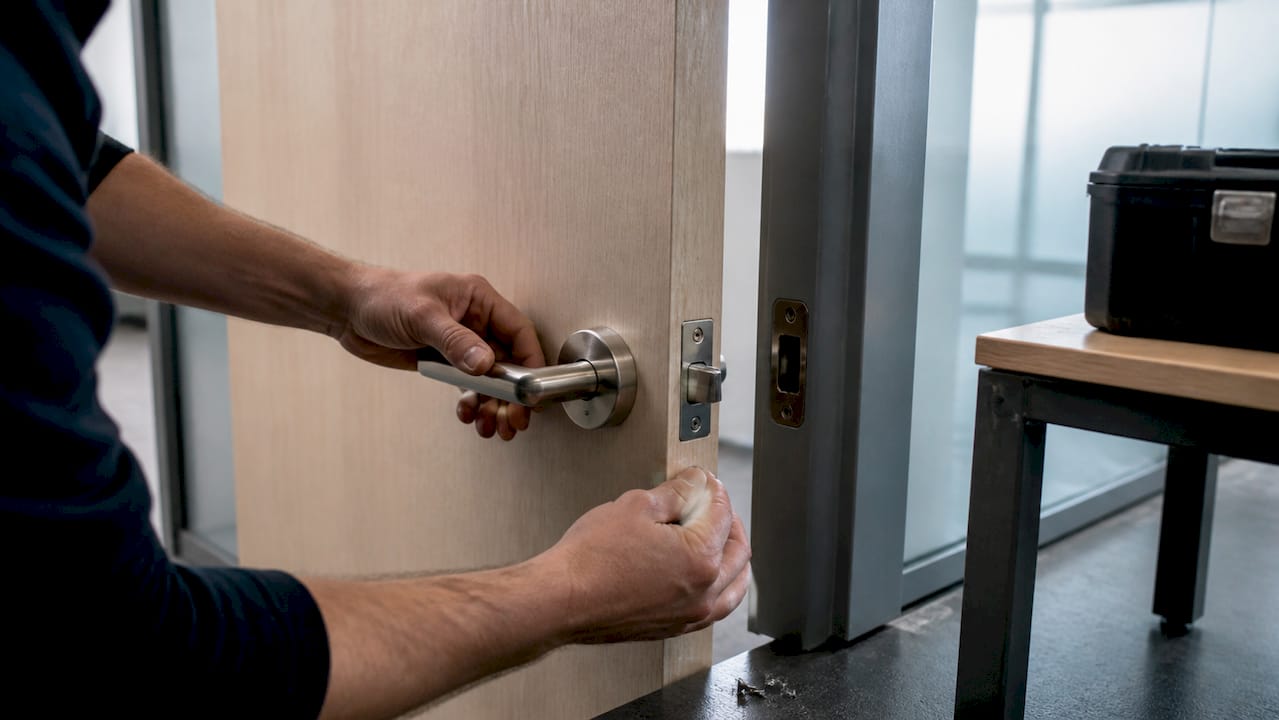
The five main commercial door lock types are cylindrical lever locksets, mortise locksets, deadbolts and supplemental hardware, electronic/keypad locks, and exit devices (panic hardware). Choosing between them comes down to one rule: match the lock format and ANSI/BHMA grade to the door’s traffic level, purpose, and code requirements.
Quick selection guide:
Cylindrical lever locks: Interior offices, conference rooms, and retrofit projects with existing bored-door prep. Cost-effective and fast to install.
Mortise locks: High-traffic corridors, exterior entries, healthcare, schools, and any opening that needs electrification or integrated deadbolt function.
Exit devices (panic hardware): Required by IBC/NFPA on egress doors serving high-occupancy spaces. Non-negotiable for code compliance.
Electronic/keypad locks: Back-of-house access, tenant entries, and any opening where audit trails or remote credential management matter.
Deadbolts/supplemental hardware: Secondary security on low-traffic doors where code permits and egress is not restricted.
For grade guidance, specify ANSI/BHMA Grade 1 on any primary entry, corridor, or high-traffic door. If you are specifying exit devices, electrified hardware, or converting between lock formats, call a licensed locksmith or security integrator before purchasing.
Pro Tip: Never default to the highest-security hardware on every door. Matching function and grade to actual use saves money and avoids premature wear on hardware that sees light traffic.
Key Takeaways
Specifying the right commercial door lock requires matching format and ANSI/BHMA grade to the door’s traffic level, code requirements, and electrification needs before selecting a brand or product line.
Point | Details |
Match format to traffic | Use mortise for high-traffic, institutional, or electrified openings; cylindrical lever for moderate-traffic and retrofit projects. |
Specify Grade 1 for primary doors | Grade 1 hardware reduces long-term maintenance costs on doors seeing heavy daily use. |
Exit devices are code-driven | IBC/NFPA requires panic hardware on egress doors serving occupant loads above 49 in assembly and educational occupancies. |
Plan electrification early | Specify electrified mortise in new construction for cleaner integration; confirm fail-safe behavior and fire-rating compliance before ordering. |
Locksmithfromiami | Provides commercial site surveys, ADA-compliant installs, and electrified hardware integration across Miami and Homestead. |
Table of Contents
What makes a commercial lock different from a residential one?
The gap between commercial and residential hardware is wider than most people expect. Commercial door lock types are built around three things residential locks are not: high-cycle durability, institutional function codes, and code listings for fire and egress.
A residential Grade 3 lockset might be tested to 250,000 cycles. A commercial Grade 1 product is tested to 250,000 cycles or more under heavier load conditions, with stricter torque and force requirements. Beyond the hardware itself, the door assembly matters as a system: a weak frame, an undersized strike, or short screws can defeat even a Grade 1 lock. Specify the frame reinforcement and strike alongside the lockset, not as an afterthought.
Key attributes that define commercial-grade hardware:
ANSI/BHMA grade listing: Grades 1, 2, and 3 define minimum cycle life, force resistance, and finish durability.
Fire and egress listings: Hardware on fire-rated doors must carry a UL or Intertek listing that matches the door’s fire label.
Institutional function codes: Commercial locks use standardized function designations (storeroom, classroom, entrance, etc.) that control exactly how the latch and lock behave.
Chassis and case construction: Commercial locksets use heavier gauge steel and larger latch bolts than residential equivalents.
Pro Tip: Specify function and grade first, then select a product. Choosing a brand before defining the function code is the most common specifier mistake.
What are the main commercial door lock types?
Cylindrical lever locksets are the most commonly used commercial lock type, and for good reason: they install quickly into a standard bored-door prep (a cross-bore through the door face and an edge-bore for the latch), making them the practical choice for retrofit projects and interior openings.
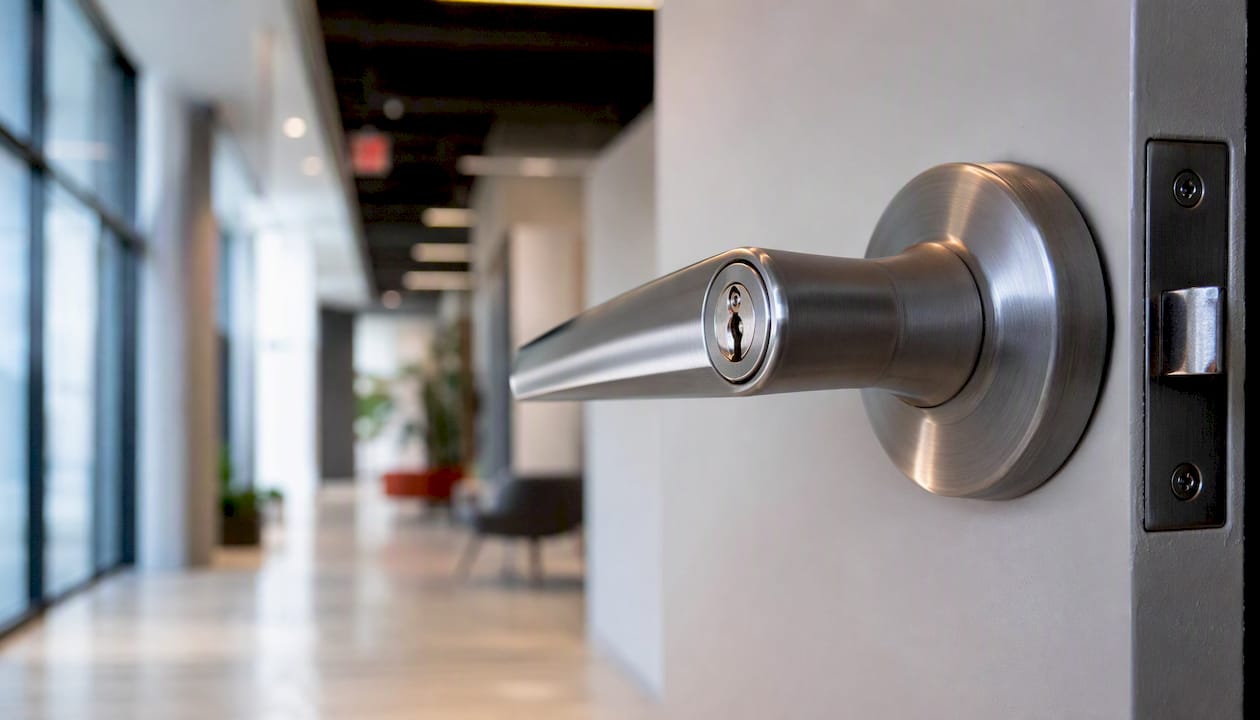
The cylindrical lever’s biggest strength is installation speed. A skilled technician can swap one in under 30 minutes on a prepped door. That speed comes with a trade-off: the lock mechanism sits in two separate pieces (chassis and cylinder) rather than a single self-contained case, which means the latch bolt and lock components take more abuse over time on heavy-traffic doors.
Application | Recommended Grade | Electrification Compatible | Typical Cost Range |
Interior office | Grade 2 or Grade 1 | Yes, with electrified chassis | Low to moderate |
Conference room | Grade 2 | Yes, wireless options available | Low to moderate |
Exterior entry (light traffic) | Grade 1 | Yes, with proper prep | Moderate |
Retrofit (existing bored prep) | Grade 1 | Yes, with compatible chassis | Low to moderate |
Best-fit applications for cylindrical levers:
Interior offices and private rooms
Conference rooms and break rooms
Classroom doors (with classroom function)
Retrofit projects where bored prep already exists
Budget-sensitive projects with moderate traffic
The main trade-off against mortise is lifecycle under abuse. A cylindrical lever on a door seeing 300 or more uses per day will wear faster than a mortise lockset, and the repair cost over five years can exceed the upfront savings.
Pro Tip: On any cylindrical lever installation, upgrade the strike plate to a heavy-duty 4-inch unit with 3-inch screws into the stud. The door frame is the weakest point, not the lock cylinder.
When does a mortise lock make more sense?
A mortise lock installs into a rectangular pocket routed into the door edge, housing the entire locking mechanism in a self-contained steel box case. That design is what gives mortise locks their durability advantage: the latch, deadbolt, and auxiliary bolt all operate from a single integrated body, distributing stress across the door rather than concentrating it at two bored holes.
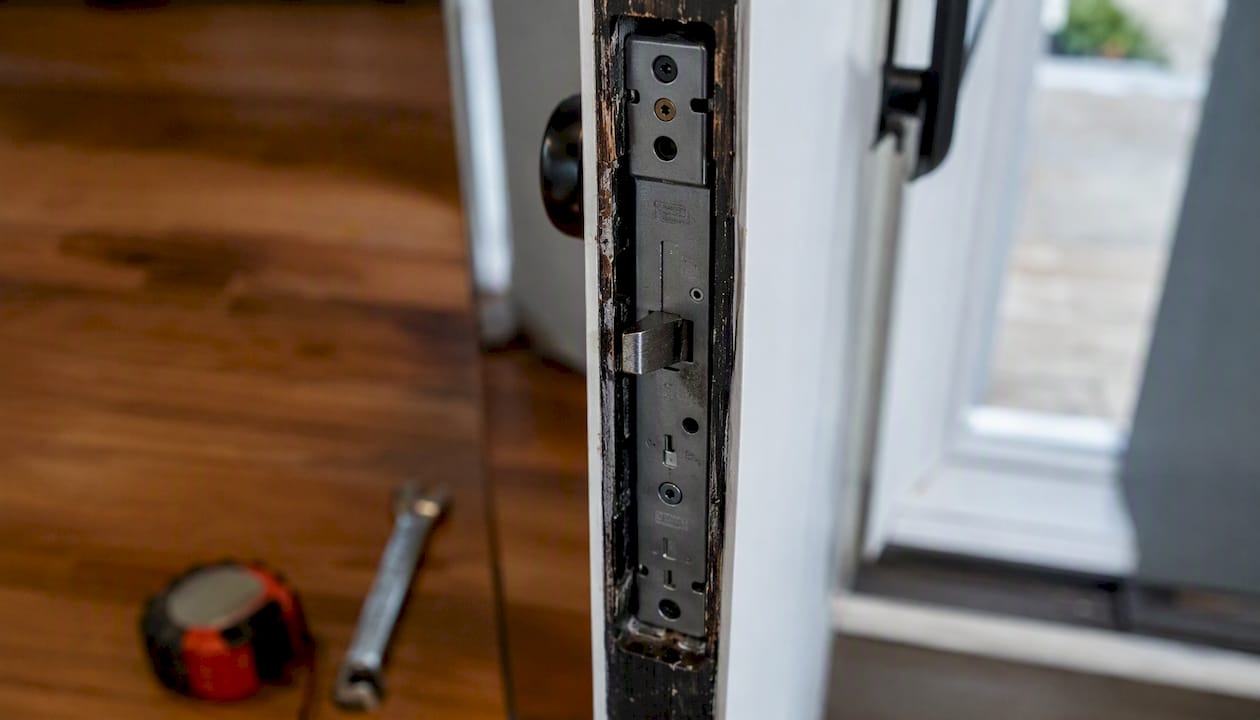
Mortise locksets are the standard specification for high-traffic and institutional applications precisely because of that mechanical strength. A busy hospital corridor door or a school main entry sees hundreds of cycles daily, and a mortise lock handles that load without the latch bolt wear that shortens cylindrical lever life.
Best-fit applications for mortise locks:
High-traffic corridors and main entries
Exterior lobby doors
Healthcare facilities and schools
Any opening requiring integrated deadbolt function
New construction where electrified access control is planned
The cylindrical vs mortise lock decision often comes down to door prep and budget. Mortise installation requires a skilled technician and a properly prepared door; the pocket must be cut precisely or the case will not seat correctly. On retrofit projects, converting a bored door to mortise prep is rarely cost-effective.
Factor | Cylindrical Lever | Mortise |
Installation complexity | Low to moderate | Moderate to high |
Cycle life under heavy traffic | Good (Grade 1) | Excellent |
Electrification integration | Possible, more field work | Cleaner, factory-ready options |
Upfront cost | Lower | Higher |
Retrofit suitability | Excellent | Poor (requires door prep change) |
Pro Tip: If you are planning electrified access control in new construction, specify electrified mortise locks from the start. The solenoid and motor integration is cleaner than retrofitting a cylindrical chassis, and you avoid field modifications later.
Deadbolts and supplemental security hardware
A standalone deadbolt adds a second bolt independent of the primary latch, and on low-traffic commercial doors where code permits, it meaningfully raises forced-entry resistance with proper insurance coverage. Single-cylinder deadbolts (keyed outside, thumb-turn inside) are the standard commercial choice. Double-cylinder deadbolts (keyed both sides) are restricted or prohibited on egress doors in most jurisdictions because they slow emergency exit.
Before adding any supplemental hardware to a commercial opening, check the door’s egress and fire-rating status. On a fire-rated door or any door in an egress path, supplemental hardware must not require more than one releasing operation to exit, per IBC and NFPA 101 requirements.
Supplemental measures that often deliver more real-world security than a cylinder upgrade:
Heavy-duty security strike plates with 3-inch screws into framing
Door reinforcement plates (hinge bolts, edge guards) on hollow-core or aluminum-frame doors
Auxiliary deadbolts on storage rooms and utility closets where egress is not a concern
Door frame reinforcement kits on older wood-frame openings
Safety note: Adding a deadbolt or secondary lock to any door in an egress path without confirming code compliance can create a life-safety violation. Verify with your authority having jurisdiction (AHJ) before installation.
Electronic locks and keypad systems: where do they fit?
Electronic locks provide audit trails and remote credential management that mechanical hardware cannot match, but they introduce dependencies that mechanical locks do not have: power, network connectivity, and a mechanical override plan.
The main categories of electronic door lock options for commercial use:
Standalone keypad locks: Self-contained, battery-powered, no network required. Good for back-of-house doors, storage rooms, and small sites.
Electrified cylindrical/mortise locksets: Mechanical lockset with an added solenoid or motor; controlled by an access control panel.
Smart/mobile-enabled locks: Credential via smartphone, fob, or card; typically wireless and cloud-managed.
Wireless locks: Communicate with an access control system over a proprietary or standard protocol without hardwired power runs.
Pros of electronic systems:
Audit trails: every credential event is logged with a timestamp.
Instant access revocation without rekeying or collecting physical keys.
Flexible scheduling: lock and unlock automatically on a time-based program.
Cons to plan around:
Power dependency: battery-powered locks need a replacement schedule; hardwired locks need a power transfer device at the hinge.
Door prep: electrified hardware often requires a power transfer hinge or continuous hinge with wiring.
Override: every electronic lock must have a mechanical key override for emergency access.
Pro Tip: Before specifying any electronic lock, confirm two things in writing from the manufacturer: the mechanical override method and the fail-safe vs. fail-secure behavior on power loss. A fail-secure lock stays locked during a power outage; a fail-safe lock releases. On egress doors, fail-safe is almost always required.
When are exit devices (panic hardware) required?
Exit devices are required by IBC and NFPA 101 on egress doors serving spaces with high occupant loads, and the threshold is lower than most facility managers expect. Generally, any door serving an assembly occupancy with an occupant load above 49 persons requires panic hardware. Specific thresholds vary by occupancy type and local amendments, so always confirm with your AHJ.
Code reference: IBC Section 1010.1.10 requires panic hardware on doors in Group A (assembly) and Group E (educational) occupancies where the occupant load exceeds 49. NFPA 101 carries similar requirements. Fire-rated doors in these paths require fire exit hardware, which is a listed subset of panic hardware with specific temperature and cycle ratings.
Device types and when to use each:
Rim exit devices: Surface-mounted crossbar that retracts a rim latch. Easiest to install; common on single doors and light-to-moderate traffic egress doors.
Surface vertical rod (SVR) devices: Rods run up and down the door face to top and bottom latches. Used on pairs of doors where a center mullion is not present.
Concealed vertical rod (CVR) devices: Rods are routed inside the door. Cleaner appearance; requires a hollow-metal door with internal rod channels.
Mortise exit devices: The exit device body replaces a mortise lockset. Strongest option for high-abuse exterior egress doors.
Electrified exit devices with electric latch retraction (ELR) allow the door to be held in a released (unlatched) state by an access control signal, enabling hands-free egress in high-traffic lobbies. Dogging (mechanically holding the crossbar depressed) is permitted on non-fire-rated doors to allow free egress during business hours, but is prohibited on fire-rated doors.
For step-by-step guidance on selecting and installing panic hardware, the panic bar installation guide covers the full process.
Why knob locks are declining in commercial use
Knob locks are still found in older commercial buildings, but they are no longer an acceptable choice for public-access doors. The ADA’s reach-and-grasp requirements are the primary reason: a round knob requires tight grasping, pinching, or twisting of the wrist, which is explicitly prohibited for operable hardware on accessible routes under the ADA Standards for Accessible Design.
Lever handles, by contrast, can be operated with a closed fist or a forearm, meeting the ADA’s one-hand, no-tight-grasp standard. For ADA door hardware compliance in Miami-Dade and across Florida, levers are the standard on all public-access doors.
Where knob locks may still be acceptable:
Non-public areas not on an accessible route (private storage, mechanical rooms with no public access)
Existing installations where ADA compliance has been documented as technically infeasible
Residential-style units within a commercial building (apartments, hotel rooms) where specific ADA unit standards apply
Pro Tip: Swapping knobs for levers on public-access doors is one of the lowest-cost ADA compliance upgrades available. A lever retrofit on a bored-prep door takes under 20 minutes and eliminates a clear liability exposure.
ANSI/BHMA grades explained: what the numbers actually mean
ANSI/BHMA grades are the minimum performance floor for commercial locksets, not a ceiling. Grade 1 is the highest rating, designed for the most demanding traffic and security applications; Grade 2 covers standard commercial use; Grade 3 is a residential rating and should not be specified for commercial openings.
Grade | Cycle Life (typical) | Recommended Applications | Cost Implication |
Grade 1 | 250,000+ cycles | Primary entries, corridors, high-traffic doors, institutional | Higher upfront |
Grade 2 | 400,000 cycles (mortise) / lower for cylindrical | Interior offices, moderate-traffic doors | Moderate |
Grade 3 | 250,000 cycles (residential standard) | Residential only | Lowest |
Grade 1 hardware typically reduces long-term maintenance costs on high-traffic doors despite its higher purchase price, because replacement and service intervals are longer. On a door seeing 200 or more uses per day, the lifecycle math almost always favors Grade 1.
Pro Tip: Specify Grade 1 on every primary entry, corridor, and egress door. Use Grade 2 only on interior doors with demonstrably light traffic, and document that decision in your door schedule.
Lock functions: matching the code to the door’s purpose
Lock function codes define exactly how a lockset behaves, and specifying the wrong function is a common and costly mistake. The most widely used commercial functions are:
F01 Passage: Latch only, no locking. Use on closets and non-secure interior doors.
F04 Office: Outside lever locked by key; inside lever always free. Standard for private offices.
F05 Classroom: Outside lever locked/unlocked by key from outside only; inside lever always free. Designed so teachers control access without entering the corridor.
F07 Storeroom: Outside lever always locked; inside lever always free. Use on server rooms, pharmacies, and high-security storage.
F10 Entrance: Outside lever locked/unlocked by key or thumbturn; inside lever always free. Standard for main entries.
F19 Privacy: Inside button locks outside lever; emergency override from outside. Use on restrooms and private offices.
Matching function to application:
Server rooms and pharmacies: F07 (storeroom). Outside is always locked; no one enters without a key.
Classrooms: F05. Teacher controls lockdown from inside without entering the hallway.
Main lobby entries: F10 (entrance). Staff can lock/unlock from inside; visitors need a key or credential.
Restrooms: F19 (privacy). Occupant locks from inside; emergency override prevents entrapment.
Break rooms and corridors: F01 (passage). No security needed; free egress at all times.
Verify the function code on the manufacturer’s datasheet before ordering. Function designations can vary slightly between manufacturers, so cross-reference the functional description, not just the code number.
Cylinder formats and key control: conventional, IC, and SFIC
The cylinder format determines how fast you can rekey a lock and how tightly you can control key duplication. Three formats dominate commercial work:
Conventional cylinders: The cylinder is permanently installed; rekeying requires a technician to disassemble the lock and replace pins. Lowest upfront cost, highest rekeying labor cost.
Interchangeable core (IC): The core pops out with a control key in seconds, no tools required. A new pre-pinned core goes in immediately. Rekeying a 100-door facility takes hours, not days.
Small-format interchangeable core (SFIC): A smaller IC format (Best/SFIC standard) that fits a wider range of hardware from multiple manufacturers. Common in institutional and healthcare specs.
Key control trade-offs:
Master keying adds convenience but increases risk if a master key is lost or copied. Document every master key issued and use a restricted keyway to limit unauthorized duplication.
IC and SFIC systems allow fast rekeying after a key loss without replacing hardware, which is a significant operational advantage in multi-tenant or high-turnover facilities.
Restricted keyways (patented or licensed) prevent hardware-store key duplication, adding a meaningful layer of key control without electronic access.
Pro Tip: On any multi-tenant or high-turnover site, specify IC or SFIC cylinders from the start. The rekeying speed pays for the upfront premium within the first key-loss event.
Electrified hardware and access control integration
Electrifying a door opening means adding a power-controlled component that allows an access control system to grant or deny entry. The main hardware options are:
Electric strikes: Replace the standard strike plate; the keeper releases electrically to allow the door to open. Works with existing locksets; lowest installation cost for retrofits.
Electrified mortise locksets: The mortise body includes a solenoid or motor that retracts the latch or deadbolt on signal. Cleanest integration for new construction.
Electric latch retraction (ELR) on exit devices: The exit device crossbar retracts electrically, allowing hands-free egress on a signal. Common in high-traffic lobbies and loading docks.
Electrified cylindrical locksets: A solenoid-equipped chassis replaces the standard cylindrical body. More field modification required than mortise options.
Decision checklist for electrified hardware:
Is the door fire-rated? If yes, the electric hardware must carry a fire listing, and fail-safe behavior must be confirmed with the AHJ.
What is the access control backend? Confirm the hardware’s protocol (Wiegand, OSDP, proprietary) matches the panel.
Is power available at the door? Hardwired options need a power transfer device; wireless options need a battery replacement plan.
What is the required behavior on power loss? Egress doors almost always require fail-safe (unlocks on power loss).
Safety callout: Electrified hardware on fire-rated doors must be coordinated with the fire marshal and AHJ before installation. An improperly wired electric strike on a fire door can void the door’s fire listing and create a life-safety violation.
Electronic access control systems require careful integration planning to avoid conflicts between security requirements and egress code. Never specify electrified hardware on an egress door without a written fail-safe/fail-secure determination from the AHJ.
Code compliance: IBC, NFPA, and ADA requirements you must check
Code compliance is not optional, and it often dictates hardware choices more strictly than budget. Three frameworks govern most commercial hardware decisions in the United States:
IBC (International Building Code): Sets occupant-load thresholds for exit device requirements, door operation requirements, and hardware restrictions on egress paths.
NFPA 101 (Life Safety Code): Parallel egress requirements; often adopted alongside or instead of IBC depending on jurisdiction.
ADA Standards for Accessible Design: Requires lever or push-type hardware on all accessible routes; sets maximum operating force (5 lbf for interior doors) and reach-range requirements.
Action items before specifying hardware:
Verify the fire label on every door in the opening schedule. Hardware on a fire-rated door must carry a matching fire listing.
Confirm occupant load calculations for any assembly or educational space. If the load exceeds 49, exit devices are likely required.
Check dogging rules: dogging is prohibited on fire-rated doors regardless of occupancy.
Confirm lever operation on all public-access doors. Knobs are not ADA-compliant on accessible routes.
Document occupant-load triggers and hardware decisions in the door schedule for AHJ review.
Pro Tip: Involve the AHJ or fire marshal early on any significant entry change, especially on fire-rated doors or high-occupancy egress paths. A pre-submittal meeting saves far more time than a failed inspection.
For Miami-Dade specific ADA and accessibility requirements, the ADA door hardware compliance guide covers local standards in detail.
How to choose the right lock for each opening
A five-step framework covers most commercial hardware decisions:
Define the door’s use and users. Who uses it, how often, and what level of security is required? A server room and a break room have entirely different answers.
Evaluate traffic level. Doors seeing more than 200 uses per day need Grade 1 hardware and should be evaluated for mortise format. Lighter-traffic interior doors can use Grade 2 cylindrical levers.
Check code and egress status. Is the door on an egress path? Is it fire-rated? Does the occupant load trigger exit-device requirements? Answer these before selecting any hardware.
Decide on electrification and key control. Does the opening need audit trails, remote access, or scheduled locking? If yes, plan the power source, access control backend, and cylinder format (IC/SFIC) at this stage.
Select format and grade. With the above answered, choose cylindrical or mortise, the correct function code, and the appropriate grade.
Red flags that push toward mortise or exit devices:
Door sees more than 200 uses per day
Opening is on a fire-rated door assembly
Access control electrification is planned or likely in the future
Occupant load triggers IBC/NFPA exit-device requirements
High-abuse environment (loading dock, school main entry, hospital corridor)
On total cost of ownership: Grade 1 hardware costs more upfront but reduces maintenance and replacement frequency on high-traffic doors. A cylindrical lever that fails in three years on a busy corridor costs more in labor and downtime than a mortise lock that runs ten years without service.
Installation and retrofit: what changes the plan
Retrofit projects have constraints that new construction does not. The most important: converting a bored-door prep to a mortise prep is rarely cost-effective. The pocket must be routed precisely into the door edge, and on hollow-metal or wood doors with existing bored holes, the patching and prep work often costs more than replacing the door entirely.
Installation checklist for any commercial lockset:
Confirm door handing (left-hand, right-hand, reverse) before ordering.
Measure door thickness and backset (2-3/4" or 2-3/8") to match the lockset spec.
Verify strike type: ANSI standard strike vs. T-strike vs. full-lip strike.
Inspect the frame for reinforcement. On wood frames, install a heavy-duty strike with 3-inch screws into the stud.
For electrified hardware, confirm the power transfer method (hinge, loop, or continuous hinge) before rough-in.
Pro Tip: When a retrofit door has a bored prep and you need mortise-level durability, a Grade 1 cylindrical lever with a heavy-duty strike and reinforced frame often delivers comparable real-world performance at a fraction of the conversion cost.
Maintenance, lifecycle, and total cost of ownership
Hardware that is not maintained fails faster than its rated cycle life. A Grade 1 mortise lock on a busy corridor can last 10 to 15 years with proper maintenance; the same lock neglected for three years may need a latch replacement at year five.
Format | Grade | Expected Service Life (typical traffic) | Key Maintenance Tasks |
Cylindrical lever | Grade 1 | 7 years | Lubricate annually, replace latch bolt at wear signs |
Cylindrical lever | Grade 2 | 4–7 years | Lubricate annually, inspect chassis quarterly |
Mortise | Grade 1 | 10–15 years | Lubricate annually, inspect case screws, check trim |
Exit device | Grade 1 | 10–15 years | Lubricate crossbar, inspect rod connections, test latching |
Maintenance checklist:
Lubricate latch bolts and cylinders annually with a dry graphite or manufacturer-recommended lubricant (never WD-40 on pin cylinders).
Rekey or rotate cylinders after key losses, staff turnover, or security incidents.
Inspect electrified components quarterly: check battery levels, test override, and verify fail-safe/fail-secure behavior.
Replace worn trim (levers, roses) before the chassis fails. Trim wear is visible; chassis wear is not.
Lifecycle cost analysis consistently favors Grade 1 hardware on high-use doors when labor costs and access disruption are factored in. Specify to minimize technician visits, especially on doors where a lockout or repair disrupts operations.
Widely used commercial product lines and where they fit
Specifiers typically work from a short list of proven product families. These are the lines most commonly referenced in commercial door schedules:
Schlage L-Series (mortise) and ND-Series (cylindrical): Schlage’s L-Series is a Grade 1 mortise line widely specified for institutional and healthcare applications. The ND-Series cylindrical lever is one of the most common interior commercial locksets in the U.S., available in a full range of functions and finishes.
Sargent 10-Line (mortise) and 8200 Series (cylindrical): Sargent’s 10-Line mortise is a standard specification for high-traffic and electrified applications. The 8200 Series cylindrical lever covers Grade 1 interior and exterior commercial use.
Corbin Russwin ML2000 Series (mortise): A heavy-duty mortise line commonly specified for schools, hospitals, and government facilities. Known for durability under institutional abuse.
BEST 9K Series (cylindrical with SFIC): BEST’s 9K line is built around the SFIC interchangeable core system, making it a standard choice for multi-tenant and healthcare facilities where fast rekeying is operationally critical.
PDQ Manufacturing heavy-duty cylindrical lines: PDQ is commonly specified for Grade 1 cylindrical applications where budget is a factor but performance requirements remain high.
Always confirm the exact function code, grade, and electrification options on the manufacturer’s datasheet before writing a specification. Product lines evolve, and a model number that carried a specific function last year may have been updated.
When should you call a locksmith or security integrator?
Some hardware decisions are straightforward enough for a facilities team to handle internally. Others carry code, safety, or technical complexity that makes professional involvement the right call.
Situations that require a licensed locksmith or security integrator:
Installing exit devices on egress doors (code compliance verification required)
Electrified access control integration (power, protocol, and fail-safe coordination)
Fire-rated door hardware replacement (listed hardware and AHJ documentation required)
Converting between lock formats (mortise to cylindrical or vice versa)
High-security applications: server rooms, pharmacies, government facilities
Any opening where an incorrect specification creates a life-safety or ADA liability
What a qualified professional should deliver on a commercial hardware project:
A site survey covering every opening in the door schedule
Written hardware recommendations with grade, function, and electrification specs
Confirmation of fire-label and ADA compliance for each opening
An installation plan with timeline and punchlist
Post-installation testing and a written warranty
Pro Tip: Ask any contractor for their door schedule documentation before they start. A professional who cannot produce a written opening-by-opening spec is not ready to work on a commercial project.
Locksmithfromiami’s commercial locksmith services cover site surveys, ADA-compliant hardware installation, electrified access control integration, and panic bar installation across Miami and Homestead. The workshop capabilities include in-house key cutting and cylinder servicing for commercial accounts.
Field perspective: what installers see that specs miss
The most common on-site surprise in commercial lock work is a fire label hidden under paint or a previous hardware installation. A door that looks like a standard hollow-metal opening turns out to carry a 90-minute fire rating, and the hardware already on it is not listed. That discovery mid-installation changes the entire scope.
Wrong handing is the second most common problem. A lockset ordered for a right-hand door installed on a left-hand reverse opening does not function correctly, and returning hardware adds days to a project. Always verify handing in person before ordering, not from a floor plan.
Previous poor patching is the third issue. When a door has been converted between lock formats before, the patch may look solid but will not hold a new strike or mortise case under load. Probe the door edge before committing to a spec.
Practical tips from installers:
Bring a fire-label reference card to every site survey. Check every door in the schedule before writing the spec.
Order one extra unit of each lockset for a large project. A damaged or wrong-handed piece on a 50-door job will delay the whole punchlist.
Test every electrified component in both power-on and power-loss states before signing off. Fail-safe behavior is not always what the datasheet says in the field.
Pro Tip: On any project with more than 10 openings, photograph every door and frame condition during the site survey. Those photos resolve disputes about pre-existing damage and wrong-handing faster than any written note.
Locksmithfromiami handles your commercial hardware from survey to punchlist
Getting the right hardware on every door in your facility is faster and less risky with a certified local locksmith who knows the Miami-Dade code environment. Locksmithfromiami provides commercial site surveys, ADA and code-compliant lock installation, electrified hardware integration, and panic bar installation for businesses across Miami and Homestead.
On a service call, you get a written opening-by-opening recommendation with grade, function, and compliance notes, not just a product quote. The team handles cylindrical and mortise locksets, exit devices, electronic access control integration, and cylinder rekeying for commercial accounts of any size.
For building owners and property managers who also need residential or automotive locksmith support, full service options are available 24/7. To schedule a commercial site survey or get a quote, contact Locksmithfromiami near you and a technician will respond promptly.
Sources
Authoritative references for commercial hardware specification:
When using manufacturer datasheets, always cross-reference the function code description (not just the code number), the ANSI/BHMA grade listing, and the electrification options table. Product lines are updated regularly, and a datasheet from two years ago may not reflect current availability.
Recommended
Comments