

Deadbolt Grades Explained: 3 Installation Fixes for Homeowners

Deadbolt grades run from 1 to 3, with Grade 1 delivering the highest lab-tested durability and forced-entry resistance, Grade 2 covering most home entry doors well, and Grade 3 serving as the baseline for lighter-duty use. The American National Standards Institute and the Builders Hardware Manufacturers Association set these grades through lab tests that count cycles and hammer strikes, not marketing claims. For most exterior entry doors, you want at least a Grade 2 deadbolt; if the door faces higher risk, a busy street entrance, a rental unit, or a commercial storefront, step up to Grade 1.
TL;DR:
Most exterior doors should have at least a Grade 2 deadbolt, with Grade 1 recommended for high-risk or commercial locations.
Certification is voluntary, so always verify a Grade 2 or Grade 1 deadbolt against the BHMA listing to ensure it has undergone independent testing.
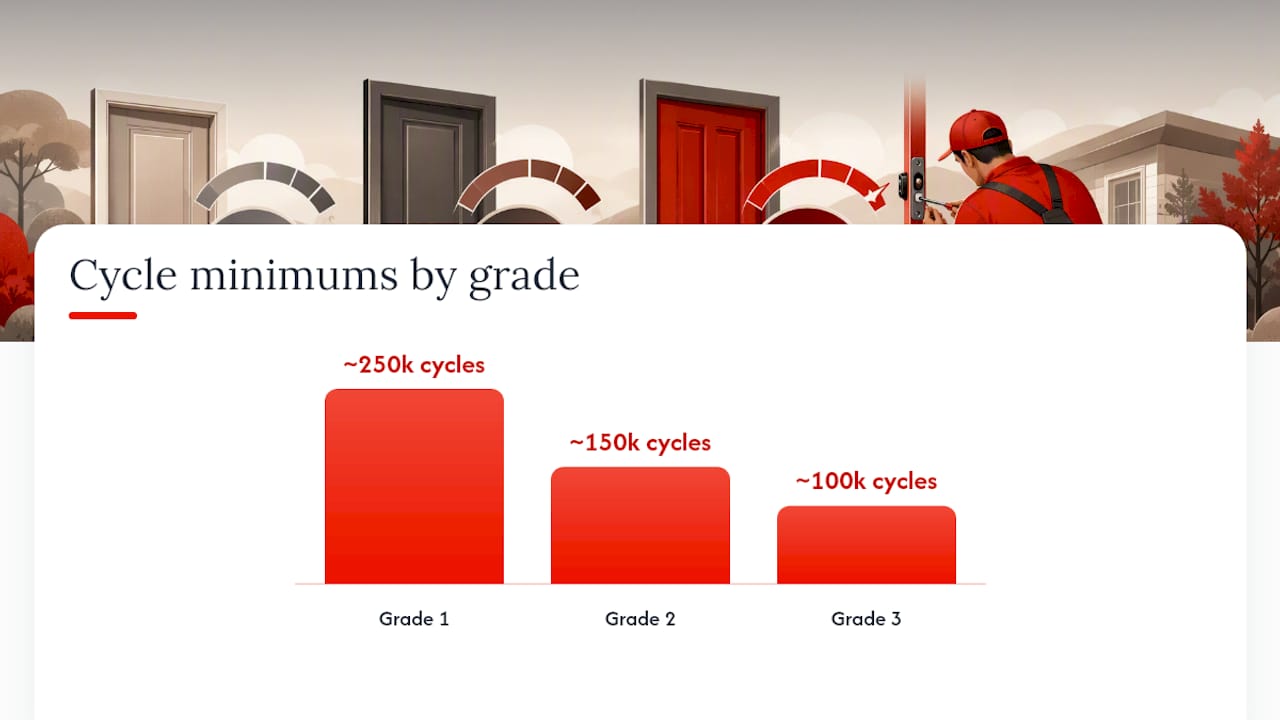
Impact and cycle tests simulate real break-in attempts, with Grade 1 deadbolts surviving around 250,000 cycles and 10 hammer blows, far above Grade 3 standards.
Installation quality, including reinforced strike plates and long screws into framing, often has a greater impact on security than the lock’s grade alone.
Smart lock grades only address physical components, so their ratings do not indicate cybersecurity strength or resistance to signal relay attacks.
Table of Contents
What ANSI and BHMA Lock Grades Actually Mean
You’ll see “ANSI Grade 2” or “BHMA certified” printed on deadbolt packaging, but few homeowners know what’s behind those letters. ANSI doesn’t test locks itself. It’s the accreditation body that recognizes standards developed by member organizations, and for door hardware, that member is BHMA.
BHMA writes the technical standard (ANSI/BHMA A156 series) and manages the certification program that assigns Grades 1 through 3 to locksets, deadbolts, hinges, and exit devices. Grade 1 sits at the top of the performance scale, with Grade 2 and Grade 3 stepping down from there.
Here’s the part that surprises most people: certification is voluntary. A manufacturer chooses to submit a product for testing and pays for it. Nobody forces a company to earn a grade, which is exactly why an unmarked deadbolt at a big box store might perform fine or might fail the first cycle test it’s never taken.
Testing happens at BHMA-approved labs, primarily UL and Intertek, across six categories:
Operational testing — does the lock function correctly under normal use
Cycle testing — how many open/close cycles the bolt survives before failure
Strength testing — resistance to physical force like kicks or pry attempts
Security testing — resistance to picking, drilling, and impact attacks
Material evaluation — corrosion resistance and component durability
Finish testing — how the coating holds up against wear and weather
To verify a claim, look for a BHMA certification mark or product number on the packaging, then cross-check it against the manufacturer’s grade listing on the BHMA site. If a listing exists, the grade is real. If you can’t find one, treat the “Grade 2” sticker as a claim, not a certification.
The Lab Tests Behind Every Deadbolt Grade
A grade isn’t a subjective quality score. It’s the outcome of a specific, repeatable battery of destructive tests that every submitted lock has to survive at a defined threshold. Four categories matter most for deadbolts.
Cycle testing simulates years of daily use by locking and unlocking the bolt mechanically, over and over, until something wears out or fails. A higher cycle count before failure means better long-term reliability, not just at the moment of purchase but five or ten years into ownership.
Impact and hammer strike testing measures how the lock cylinder and bolt hold up against blunt force, the kind of blow a burglar delivers with a hammer or crowbar. Labs count how many strikes at a set force the lock survives before the mechanism gives way.
Weight and torque testing applies sustained force to knobs, levers, and trim to check whether someone can twist or tear the hardware off the door. This test matters more for knob and lever locksets than for a standalone deadbolt cylinder, but it factors into full lockset grading.
Drilling resistance and latch strength checks round out the security battery, testing whether a drill bit can compromise the cylinder in a set time and whether the bolt itself bends or shears under lateral pressure.
Fast fact: ANSI/BHMA impact testing applies hammer blows at roughly 75 foot-pounds of force, and the number of blows a deadbolt must withstand without failing is the single biggest numeric gap between the three grades.
These tests exist because real break-in attempts rarely involve sophisticated lock picking. Most forced entries rely on brute force, a kick to the door or a hammer to the cylinder, which is exactly what impact and strength testing simulate.
Grade 1 vs Grade 2 vs Grade 3: The Numbers That Matter
Once you know what the tests measure, the numeric minimums turn an abstract grade into a concrete buying decision. These figures come from the ANSI/BHMA deadbolt testing standards that most cylindrical deadbolts on the market are measured against.
Grade 1 deadbolts are rated for approximately 250,000 open/close cycles and must survive 10 hammer blows at 75 foot-pounds of force without failing. This is commercial-grade hardware, the kind you’ll find on storefronts, apartment building entries, and high-value residential doors. If you’re locking up a home in an area with a documented break-in history, or you simply want the strongest physical deterrent available at retail, Grade 1 is the answer.
Grade 2 deadbolts are tested to roughly 150,000 cycles and 5 hammer blows at the same force level. This is the grade most consumer guides recommend for exterior home doors, and for good reason: it balances real security against cost, and it comfortably outperforms what most residential break-in attempts are designed to defeat.
Grade 3 deadbolts carry a minimum of about 100,000 cycles and only 2 hammer blows. These locks satisfy building code minimums in many jurisdictions, but they’re built for lighter duty, think interior doors, closets, or secondary entries where the stakes are lower.
Grade | Cycle minimum | Hammer blows (75 ft-lb) | Best use case |
Grade 1 | ~250,000 cycles | 10 blows | Commercial doors, high-risk residential entries |
Grade 2 | ~150,000 cycles | 5 blows | Most exterior home doors |
Grade 3 | ~100,000 cycles | 2 blows | Interior doors, low-risk secondary entries |
A few caveats matter here. First, these are minimums, not averages. Some Grade 2 products from reputable manufacturers exceed their required cycle count by a wide margin, while others test right at the floor. Second, industry analysts have pointed out that cycle counts and lab conditions don’t always translate directly into predictable field performance, since a lab test controls variables like installation quality and door condition that vary wildly in the real world. A Grade 1 deadbolt installed into a rotted door frame will not outperform a Grade 2 deadbolt installed correctly.
The practical takeaway: use the grade as a floor, not a guarantee. Check the BHMA certification listing for the exact model before you buy, since two deadbolts with the same grade sticker can still differ in build quality, warranty, and finish durability.
Choosing the Right Grade for Your Door
Matching the grade to the door is simpler than the testing standards make it sound. Front and back exterior doors, the ones a stranger could walk up to unseen, deserve at least a Grade 2 deadbolt. If that door sits in a high-traffic area, belongs to a rental property with turnover you can’t fully control, or opens into a commercial space, move up to Grade 1. Interior doors, including closets, home offices, and secondary bedroom doors, rarely need more than Grade 3.
But the grade is only half the security equation. A locksmith will tell you that installation quality often decides whether a break-in succeeds far more than the number on the package.
Upgrade to a reinforced strike plate, ideally one that spans multiple studs, instead of the thin metal plate that ships with most standard door hardware.
Use 3-inch screws that bite into the door frame’s structural stud, not just the trim, when mounting the strike plate and hinges.
Confirm the deadbolt has a 1-inch throw length at minimum, since a shorter bolt gives a kicked door less material to resist.
Inspect the door and frame condition before installation. Soft wood, warped frames, or gaps around the strike plate undermine even a Grade 1 lock.
Consider frame reinforcement kits on doors with glass panels near the lock, since a broken pane can let an intruder reach the thumb turn directly.
Pro Tip: A Grade 2 deadbolt installed with a reinforced strike plate and 3-inch screws into the framing will usually outlast a Grade 1 deadbolt mounted with the factory 3/4-inch screws that came in the box. Hardware quality and installation quality are two separate battles, and you have to win both.
If your door has narrow glass sidelights, a hollow-core interior door mistakenly used as an exterior door, or you’re managing a rental where previous tenants may have compromised the frame, professional installation is worth the cost. A locksmith who understands door construction can spot problems a DIY install misses entirely.
Grade Labels, BHMA Ratings, and What They Don’t Cover
Homeowners often conflate two related but distinct labeling systems. The ANSI Grade 1/2/3 system rates overall lock performance across the operational and security tests described above. Separately, BHMA also issues letter-based ratings (A, B, C) in specific categories like Security, Durability, and Finish for some product lines, which can appear alongside the numeric grade on spec sheets. The two systems overlap but aren’t interchangeable, so read the full certification listing rather than assuming a letter grade means the same thing as a number grade.
A more important gap: BHMA’s residential security testing doesn’t currently evaluate electronic components. A smart deadbolt’s Grade 1 rating tells you the physical bolt and cylinder survived the standard tests. It says nothing about the strength of its Bluetooth encryption, app security, or resistance to signal relay attacks. If you’re comparing a smart lock against a traditional deadbolt, treat the grade as a physical security score only.
A few points worth remembering when you’re reading spec sheets:
Certification is voluntary, so a missing grade doesn’t automatically mean poor quality, but it does mean no independent lab verified the claim.
BHMA approved labs, mainly UL and Intertek, run the actual testing, not the manufacturer.
Grade numbers and letter ratings can appear together but measure different things.
Electronic security in smart locks currently sits outside ANSI/BHMA’s physical grading scope.
How Locksmiths Actually Weigh Grades on the Job
Locksmiths rarely lead with the grade number when they’re standing at your door. Grade matters, but it’s one input among several, and experienced technicians weigh it against the door material, frame condition, existing strike plate, and how the hardware was mounted the first time. A brand-new Grade 1 deadbolt dropped into a door with a stripped-out strike pocket won’t perform like its rating suggests.
What professionals look for first is whether the installation itself can support a serious upgrade at all. Reinforcing a frame, resetting a strike plate with longer screws, and confirming the door slab isn’t hollow or rotted often moves the needle further than swapping a Grade 2 lock for a Grade 1.
Evaluate the door and frame before recommending any specific grade
Prioritize reinforced strike plates and proper screw length over the grade sticker alone
Match the deadbolt to the actual risk profile of the door, not a blanket rule
Progressive Locksmith - Cerrajero Miami’s technicians handle deadbolt and door lock installation with this full picture in mind, not just the box the lock came in.
What Homeowners Get Wrong About Deadbolt Grades
Most advice on deadbolt grades stops at “buy Grade 1 if you can afford it,” and that’s where it falls short. The grade number tells you how a lock performed in a lab, isolated from the door it’s mounted to. It says nothing about whether your specific door frame can hold up its end of the bargain.
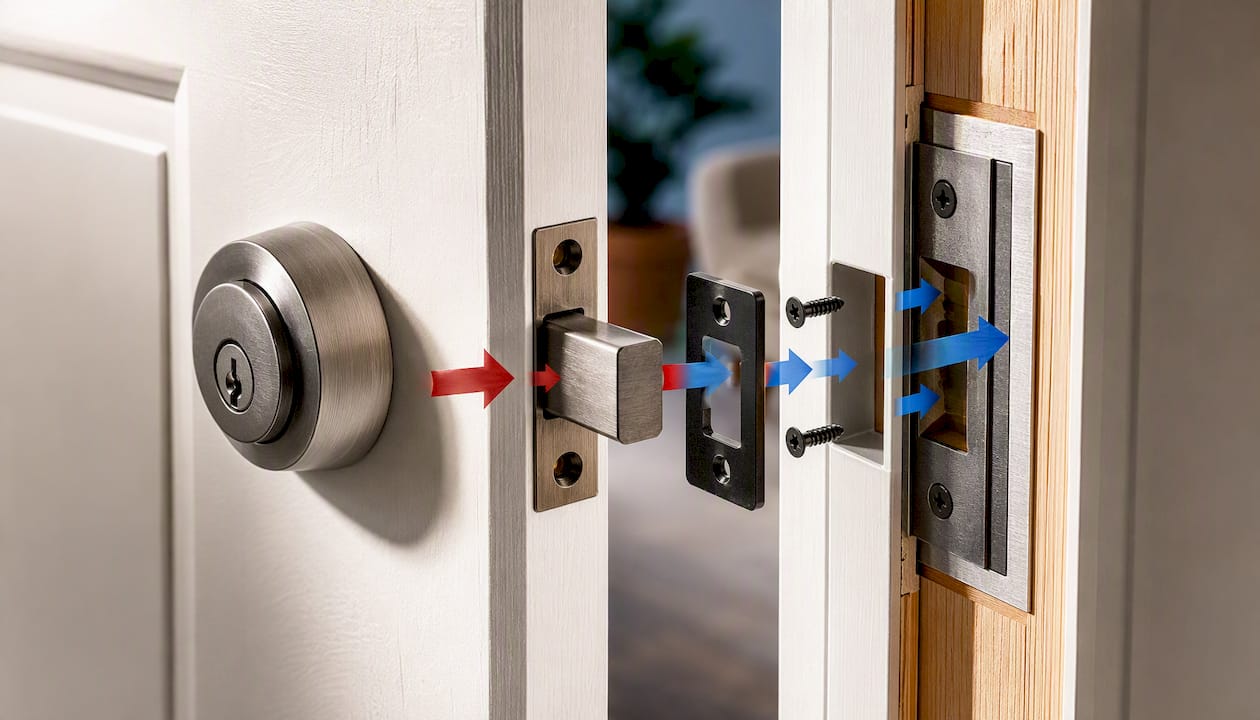
I’d argue the industry undersells installation quality relative to how much attention it gives the grade sticker. A 250,000 cycle rating and 10 hammer-blow resistance mean little if the strike plate is held on by two half-inch screws sunk into trim board instead of framing lumber. That’s not a hypothetical. It’s the most common failure point locksmiths see on service calls, and it has nothing to do with which grade the homeowner bought.
My advice: buy at least Grade 2 for any exterior door, don’t lose sleep chasing Grade 1 unless your risk profile genuinely calls for it, and then spend your remaining attention and budget on the strike plate, the screws, and the frame. That’s where real-world security is actually won or lost.
— Julio Borroto
Get Your Deadbolt Graded and Installed Right the First Time
Reading a spec sheet only gets you halfway there. Skilled locksmiths handle the part that actually determines whether your new deadbolt performs the way its grade promises: correct installation, a reinforced strike plate anchored into real framing, and a door assessment before any hardware goes in.

Every service visit starts with an assessment of your door and frame, a straightforward quote, and installation using hardware suited to your specific risk level, whether that’s a Grade 2 deadbolt for a standard front door or a higher-grade lock for a higher-risk entry. Services are offered with 24/7 availability, bilingual service in English and Spanish, and upfront pricing with no surprises on the invoice. If your current deadbolt feels loose, your strike plate looks worn, or you’re simply not sure what grade is behind your front door, request a deadbolt and door lock installation quote today and get it handled by someone who checks the frame, not just the box.
Sources
FAQ
Is a Grade 3 deadbolt good or bad?
A Grade 3 deadbolt isn’t bad, it’s simply built for lower-risk applications like interior doors or secondary entries, with a minimum rating of about 100,000 cycles and 2 hammer blows. For a primary exterior entry door, most guidance points to Grade 2 or higher as the better baseline.
What is the difference between deadbolt Grade 1 and Grade 2?
Grade 1 deadbolts are tested to survive roughly 250,000 cycles and 10 hammer blows at 75 foot-pounds, while Grade 2 deadbolts are tested to about 150,000 cycles and 5 blows. Grade 1 suits commercial doors and high-risk residential entries; Grade 2 covers most standard home exterior doors well.
What does Grade 3 mean on a deadbolt?
Grade 3 is the entry-level ANSI/BHMA rating, requiring a minimum of about 100,000 open/close cycles and 2 hammer strikes at 75 foot-pounds before failure. It typically meets building code minimums but isn’t the recommended choice for a primary exterior door.
What’s the difference between Grade 2 and Grade 3 front door locks?
Grade 2 locks are tested to a higher cycle count and more impact resistance than Grade 3, roughly 150,000 cycles and 5 hammer blows versus 100,000 cycles and 2 blows. For a front door, Grade 2 is the widely recommended minimum, with Grade 3 reserved for lower-risk or interior applications.
Does a higher grade guarantee better real-world security?
Not on its own. Lab grades measure the hardware in controlled conditions, but installation quality, including the strike plate, screw length, and door frame condition, heavily influences actual break-in resistance. A well-installed Grade 2 deadbolt often outperforms a poorly installed Grade 1.
How much does professional deadbolt installation cost?
Pricing depends on the hardware and door condition, and current rates are available directly through Progressive Locksmith - Cerrajero Miami’s service page. Every visit includes a door assessment and an upfront quote before any work begins.
Recommended
Comments