

6 Garage Side Door Security Fixes Homeowners Can Do Tonight

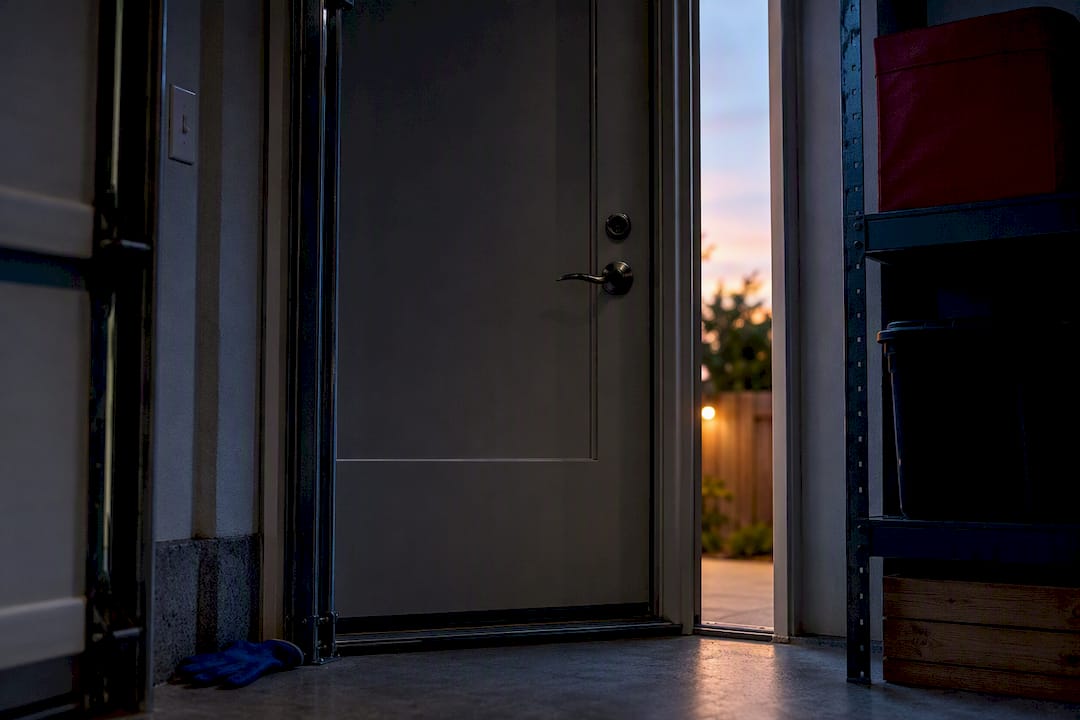
Lock the door, fit an inside slide lock, and reinforce the strike plate. Those three actions cut most garage side door security risks immediately. Both Today’s Homeowner and CNET point to weak hardware and unlocked entry doors as the main culprits. Simple upgrades handle most of it yourself; jamb reinforcement or automatic lock wiring is where Progressive Locksmith Cerrajero earns its call.
TL;DR:
Lock the garage door, reinforce the strike plate with 3-inch screws, and use an inside slide lock to prevent most forced entries.
Install a security film or textured glass on any windows or panels, and position cameras and motion lights to deter burglars before they try to break in.
Use a zip tie to secure the emergency release cord and upgrade to rolling-code openers to prevent remote cloning and hacking.
Focus on the door frame and hinge screws, as most break-ins occur when weak frames or short screws allow forced entry.
Schedule professional locksmith services for structural reinforcement and hardware upgrades when DIY fixes reveal underlying weaknesses.
Table of Contents
Quick Wins: What To Fix Tonight
You don’t need a weekend project to make real progress on garage side door security. Most of the fixes below take less than 15 minutes each, and you can knock out the whole list in an evening.
Close and lock the door. It sounds obvious, but locksmiths see unlocked side doors on service calls constantly, especially in homes where the garage feels like a “safe” back room.
Pull garage remotes out of your car. A stolen remote from an unlocked vehicle gives a thief the same access as a stolen key.
Engage an inside slide lock overnight or while traveling. These deadlocks mount on the door track and can’t be manipulated from outside.
Secure the emergency release with a zip tie. This blocks the classic wire hook trick without disabling your ability to escape in a fire.
Add motion lighting and clear away boxes or landscaping near the door. Burglars avoid well lit, visible entry points.
Book one priority upgrade with a locksmith. If your strike plate is stripped or your deadbolt cylinder feels loose, that’s the one item worth scheduling this week.
Do these six things and you’ve already closed off the paths burglars use most often, according to the countermeasures outlined by CNET.
Which Locks Actually Secure a Garage Side Door?
Not every lock belongs on every door. The right choice depends on your door’s construction, how often you use that entry, and whether you want a key at all.
Slide locks (also called inside deadlocks) mount on the door and engage against the vertical door track from the inside. They’re cheap, fast to install, and nearly impossible to defeat from outside because there’s no exterior access point. Ideal Industries sells them as a common reversible side lock, and the tradeoff is clear: they only work when someone remembers to engage them, and they require enough clearance around the track to mount the bracket without binding.
T-handle locks are the keyed cylinder locks you see on the exterior of many metal roll-up doors, letting you unlock from outside without going through the house. They’re a good fit for detached garages accessed from outside, but they add a second point of failure since the cylinder itself can be picked or drilled if it’s a cheap model.
Deadbolts are the standard for the actual pedestrian side door, the walk-through entry most homes have next to or inside the garage. This is where lock grade matters most.
Automatic locks wire into your garage door opener or a smart hub, locking automatically at set times or when the door closes. They’re convenient but depend on a stable Wi-Fi connection and battery backup; a dead battery during a power outage is not the moment you want to discover your automatic lock failed.
Statistic Callout: Roughly 9% of home break-ins involve the garage, which puts this entry point in the same conversation as front and back doors when you’re deciding where to spend your security budget.
A few practical fastener notes matter more than most homeowners realize:
Steel skin doors need self-tapping screws; wood-core doors need wood-tapping screws, and mixing them up strips the hole fast, per Ideal Industries’ installation guidance.
For pedestrian doors, look for a deadbolt rated ANSI Grade 1 or Grade 2. Grade 1 is the commercial-strength standard; Grade 2 is the residential standard most builders install by default, and upgrading from Grade 3 hardware (the cheapest builder-grade option) is one of the highest-value swaps you can make.
Bolt throw, meaning how far the deadbolt extends into the frame, should be sufficient to provide effective forced-entry resistance.
Keyed locks are more secure against opportunistic theft but mean carrying another key; keyless combination or smart deadbolts trade a little security for convenience.
Cylinder replacement on an existing lock body sounds simple until you hit a rusted or mismatched cylinder, which is when calling a locksmith saves you from buying a second lock. Browsing available garage door lock types before you shop helps you match hardware to your door instead of guessing at the store.
Why Your Door Frame Matters More Than Your Lock
Here’s the part most homeowners skip: the strongest deadbolt in the world does nothing if the frame around it splinters on the first kick. Door frames and hinge screws are the most common failure point in forced entries, and InterNACHI’s inspection standards back this up directly.
Most builder-grade strike plates are held in with half-inch screws that barely bite into the door jamb, let alone the wall stud behind it. The fix costs about $5 and takes ten minutes.
Replace strike plate screws with 3-inch construction screws that reach through the jamb into the framing stud.
Do the same on at least one screw per hinge, since a kicked door often tears hinges loose before the lock even engages.
Check your hinges are the right type for the door’s weight; sagging hinges create the gap that lets a bar or crowbar get purchase.
For a bigger upgrade, box strike reinforcers or full-jamb shields (steel plates that wrap the entire door frame) spread impact force across the whole jamb instead of one weak point. These run higher in materials and labor, but they justify the cost on any door that’s shown wear, warping, or previous forced-entry damage.
Pro Tip: Test your current screws before buying anything. If a strike plate screw spins freely or pulls out with light hand pressure, that door has already failed the most basic security check, and it’s a five-minute fix, not a five-day project.
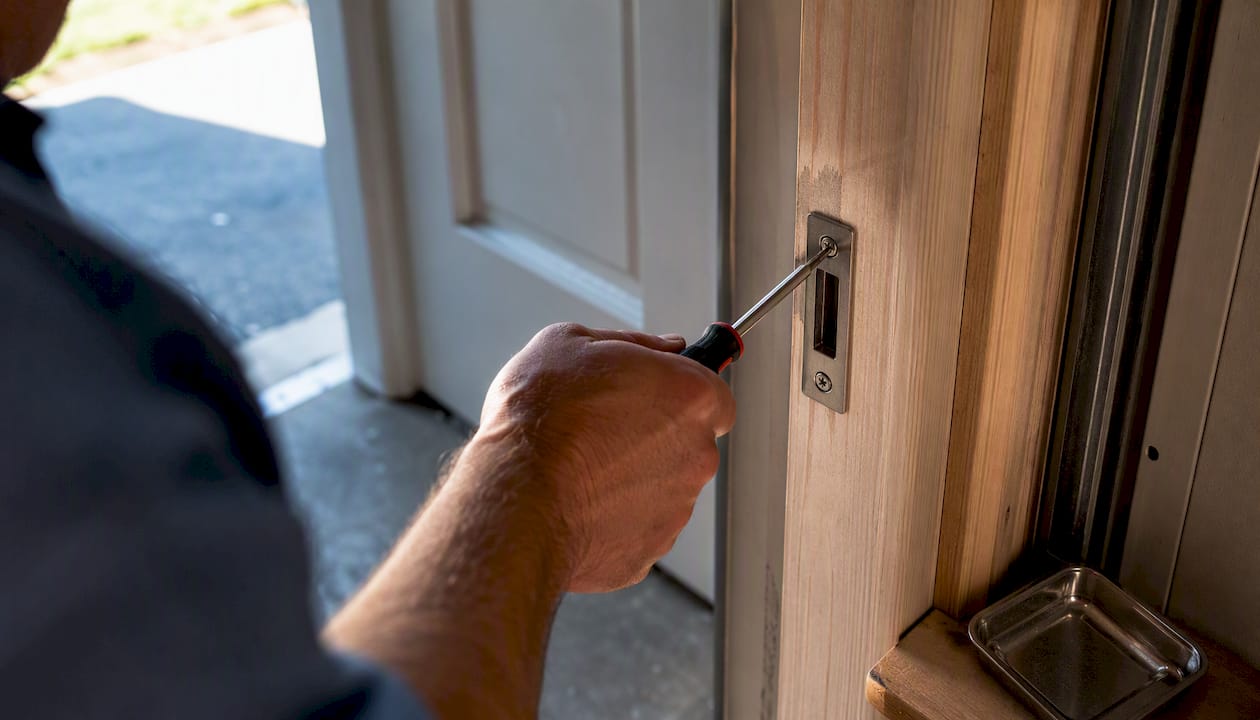
DIY works fine for the screw swap. Full-jamb reinforcement is a different story: it usually means removing trim, checking for square, and sometimes shimming the frame, which is where a door that won’t latch properly turns into a bigger repair than expected. If your door has warped or the jamb shows rot, that’s a call-a-pro situation, not a Saturday project.
How Burglars Beat Garage Openers (And How To Stop It)
The coat-hanger trick is real, and it’s simpler than most homeowners assume. Every garage opener has a manual emergency release, a red cord hanging near the motor, designed so you can open the door by hand during a power outage. An intruder slides a wire coat hanger through the small gap above the door, hooks the release cord, and pulls it, disconnecting the opener entirely. From there, the door lifts by hand.
The fix doesn’t require removing the release, which you need for actual emergencies. Homeowner security guides consistently recommend a low-tech mitigation: zip-tying the release cord in its engaged position. A zip tie is strong enough to resist a hook pulling from outside but weak enough to snap with a firm hand tug from inside during a real outage.
Loop a plastic zip tie through the release mechanism’s hole to hold it in the engaged position.
Test it once, from inside, so you know exactly how much force it takes to break in an actual emergency.
Never use wire or a permanent fastener; it has to fail intentionally under hand pressure.
Beyond the release, remote cloning is the other overlooked risk. Older garage openers use fixed-code signals that a $30 code-grabbing device can intercept and replay. If your opener predates 2011 or so and doesn’t mention rolling-code or rolling-security technology, it’s worth replacing.
Upgrade to a rolling-code opener, which generates a new signal every time and can’t be replayed.
Never leave a remote in an unattended car; it’s the single easiest way for a thief to get in without touching your lock at all.
Consider a monitored smart controller if you want a notification every time the door opens, especially useful for tracking teen drivers or package deliveries.
Don’t Let Windows Undo Your Lock Upgrades
A reinforced deadbolt means nothing if a burglar can see your tools, bikes, and side door lock through a glazed panel. Garage side doors, especially the pedestrian entries with a small window near eye level, hand intruders two things at once: a look at what’s worth stealing and, in some cases, an easy way in if the glass isn’t reinforced.
Line-of-sight matters more than most homeowners think. If someone can see your garage is unoccupied and unwatched, they’ve already done half their planning from the sidewalk.
Privacy film frosts the glass without blocking light, and it’s a $15 to $40 fix you can install yourself in under an hour.
Frosted or textured glass panels work as a permanent swap if you’re replacing the door anyway.
Laminated or tempered glazing resists shattering far better than standard single-pane glass, worth the upgrade if your door takes direct hits from lawn equipment or has a history of break-ins nearby.
Interior security bars add a physical barrier behind the glass for doors with larger window panels.
If your window is small and decorative, film is the fast fix. If it’s a full sidelight panel next to the door, that’s a case for swapping the glazing entirely rather than papering over a bigger structural weakness.
Cameras, Lights, and Smart Locks That Actually Help
Physical locks stop entry; cameras and lighting stop the attempt before it starts, and they give you evidence if it happens anyway. The combination is what security guides consistently recommend over either approach alone, since layering physical and electronic security closes gaps that a single method leaves open.
Motion-activated floodlights aimed at the side door approach deter opportunistic break-ins better than a static porch light, since sudden brightness signals to a passerby that someone’s noticed.
Camera placement matters more than camera count. One camera angled to capture the door and the walkway leading to it beats three cameras pointed at open yard space.
Smart garage controllers send a notification the moment the door opens, which is useful, but they run on your home Wi-Fi, so a weak router password becomes a security gap of its own.
Pair physical locks with monitored alerts. A slide lock stops entry; a camera notification means you find out about an attempt in real time instead of after the fact.
Statistic Callout: Insight from garage security reporting consistently frames layered defenses as more effective than any single upgrade, meaning a $40 camera paired with a $15 slide lock often outperforms one $150 smart deadbolt bought alone.
Set up cameras before you spend heavily on smart locks. Detection buys you response time; a lock only buys you delay.
What Upgrades Cost and How Often To Check Them
Garage side door security isn’t a one-time project. It’s a short list of checks plus a handful of upgrades you can spread across a few paychecks if needed.
Monthly: Test that the slide lock still engages smoothly and the zip tie on the emergency release hasn’t degraded.
Annually: Check hinge and strike screws for looseness, inspect weatherstripping for gaps, and confirm your opener’s remote batteries and rolling-code function still work.
Slide lock (2-pack): roughly $15 to $25, about 20 minutes to install.
ANSI Grade 1 or 2 deadbolt: roughly $40 to $120 depending on brand, 30 to 60 minutes.
Jamb reinforcement kit: roughly $30 to $80 in materials, an afternoon project or a short locksmith visit.
Professional locksmith visit: varies by scope; expect a quote before work begins rather than a flat number.
Check warranty terms before buying deadbolts online; some manufacturer warranties require professional installation to stay valid, which matters if a lock fails within its first year.
When a Job Is Bigger Than a Weekend Project
Some garage side door security upgrades are simple enough for anyone with a screwdriver. Others involve wiring, precise alignment, or hardware that needs to meet a specific security standard, and that’s where a trained locksmith changes the outcome.
Automatic lock wiring into an opener or smart hub involves low-voltage electrical work that’s easy to get wrong in a way that either fails silently or damages the opener board.
Full-jamb reinforcement on a warped or previously damaged frame often means the door needs to come off, get squared, and go back on correctly, not just have a plate bolted over the old damage.
Replacing a lock cylinder to ANSI Grade 1 standards requires matching the bore, backset, and strike geometry precisely; a mismatched install undermines the grade rating you paid for.
A typical service call starts with an inspection of your existing door, frame, and hardware, followed by a quote before any work begins, and installation that usually runs under an hour for a standard lock swap. Before hiring anyone, confirm they carry liability insurance and can show licensing for your area; [brand_signal] Progressive Locksmith Cerrajero’s technicians handle these upgrades daily across residential garages in the Miami and Homestead area.
Pro Tip: Ask any locksmith you’re considering whether they can show you the ANSI grade stamp on the lock they’re installing. A tech who can point to it and explain what it means is one who takes the standard seriously.
Your 30 And 90 Day Garage Security Plan
Three things to do immediately: lock the door, zip-tie the emergency release, and swap in longer strike plate screws. All three cost under $20 combined and take less than an hour.
This week: Complete the immediate fixes above, then add motion lighting near the door.
Within 30 days: Install an inside slide lock and reinforce hinges with 3-inch screws.
Within 90 days: Upgrade to an ANSI Grade 1 or 2 deadbolt and evaluate a smart controller or camera for the garage entry point.
For anything involving jamb reinforcement, cylinder replacement, or automatic lock wiring, schedule a locksmith rather than guessing. A rushed DIY job on structural hardware often costs more to fix than it would have cost to do right the first time.
What Fifteen Years Of Service Calls Taught Me About Garage Doors
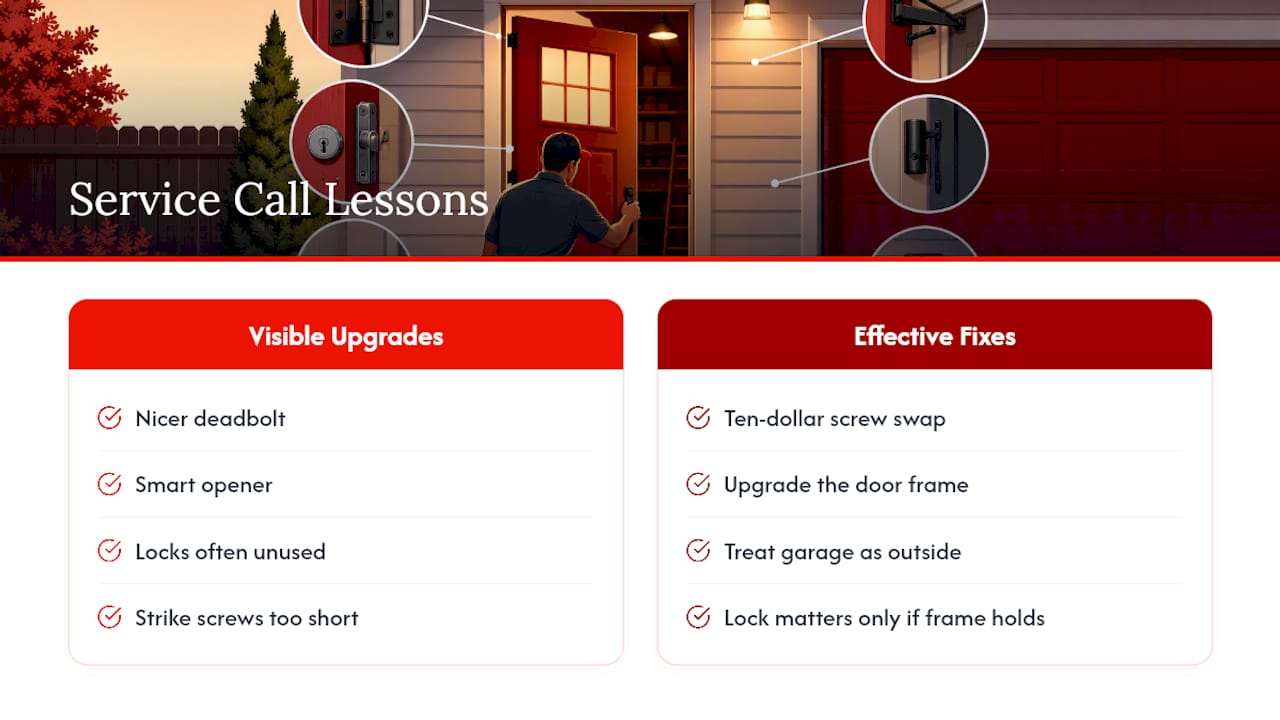
The most common thing I see on a service call isn’t a broken lock. It’s a perfectly good lock that nobody used, on a door with strike screws so short they’d barely hold a picture frame. Homeowners spend money on the visible stuff, a nicer deadbolt, a smart opener, and skip the ten dollar screw swap that actually stops a kicked-in door.
The second pattern: garages get treated as “inside” the house even when the side door leads straight outside. That mental gap is where break-ins happen. If you upgrade one thing this month, make it the frame, not the lock. The lock only matters if the wood around it can hold.
— Julio Borroto
Get Your Garage Side Door Professionally Secured
Hiring a professional locksmith is a practical alternative to guessing your way through a hardware store aisle. Instead of buying a slide lock, a deadbolt, and a jamb kit separately and hoping they fit your door, you get a technician who inspects your actual door, frame, and opener setup and installs the right combination the first time.

Our services cover the full range this article walks through: lock installation and replacement, jamb and strike reinforcement, automatic lock wiring, and emergency lockout response if you ever get shut out mid-project. Services are available to homeowners in Homestead and various locations in the Miami-Dade area. If you’re ready to move past the DIY checklist and get a professional assessment of your garage side door, visit our locksmith services page to see what’s included, or find your nearest local service option to schedule a visit this week.
Sources
Recommended
Comments