

5 Minute Phone Checklist to Choose a Locksmith for Home, Rental, or Car

Check three things before you hire any locksmith: verifiable credentials, proof of insurance, and written pricing before work begins. Legitimate locksmiths ask for your ID and proof of address or ownership when they arrive, so expect that step, not just from them but as a good sign. Save a vetted locksmith’s number in your phone now, before a lockout forces you to choose in a hurry.
TL;DR:
Verify a locksmith’s license, insurance, and trade memberships before hiring, and confirm all documentation is current and matches official records.
Obtain written estimates covering scope, parts, labor, warranty, and payment terms; refuse service if only verbal quotes are provided.
Watch out for scam signs such as unusually low quotes, cash-only requests, refusal to show ID, and immediate drilling without attempting non-destructive methods.
During emergencies, verify ID and proof of ownership before allowing work, pay only after completion, and prioritize vetting when not under pressure.
Choose a locksmith proactively by researching, saving contacts, and verifying credentials beforehand to prevent scams and reforms in urgent situations.
Table of Contents
How to Verify Licensing, Insurance, and Professional Memberships
Questions to Ask, Comparing Quotes, and What to Get in Writing
If You’re Locked Out Now: What to Verify Before You Let Anyone In
Emergency Calls vs. Planned Lock Projects: Adjust Your Vetting
Progressive Locksmith - Cerrajero Miami: A Working Example of These Practices
How to Make Sure a Locksmith Tries Non-Destructive Entry First
How to Check a Locksmith’s Professional Affiliations and Certifications
Get Help Now From a Locksmith Who Follows This Exact Checklist
How to Choose a Locksmith: A Phone Screening Checklist
You can screen a locksmith in under five minutes on the phone, before they ever pull into your driveway. Run through this list with anyone you’re considering, whether you found them through a search, a neighbor’s recommendation, or an app.
Ask for their license or registration number. Not every state requires locksmith licensing, but where it’s required, a real business gives you the number without hesitation.
Request proof of general liability insurance and workers’ compensation. A company that carries both protects you if something breaks or someone gets hurt on your property.
Check recent reviews and ask for a referral. A landlord, neighbor, or your own quick search should turn up a pattern, not just one glowing testimonial.
Confirm the call-out fee and whether the quote is fixed or an estimate. Reputable locksmiths give straight answers about pricing structure before they hang up.
Ask what they’ll check when they arrive. A legitimate locksmith will tell you upfront that they need ID and proof of address or ownership.
None of this takes long, and a locksmith worth hiring won’t flinch at any of it. Professional guides recommend checking licensing and insurance and reading multiple reviews before you commit, and this five-question call does exactly that in real time.
How to Verify Licensing, Insurance, and Professional Memberships
Licensing rules for locksmiths vary by state and even by city, so the first move is checking your state’s contractor board or consumer affairs office. State consumer protection pages specifically advise verifying license numbers and checking Better Business Bureau records before you hire.
Insurance matters just as much as licensing. General liability insurance covers property damage, while workers’ compensation protects you if a technician gets injured on your job. Ask for a certificate of insurance, not just a verbal assurance, and confirm both policies are active if a technician will be working inside your home or vehicle.
Trade membership adds another layer of confidence. The Associated Locksmiths of America runs a FindALocksmith directory and recommends credential checks through vetted listings rather than a random online search.
Quick verification checklist:
License number that matches your state’s public registry
Certificate of general liability insurance
Proof of workers’ compensation coverage
Listing in a trade directory like ALOA or a positive BBB record
Pro Tip: Screenshot or save the license number and insurance details the moment you get them. If a dispute comes up later, you’ll want that record, not a memory of a phone call.
Questions to Ask, Comparing Quotes, and What to Get in Writing
A short phone call can save you hundreds of dollars and a bad afternoon. Ask these questions before you agree to anything:
What’s your call-out fee, and is it credited toward the final bill?
Is this a fixed price or an estimate that could change once you see the job?
Will you attempt non-destructive entry before drilling or cutting?
What’s your estimated arrival time, and do you charge extra for after-hours calls?
For anything beyond a simple lockout, get two or three written quotes and compare them line by line. Good practice calls for comparing multiple written estimates, checking scope, materials, and warranty terms rather than just the bottom-line number. A quote $40 lower than the others might be missing a warranty or using cheaper hardware.
Before any work starts, get these five things in writing: the scope of work, parts and labor costs, warranty terms, start and completion timing, and payment terms. Ask for an itemized receipt when the job’s done.
Pro Tip: If a locksmith won’t put the estimate in writing, treat that as your answer. A verbal quote can change the moment they’re standing in your doorway.
Warning Signs and Locksmith Scams to Watch For
Locksmith scams follow predictable patterns, and knowing them ahead of time is your best defense. Documented scam tactics include bait-and-switch pricing, where a rock-bottom advertised rate balloons once the technician is on-site, sometimes triple or more the original quote.
Watch for these red flags:
A quoted price that’s dramatically lower than every other estimate you got
Local-sounding business names tied to a virtual address with no real storefront
Insistence on cash only, with no card payment option offered
Refusal to show ID or a license number when asked directly
Reaching for a drill before attempting a non-destructive entry method
If you suspect you’re dealing with a scam, refuse the service before any work starts, document the company name, phone number, and vehicle details, and report it to your local police or state consumer protection office.
If You’re Locked Out Now: What to Verify Before You Let Anyone In
Lockouts push people into decisions they’d normally think twice about. Slow down for two minutes and follow this order:
Check for a faster, free fix first: a spare key with a neighbor, your landlord, or roadside assistance through your car insurer.
If you need a locksmith, call one you already vetted, or use a directory search rather than the first ad you see.
When the technician arrives, ask for their name, company, photo ID, and license number before you let them touch your lock.
Have your own ID and proof of address or ownership ready. Professional locksmiths commonly ask for this before starting a lockout job, and it’s a good sign, not an inconvenience.
Don’t pay the full amount upfront. Pay after the work is done and get an itemized receipt.
If anything feels off, ask the technician to wait while you call the company directly or contact local police to confirm they’re legitimate.
Emergency Calls vs. Planned Lock Projects: Adjust Your Vetting
An emergency lockout and a planned lock upgrade call for different levels of scrutiny, even though the trust checks stay the same underneath.
Emergency lockouts: Prioritize speed without skipping ID verification, a clear price before work starts, and refusing full payment until the job is finished. If something feels wrong, call local police or your insurer for a recommended vendor.
Planned projects (rekeying, new locks, security upgrades): Take the time to get two or three written quotes, ask about warranties, and visit a shop location if one exists.
Either way: save the contact details of a locksmith you’ve vetted once you’ve confirmed them, so the next emergency doesn’t start from zero.
The upfront work you do during a calm moment pays off the next time a lock fails at 11 p.m.
Progressive Locksmith - Cerrajero Miami: A Working Example of These Practices
Some locksmiths operate with the practices this checklist describes, providing a useful real-world reference rather than a theory.
Offers emergency lockout response, residential and commercial lock repair, key duplication, and automotive key and fob programming, with 24/7 availability for urgent calls.
Runs an in-house workshop for lock repair and key work, giving customers visibility into how jobs actually get done.
Follows typical arrival protocols that may include checking ID and proof of ownership and providing written estimates before starting work.
That combination of documented service scope and standard verification steps is exactly what this checklist tells you to look for in any locksmith.
Where to Find and Shortlist Local Locksmiths
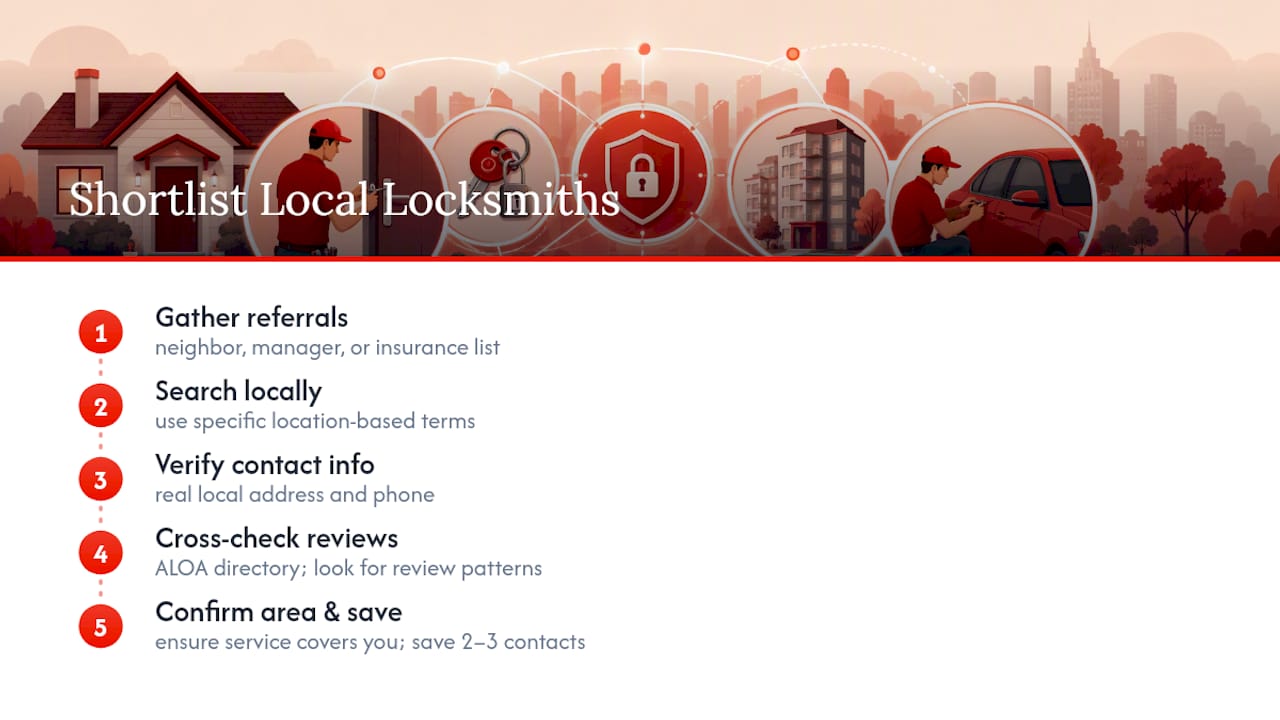
Start with the people who’ve already had a good experience: a neighbor, your building manager, or your car insurance agent’s referral list. Personal recommendations filter out a lot of risk before you even open a search engine.
If you’re starting from scratch, search with specific, location-based terms rather than generic ones. “Best locksmiths near me” pulls up a mix of legitimate local businesses and lead-generation sites that route your call to a random dispatcher, so pay attention to whether a business has a real local address and phone number, not just a listing that claims to be nearby.
Cross-check candidates against a trade directory like ALOA’s FindALocksmith tool, then look at their review history. Volume matters as much as star rating. A business with 300 reviews averaging 4.6 stars tells you more than one with 12 reviews at 5.0. Watch for patterns in the negative reviews specifically. Complaints about surprise pricing or no-shows repeated across multiple reviewers are a signal worth taking seriously, and reputation management resources can help you spot fake or inflated review clusters if something looks off.
Build a shortlist of two or three locksmiths before you need one urgently. Confirm each one’s service area actually covers your neighborhood, since some directories list broader coverage than a company can realistically deliver on short notice. Once you’ve vetted a shortlist, save the contact info somewhere you’ll actually find it during an emergency, not buried in an old text thread.
How to Make Sure a Locksmith Tries Non-Destructive Entry First
Non-destructive entry means picking, bypassing, or decoding a lock without damaging the door, frame, or lock cylinder itself. Drilling is a last resort, not a first move, and a skilled locksmith will say so when you ask.
Bring this up during your initial phone call, not after someone’s already at your door. Ask directly: “Will you attempt non-destructive entry before drilling?” A confident, specific answer, explaining that they’ll try picking or bypass techniques first and only drill if the lock is damaged or a non-standard security cylinder blocks other methods, is what you want to hear.
Watch the technician’s actual approach on-site. If they go straight for a drill without trying at least one non-destructive method first, especially on a standard residential lock, that’s worth questioning on the spot. Drilling destroys the lock and typically means a full replacement, which costs more than a repair and takes longer.
There are legitimate reasons a locksmith might need to drill: high-security cylinders, damaged internals, or a lock that’s already been tampered with. The difference between a legitimate call for drilling and a shortcut is whether they explain why before they do it. Ask them to walk you through the reasoning if it’s not offered upfront, and treat a locksmith who can’t explain the decision as a reason to get a second opinion next time.
How to Check a Locksmith’s Professional Affiliations and Certifications
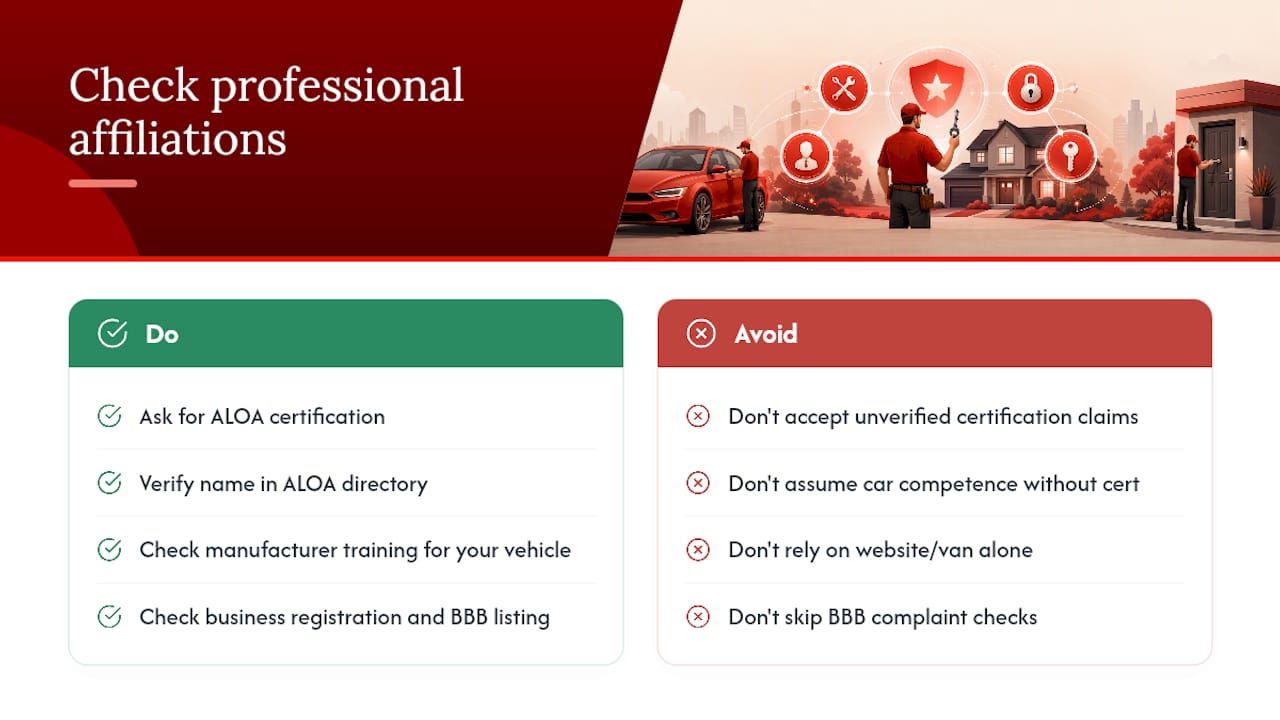
Trade certifications signal that a locksmith has been tested on real skills, not just handed a business card and a van. The Associated Locksmiths of America issues credentials like Certified Registered Locksmith and higher-level designations that require passing exams on lock mechanisms, security systems, and ethical practice.
Ask directly whether the technician or company holds ALOA certification, and cross-check the name against ALOA’s public directory rather than taking their word for it. A legitimate certification holder won’t mind you looking it up.
Beyond ALOA, check for manufacturer-specific training, particularly for automotive key programming, since fob and transponder systems vary significantly by vehicle brand and require specific equipment and manufacturer authorization to program correctly. A locksmith who’s certified to work on your car’s specific key system will usually say so without you having to dig for it.
Local business registration matters too. Confirm the company is registered to do business in your state or county, which you can typically verify through your state’s secretary of state or business registration website. Combine that with a BBB listing check for any pattern of unresolved complaints. None of these checks take more than a few minutes each, and together they separate a credentialed professional from someone who bought a van and a website last month.
Red Flags That Should Stop You From Hiring on the Spot
Certain warning signs should end the conversation immediately, regardless of how convenient the timing feels. No written estimate before work begins tops the list. If a locksmith wants to start drilling or picking before giving you a number, even a rough one, that’s not urgency, that’s a setup for a surprise bill.
A suspiciously low quote compared to every other estimate you’ve gathered deserves the same suspicion. Industry guides consistently flag unusually low quotes as a common precursor to bait-and-switch pricing, where the real number appears only after the work is already underway.
Cash-only demands are another flag. Legitimate businesses generally accept cards or digital payment, and a cash-only insistence often means there’s no paper trail the company wants left behind. Pair that with reluctance to show ID or a license number, and you’ve got enough reason to send them away before they touch your lock.
Finally, watch for immediate drilling without attempting a non-destructive method first, particularly on a standard lock with no obvious damage. That combination, no estimate, low price, cash demand, and a drill in hand, is close to a checklist of exactly what to avoid.
What Homeowners Get Wrong About Hiring a Locksmith
Most advice on this topic treats every lock issue like a five-alarm emergency, and that’s exactly the mindset that gets people scammed. The research is consistent: bait-and-switch pricing and fake local listings thrive specifically because panic shortens the time someone spends checking credentials. The fix isn’t more vigilance in the moment. It’s doing the vetting work before you’re standing outside your own door at midnight.
The conventional advice also overweights price and underweights process. A locksmith who asks for your ID, gives you a written estimate, and tries a pick before a drill is showing you their standards, not slowing you down. Homeowners who chase the cheapest quote consistently end up paying more once the real bill arrives.
My actual recommendation: pick a locksmith when you don’t need one. Verify their license, save their number, and you’ll never have to make that decision under pressure again. That single habit does more to prevent a bad hire than any checklist you scan mid-crisis.
— Julio Borroto
Get Help Now From a Locksmith Who Follows This Exact Checklist
You don’t have to run this whole vetting process from scratch. Certain locksmiths operate according to these standards: providing written estimates before work starts, checking ID and proof of ownership on arrival, and offering 24/7 availability for urgent situations.
The service lineup covers what most households and drivers actually need: emergency lockout response, residential and commercial lock repair and installation, key duplication, and automotive key and fob programming through the auto locksmith team. If you want to see how the work actually gets done before you call, the in-house workshop page shows the repair and fabrication process behind the scenes.
If you’re locked out right now or planning a lock upgrade for your home or business, view the full service list and call for a written estimate before any work begins. That’s the exact standard this article told you to demand, and it’s the one you’ll get.
Sources
Check these directly before signing off on any locksmith:
Verify license numbers and insurance certificates yourself, every time, no matter how good the referral sounds.
Recommended
Comments