

Ignition Cylinder Repair: Fix It or Replace It?

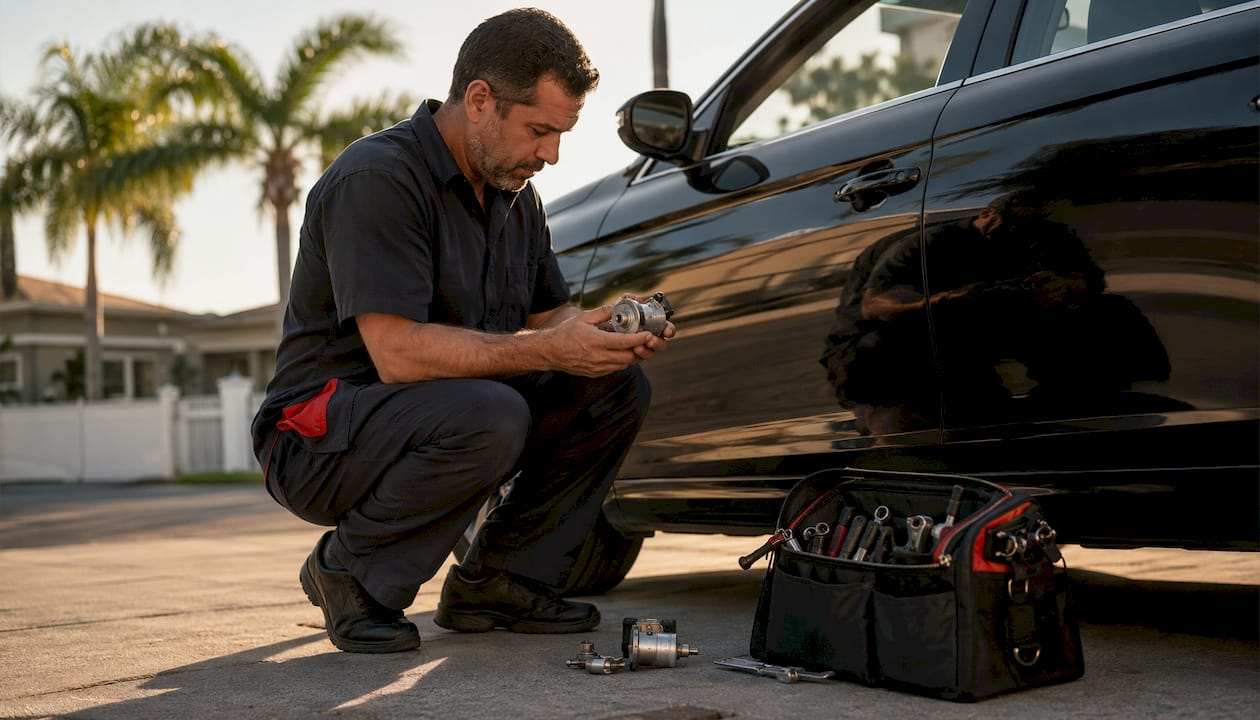
Most sticking or sticky-turn problems can be repaired without replacing the whole cylinder. If your key won’t turn, try the steering wheel unlock first — press the key in gently while rocking the wheel side to side. That single step resolves a surprising number of calls. If you have a spare key, test it next. Still stuck? Here’s what you’re likely looking at:
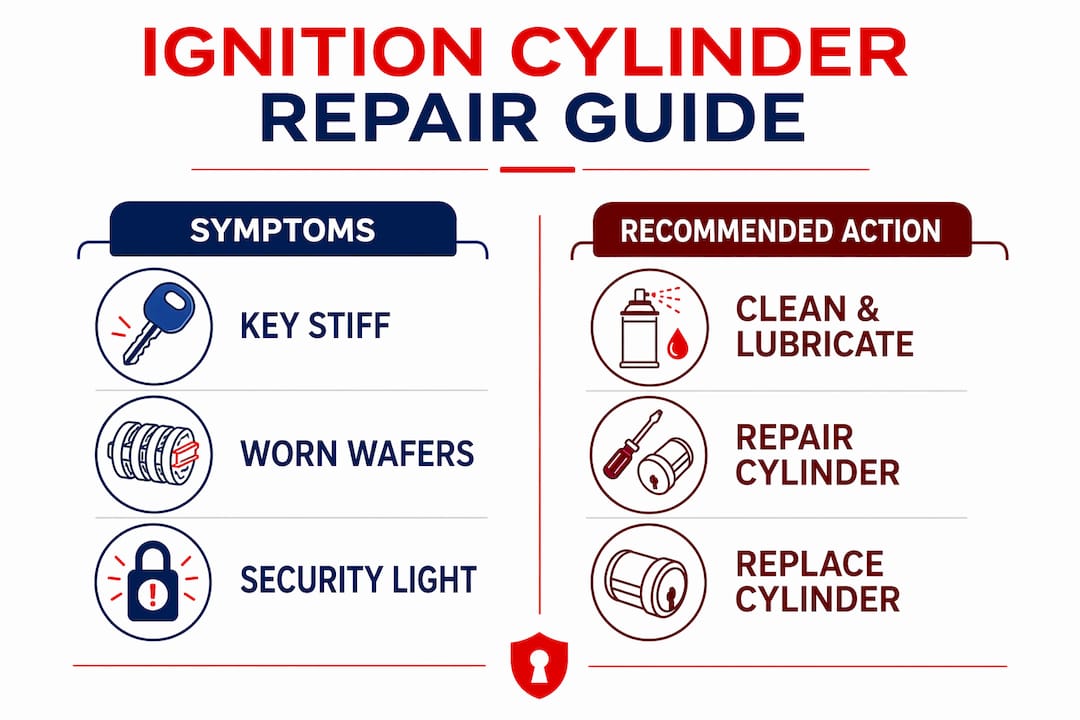
Repairable: Debris in the keyway, worn wafers or springs, a key that’s bent or copied from a worn original
Needs replacement: Cracked housing, broken sidebar, evidence of forced entry or tampering
Needs a pro immediately: Broken key fragment inside the cylinder, immobilizer warning light on dash, engine cranks then dies
Quick cost reference:
DIY parts only: $20–$400 depending on make and model
Mobile locksmith (on-site repair or swap): typically $200–$600 or more, depending on vehicle and service
Dealer (OEM programming, possible multi-day hold): usually more expensive, plus towing costs if needed
If you see a security light flashing or the engine starts and immediately dies, stop. That’s an immobilizer signal, not a mechanical cylinder problem. An OBD-II scan needs to happen before anyone touches the cylinder.
Table of Contents
How to safely repair or replace your ignition lock cylinder
Tools and parts you’ll need
Gather everything before you start. Mid-job trips to the parts store are where mistakes happen.
Phillips and flathead screwdrivers, trim removal pry tools
Socket set (metric and standard), torque driver
Pin punch set, small pick set
Replacement cylinder matched to your exact year, make, and model
Graphite or PTFE lock lubricant (not WD-40 or any oil-based spray)
Safety glasses, work gloves
Spare key (if available)
Preparation
Park on a flat surface, set the parking brake, and remove any heavy items from your key ring before you begin. Disconnect the negative battery terminal and wait at least 15 minutes if your vehicle has airbags near the steering column. This is non-negotiable — airbag deployment during column work causes serious injury.
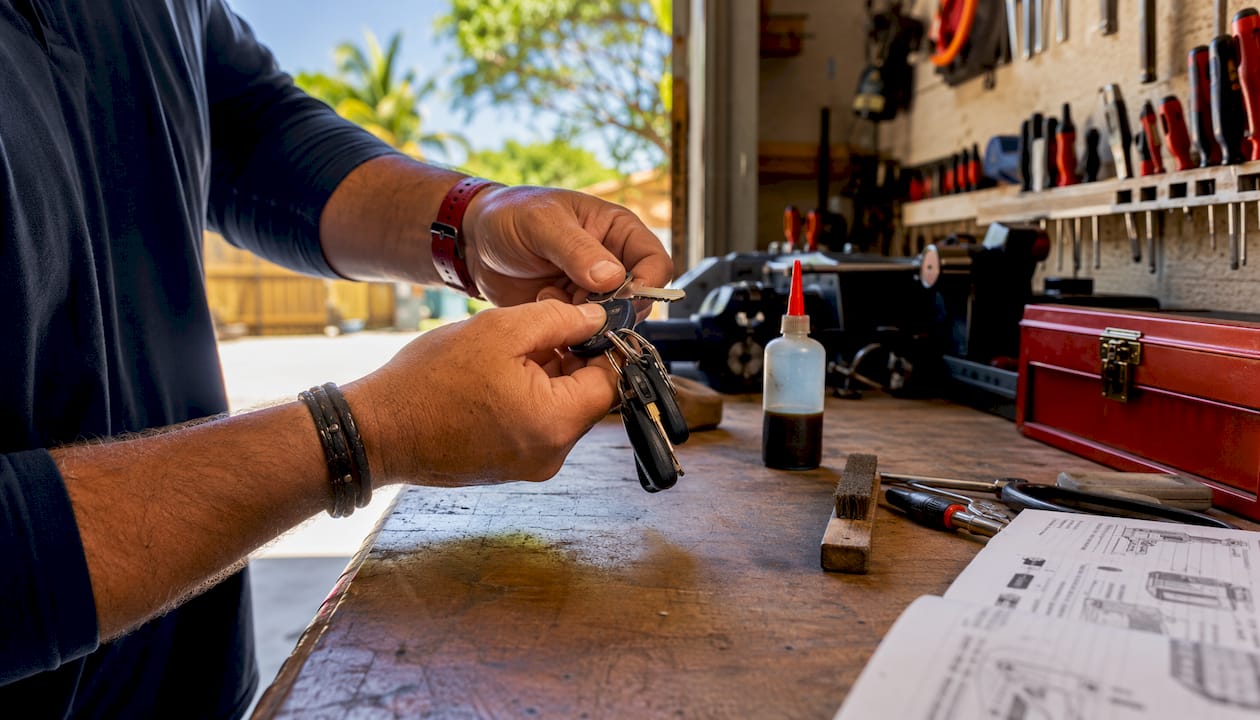
Pro Tip: Lighten your key ring permanently. A heavy keychain creates constant downward torque on the wafer stack while driving, and that’s one of the most common causes of premature cylinder wear we see in the Miami area.
Step-by-step procedure
Remove steering-column trim panels. Use trim pry tools, not a flathead screwdriver, to avoid cracking the plastic. Set screws aside in a labeled container. Do not pry near airbag covers.
Locate the release pin or tab. On most domestic vehicles, this is a small button or tab on the cylinder face, accessible with the key turned to the “Accessory” position. Check your vehicle’s service manual for the exact location — it varies by manufacturer.
Attempt the repair option first. If the housing is intact, remove the cylinder, disassemble it carefully, and inspect the wafer stack. Worn wafers or pins prevent the key from rotating. Replace damaged wafers with the correct replacements, clean out any debris, apply a small amount of graphite lubricant, and reassemble.
If replacing the cylinder: Slide the old cylinder out after depressing the release tab. Install the new or OEM-equivalent cylinder, aligning it with the housing so it seats fully. Confirm the tab clicks into place.
Reassemble the column trim. Work in reverse order. Do not overtighten trim screws.
Reconnect the battery and test. Turn the key through all positions: Off, Accessory, On, Start. Confirm the steering lock releases, the engine starts cleanly, and the key removes at Off.
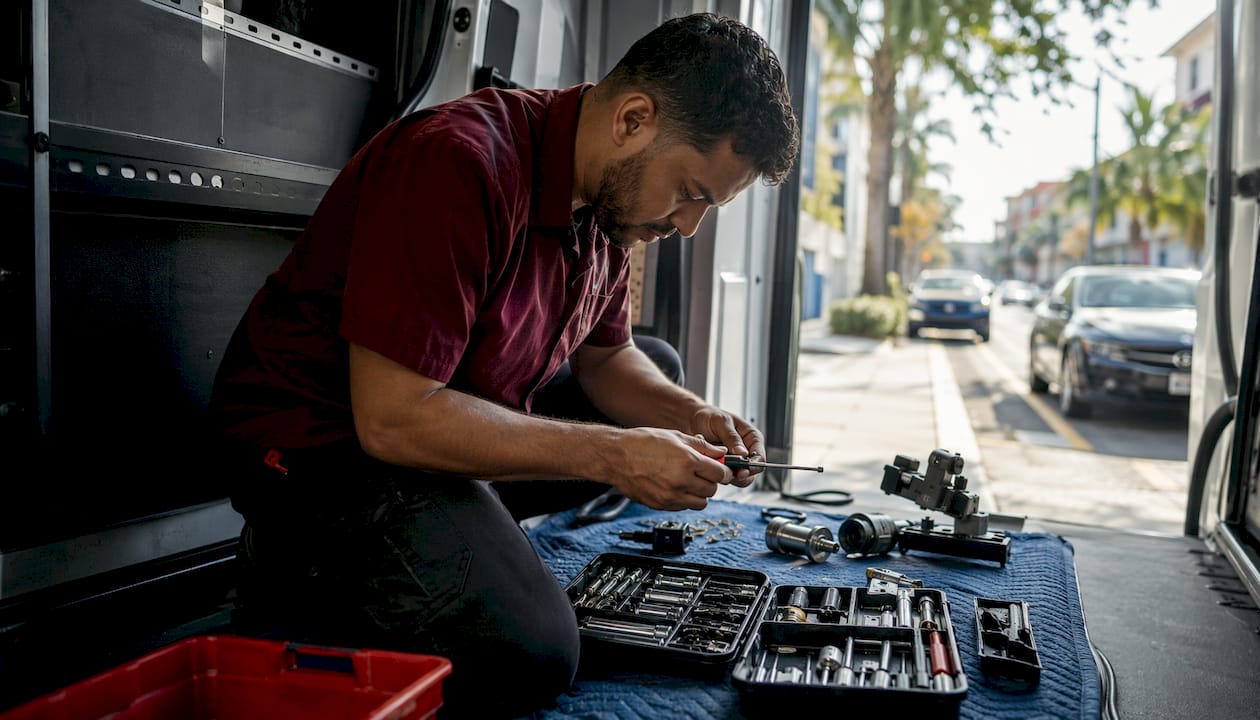
Electronic note: If your vehicle uses a transponder key, push-button start, or a Passive Entry/Passive Start (PEPS) module, stop before reassembly and read the next section. Installing a new cylinder without addressing key programming will leave you with a car that cranks but won’t run. OBD-II key programming tools like the XTOOL X100 Pro2 are what professionals use for this step — it’s not a DIY task without the right equipment and authorization.
Is your cylinder repairable, or does it need to be replaced?
The answer comes down to what’s actually failing. Many ignition cylinder problems — sticking keys, worn wafers, debris — can be fixed without swapping the whole unit. Cracked housings, broken sidebars, and theft damage are a different story.
Symptom checklist
Watch for these signs of a failing cylinder:
Key is hard to insert or won’t go in fully
Key turns only after jiggling or wiggling
Key rotates but the engine doesn’t crank
Key falls out while the engine is running
Steering wheel won’t unlock when you turn the key
Diagnostic steps
Try these before pulling anything apart:
Test a spare key. A worn key is often the real culprit. If the spare works smoothly, you need a new key cut from the original code, not a new cylinder.
Jiggle the steering wheel. A jammed steering lock is one of the most common reasons a key appears seized. Gently rock the wheel while applying light turning pressure to the key.
Watch the dash. If a security or anti-theft light is active, or the engine cranks and immediately dies, the problem is likely an immobilizer fault, not the cylinder itself. An OBD-II scan is the right next step.
Check accessories. Turn the key to Accessory. If the radio and lights work, the cylinder is rotating — the problem may be in the starting circuit, not the lock.
Decision guide
Symptom | Action |
Key stiff but turns, no dash warning | Clean keyway, try graphite lube, test spare key |
Key won’t turn at all | Check steering lock first; inspect cylinder if lock is clear |
Key turns, no crank, no dash warning | Check battery and starter circuit |
Security light on, engine cranks then dies | OBD-II scan before any mechanical work |
Broken key fragment inside cylinder | Call a professional locksmith |
Cracked housing or tamper evidence | Replace cylinder; call a pro |
Pro Tip: Before assuming the cylinder is bad, have a locksmith or dealer cut a fresh key from the original key code rather than duplicating your worn key. A worn key copied from another worn key compounds the problem.
What does ignition cylinder repair actually cost?
Costs vary by vehicle and what the job actually involves. Here’s a realistic breakdown.
Service | Typical cost range | Notes |
DIY parts (cylinder only) | $20–$400 | Varies widely by make/model; domestic vehicles tend toward the lower end |
Mobile locksmith (repair or swap) | $200–$600+ | Usually includes diagnosis, cylinder work, and basic key cutting |
Dealer (OEM parts + programming) | Often higher | May require towing; some manufacturer programming takes multiple days |
What drives the price up:
European and luxury vehicles with proprietary security modules
NASTF VSP-level programming requirements for transponder or smart keys
Broken-key extraction as a pre-step before cylinder work
After-hours or emergency service rates
Towing costs if the vehicle can’t be moved ($100–$200 on average)
Mobile automotive locksmiths typically complete on-site diagnostics, cylinder repairs or swaps, and key cutting within a couple of hours for most domestic and Asian vehicles. That’s a meaningful time advantage over dealer scheduling, which can stretch to multiple days when OEM programming is involved.
Risks and mistakes that make ignition problems worse
A few common moves turn a fixable problem into an expensive one.
Never do these:
Force a stuck key. Forcing it can snap the key inside the cylinder, turning a $150 repair into a $400+ extraction and replacement job.
Use WD-40 or oil-based sprays in the keyway. Oil-based lubricants attract dust and grit, forming an abrasive paste that accelerates wafer wear and may require full cylinder replacement.
Use tweezers, glue, or improvised tools to extract a broken key. These methods push fragments deeper or damage the wafer stack. Broken key extraction requires purpose-built extractors.
Pry near airbag covers. Accidental airbag deployment during column work is a medical emergency.
Skip the battery disconnect. Working near airbag components with the battery connected is unsafe.
Safer alternatives:
Graphite powder or PTFE spray for keyway lubrication — applied sparingly
Compressed air to clear debris before lubricating
The steering-wheel jiggle technique before assuming the cylinder is seized
A professional extraction kit (or a locksmith) for any broken key situation
Pro Tip: Avoid heavy keychains. Graphite or PTFE lubricant applied once or twice a year keeps wafers moving freely. Those two habits alone prevent most of the cylinder calls we get.
One important note: tasks that involve airbag module removal or OBD/NASTF-level programming require licensed equipment and, in some cases, manufacturer authorization. Attempting them without the right tools risks both personal safety and vehicle security system damage.
When should you stop DIYing and call a professional?
Some situations call for a pro from the start. Knowing when to stop saves money and prevents further damage.
Call a locksmith or mechanic immediately if:
A key fragment is broken inside the cylinder
The housing is visibly cracked or deformed
There are signs of forced entry or tampering
The dash shows a security or immobilizer warning
You can’t safely access or remove the cylinder
The engine cranks but immediately shuts off
Questions to ask before you hire anyone
Do you carry OEM-equivalent cylinders for my make and model?
Are you NASTF VSP-authorized for module programming?
Can you cut and program a key on site, or will the car need to go somewhere else?
What’s your estimated cost, and will you provide that in writing before starting?
Are you insured and bonded?
Credentials to look for
Mobile on-site capability (no tow required for most jobs)
OBD-II diagnostic tools for transponder and immobilizer verification
NASTF or NASTF VSP authorization for programming-level work
Written estimate provided before any work begins
Verifiable insurance and bonding
Red flags: Any technician who refuses a written estimate, can’t verify credentials, insists on towing without a clear reason, or advises you to force the key should not be working on your vehicle.
What a professional locksmith does on site
A qualified automotive locksmith follows a specific sequence. First, they run an on-site diagnostic to separate mechanical cylinder problems from electronic or immobilizer faults. If the dash shows a security message, they connect an OBD-II tool to verify transponder communication before touching the cylinder. That step alone prevents unnecessary replacements.
Once the fault is confirmed as mechanical, they access the steering column, remove the cylinder, and assess whether cleaning and wafer replacement will restore function or whether a full swap is needed. For most domestic and Asian vehicles, a mobile locksmith carries OEM-equivalent cylinders and can complete the job on site. Key cutting follows, and if the vehicle requires transponder programming, that happens via OBD-II before the final function test.
One often-overlooked option: a locksmith can frequently rekey a new cylinder to match your existing door and trunk keys, so you don’t end up carrying multiple keys for the same vehicle.
Locksmithfromiami operates as a mobile unit serving Miami-Dade County, including Homestead, Kendall, and Cutler Bay. The automotive locksmith services include on-site ignition cylinder diagnosis, repair and replacement, broken-key extraction, key cutting, and OBD-level programming for vehicles that require it. Technicians arrive with parts stocked for common domestic and Asian makes, and every job includes a function test before the technician leaves.
Key Takeaways
Most ignition cylinder problems are repairable if you catch them early — but immobilizer faults, cracked housings, and broken key fragments require professional tools and expertise, not a DIY attempt.
Point | Details |
Try the steering wheel first | Rocking the wheel while turning the key resolves many apparent cylinder seizures instantly. |
Spare key test before anything else | A worn key is often the real problem; a fresh key cut from the original code may fix it without any cylinder work. |
DIY parts cost varies widely depending on vehicle make and model | Professional repair typically costs $200–$600+ depending on service and vehicle; dealer work typically costs more and takes longer. |
Locksmithfromiami handles it on site | Mobile ignition repair, broken-key extraction, and key programming in Miami-Dade — no tow required for most vehicles. |
A practical note from a local locksmith
The most common ignition call in the Miami area isn’t a failed cylinder. It’s a worn key that was duplicated from another worn key, combined with a heavy keychain that’s been grinding the wafers down for years. By the time the owner notices the key sticking, the wafers are already at the edge of their tolerance.
My honest advice: get a spare key cut from the original key code now, before you need it. Keep your key ring light. And if the key starts feeling stiff, use a small amount of graphite lubricant rather than waiting until it won’t turn at all. Those three habits will extend the life of your cylinder significantly and keep you from being stranded.
Locksmithfromiami brings ignition repair to your location
When the cylinder is beyond a quick fix, Locksmithfromiami is the faster, lower-cost alternative to a dealer visit for Miami-Dade drivers. The mobile unit comes to you — whether you’re at home, at work, or in a parking lot — with the tools and parts to handle ignition cylinder repair and replacement, broken-key extraction, on-site key cutting, and OBD-level programming for vehicles that require it.

No tow truck, no multi-day dealer hold. Most jobs on domestic and Asian vehicles are completed on site in under two hours. Pricing is transparent: you get an estimate before any work starts, and there are no surprise charges. Locksmithfromiami serves Homestead, Kendall, Cutler Bay, and the broader Miami-Dade area, 24/7.
To request service, visit the automotive locksmith services page or check what the workshop carries for your make and model. Have your vehicle’s year, make, model, and a description of the symptoms ready when you call — it helps the technician arrive with the right parts.
Useful sources and further reading
The sources below are worth bookmarking for model-specific steps, official programming guidance, and additional diagnostic detail.
AutoZone DIY Guide: How to Replace an Ignition Lock Cylinder — step-by-step walkthrough with photos, useful for common domestic vehicles
Cars.com Glossary: Ignition Lock Cylinder — clear explanation of wafer mechanics and when replacement is warranted
AA1Car Ignition Switch Diagnosis: How to Diagnose Ignition Switch Problems — detailed electrical and mechanical fault trees, including immobilizer and anti-theft system checks
PartCatalog: Signs your ignition lock cylinder is failing — symptom reference for early diagnosis
NASTF (National Automotive Service Task Force): nastf.org — the governing body for Vehicle Security Professional authorization; use this to verify whether a locksmith or shop holds VSP credentials for programming work on your vehicle
Resource | Best for |
AutoZone DIY Guide | Step-by-step cylinder replacement with photos |
Cars.com Glossary | Understanding wafer mechanics and repair vs. replace decisions |
AA1Car Ignition Switch Diagnosis | Electrical fault trees and immobilizer troubleshooting |
PartCatalog Symptom Guide | Early symptom identification |
NASTF | Verifying VSP programming authorization for locksmiths and shops |
This article is general information, not professional automotive or legal advice. Confirm current programming requirements and safety procedures with your vehicle manufacturer, a NASTF-authorized technician, or a qualified mechanic for your specific situation.
Recommended
Comments