

Stop Replacing Parts: 5 Quick Tests to Diagnose Key Fob Interference

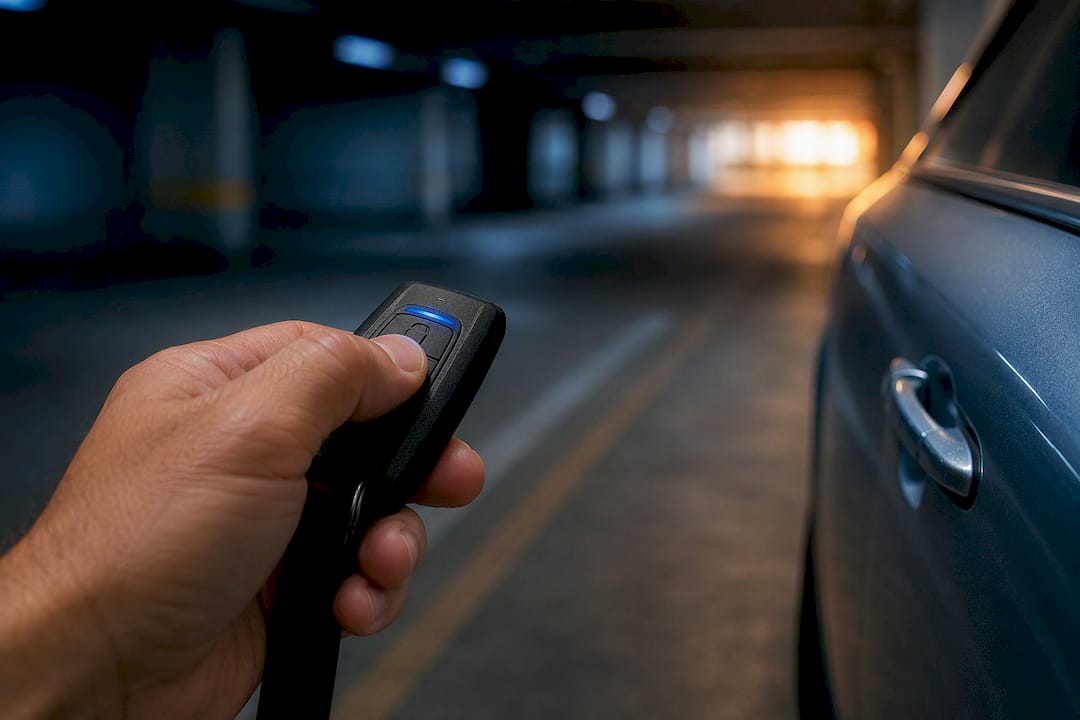
Most intermittent key fob failures come down to two things: local RF interference or a battery running low, either in the fob or the car. Before you assume the worst, try a spare fob, walk a moderate distance from where the fob failed, or slide the fob into the vehicle’s emergency start slot. If any of those fix it instantly, you’ve already found your answer.
TL;DR:
Most key fob failures are caused by low batteries or nearby RF interference, often detectable by testing the fob battery voltage or swapping to a spare fob.
Location-specific interference can be identified by testing the fob at different spots and times, with common culprits including LED bulbs, wireless chargers, and aftermarket electronics.
Fixes such as replacing suspect LEDs, moving wireless chargers, or unplugging aftermarket devices usually resolve interference without costly repairs.
When multiple fobs fail together or diagnostic trouble codes appear, professional diagnosis with advanced tools becomes necessary for accurate repair.
Keeping fobs away from other electronic devices and periodically checking batteries can prevent interference issues in the long term.
Table of Contents
Diagnosing Key Fob Interference: A Fast Checklist
Before you chase down noisy LED bulbs or blame a bad receiver, rule out the boring stuff. Batteries and voltage problems cause more “interference” complaints than actual interference does, and they take five minutes to check.
Work through these in order:
Test the fob battery. Most fobs use a CR2032 or CR2025 coin cell. On several Stellantis models, an open-circuit voltage below roughly 2.9V means the battery needs replacing, according to Stellantis technical service bulletin guidance. If you have a multimeter, check it. If not, swap in a fresh battery and retest.
Grab your spare fob. If the spare works fine in the same spot where the primary fob failed, the problem is the fob itself, not interference. If both fobs fail in the same location, you’re likely dealing with a noise source.
Change locations. Walk the car (or yourself) to a different spot, ideally 50 feet away or more, and test again. RF interference tends to be location-specific, so a fob that works fine in the driveway but fails in the garage points straight at something nearby.
Check the vehicle battery and fuses. A weak 12-volt battery or a blown fuse tied to the receiver module can mimic interference symptoms perfectly. AutoZone’s troubleshooting guidance recommends this as a standard early step.
Use the emergency start slot. Nearly every keyless vehicle has a hidden slot, often near the cup holder or start button, that lets you start the car by touching the fob directly to a sensor. If this works when remote start doesn’t, your antenna or receiver is functioning. The problem is signal reception at distance, not a dead module.
If you clear all five and the fob still fails intermittently in specific spots, move on to actual interference mapping.
How to Locate the Source of Key Fob Interference
Finding the culprit is mostly about pattern recognition. You’re looking for a location, a time, or a device that correlates with the failure.
Start with a walk-away test. Stand next to the car and press the fob, then take five steps back and try again. Keep going until it fails, and mark that spot. Do this from multiple directions around the vehicle. A dead zone that only appears from one side often points to a specific nearby object, like a transformer box, a neighbor’s equipment, or a piece of your own garage gear sitting between you and the car.
Time-of-day checks catch culprits that cycle on and off:
Test at different hours, morning, afternoon, and night.
Note if the failure lines up with when a refrigerator, pool pump, or HVAC system typically kicks on.
Cycling equipment is one of the most commonly reported causes in owner forums, where users have traced failures to newly installed LED signage or nearby machinery using exactly this method.
If the dead zone is inside or near your home, use your breaker panel. Flip breakers off one at a time and retest the fob after each. When the dead zone disappears, you’ve found the circuit. From there, unplug devices on that circuit individually until the fob works again.
Pro Tip: If you own a cheap SDR (software-defined radio) dongle, you can watch for broadband noise around the 315 MHz or 433 MHz bands most fobs use. It’s optional, but it turns a guessing game into a visual one. ScienceInsights’ walk-away and breaker-elimination method works without any tools at all, so don’t feel like you need equipment to get an answer.
Skip handheld RF detectors unless you already own one. They’re rarely worth buying just for this.
Common Culprits Behind Key Fob Signal Issues
Certain devices show up again and again once owners actually track down their interference. Each one has a slightly different signature.
LED bulbs with cheap drivers. Poorly shielded LED drivers throw off electrical noise that’s remarkably good at drowning out a fob’s weak signal. This is one of the most frequently reported causes of repeatable interference, and it’s usually tied directly to whether the light is on. If your dead zone appears only when a garage light or porch fixture is lit, you’ve likely found your answer.
Wireless phone chargers. A charging pad in the center console can block fob detection at close range. OEM guidance on some models recommends keeping the fob at least about 8 inches away from an active charger to avoid “key not detected” warnings.
Aftermarket dashcams and OBD trackers. These plug into always-on power and sit close to the dashboard, right where a fob’s signal has to travel. Unplug them for a day and retest before assuming your receiver is failing.
Outside sources. Commercial equipment, cell towers, or a neighbor’s new electronics can occasionally create dead zones you can’t control. These are rarer than the household causes above, but they explain why a fob that works everywhere else consistently fails in one exact parking spot.
What OEM Guidance Says Before You Replace Anything
Manufacturers don’t want you swapping expensive parts on a hunch, and their technical service bulletins reflect that. Stellantis TSB documentation, for instance, walks technicians through a specific sequence before authorizing a fob or module replacement.
That sequence exists because throwing parts at intermittent problems rarely fixes them. A key fob is a low-power, unlicensed transmitter, and under FCC Part 15 rules, it has no legal right to a clean signal and must simply tolerate whatever interference is present. That’s true for every fob on the market, not just older or cheaper ones. Replacing the fob won’t fix a noisy environment.
Before spending money, confirm three things: the fob’s battery voltage sits above the manufacturer’s threshold (around 2.9V open circuit on the models tested in the Stellantis TSB), there are no stored diagnostic trouble codes pointing to the RF hub or body control module, and the vehicle’s software is current. Dealers can pull DTCs and check for pending updates in a few minutes, and it often costs less than a single replacement part.
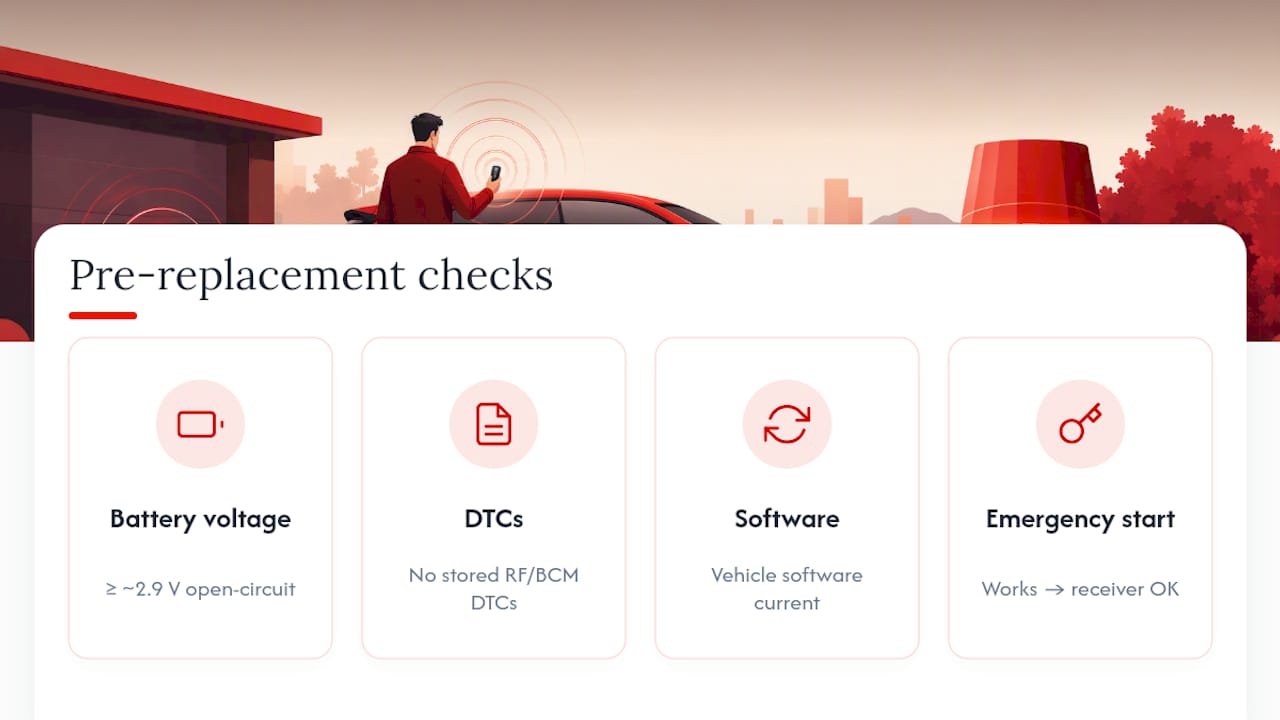
The emergency start procedure matters here too. If it works, the receiver hardware is functioning, and the issue is almost certainly environmental noise or a weak fob signal, not a failed module.
Fixing and Preventing Key Fob Interference
Once you’ve identified the source, most fixes are cheap and permanent.
For an immediate workaround, hold the fob directly against the start button, use your spare fob, or park in a different spot while you sort out the root cause. Longer term:
Swap out suspect LED bulbs for better-shielded, name-brand replacements rather than the cheapest option on the shelf.
Move wireless chargers out of the console or unplug them when not actively charging a phone.
Add a ferrite choke, a small clip-on filter available at most electronics stores, to noisy power cords near where you park.
Remove aftermarket dashcams or OBD trackers one at a time and retest before reinstalling.
Store fobs at least 25 feet from the parked car when possible, and keep them away from other fobs, phones, and metal objects that can cause desynchronization.
Pro Tip: Keep two fobs in the same pocket and you can sometimes get cross-interference between them. Separate them, even by a few inches, if you’re carrying both regularly.
When to Call a Professional Locksmith or Dealer
DIY testing solves a lot of these problems, but some situations call for a technician with the right diagnostic tools.
Call a professional when:
Multiple fobs fail the same way. If your spare and primary both struggle in the same spot, or both intermittently fail everywhere, that points to a vehicle-side issue rather than a fob problem.
You’ve pulled a diagnostic trouble code. A DTC tied to the RF hub, BCM, or receiver antenna needs a scan tool to interpret correctly, and clearing it without addressing the cause rarely holds.
The failure resists every mapping attempt. If you can’t pin the dead zone to a location, time, or device after a few days of testing, a technician with a spectrum analyzer or scope can often isolate it faster than continued guesswork.
You need programming, not just diagnosis. A weak or dying fob sometimes needs reprogramming or replacement, and that requires equipment most owners don’t have at home. Our guide to key fob programming walks through what that process typically involves.
Before your visit, write down when the failure happens, where, and what you’ve already tried. That log saves diagnostic time and money, whether you’re calling Progressive Locksmith - Cerrajero Miami or a dealer.
A Practical Note on DIY Testing Before You Pay for Parts
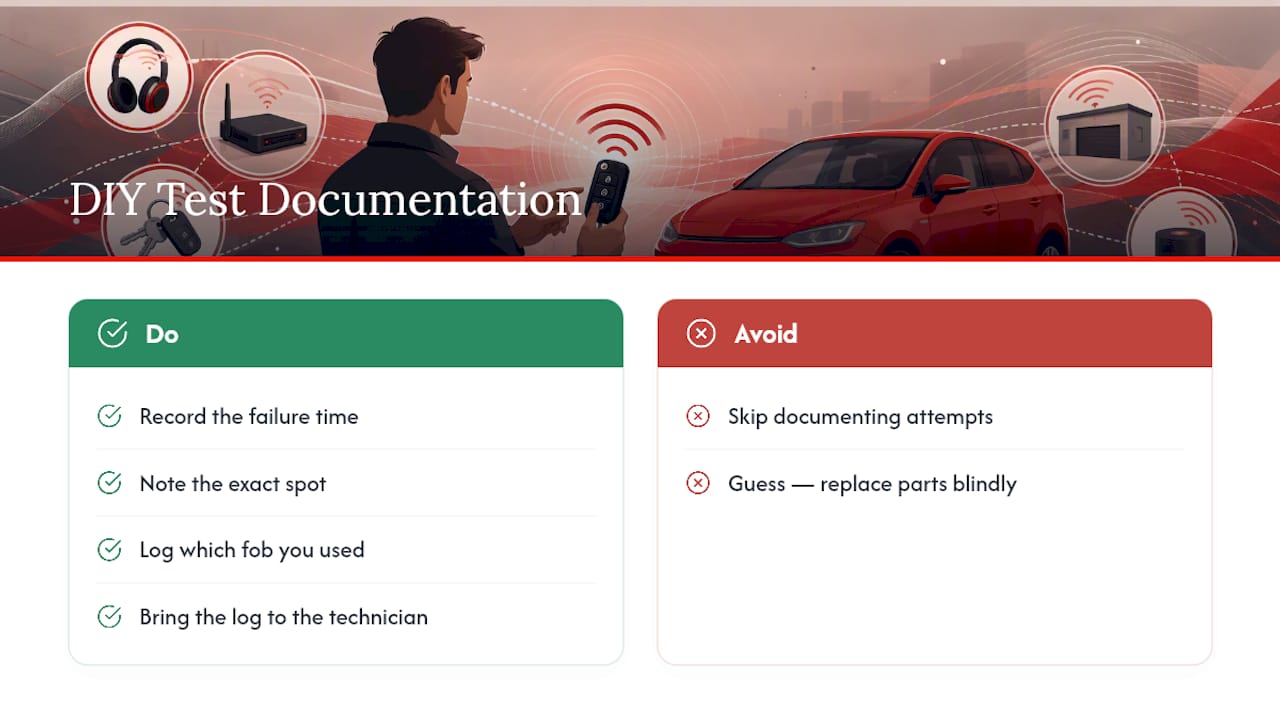
Most fob interference is fixable by the owner, and I’d rather see someone spend twenty minutes walking their driveway with a fob in hand than pay for a module replacement they didn’t need. The mistake I see most often is skipping documentation. Write down the time, the exact spot, and which fob you used for every failed attempt.
That log is what separates a five-minute professional diagnosis from a guessing game that ends in unnecessary parts. Bring it with you if you do end up calling someone.
— Julio Borroto
Get a Fast, On-Site Diagnosis From Progressive Locksmith - Cerrajero Miami
If you’ve worked through the checklist above and you’re still stuck, a technician can finish the job faster than another round of guesswork, especially when a scan tool or module-level check is the only way forward. A locksmith service runs mobile diagnostic visits in the Miami and Homestead areas, so you don’t have to remove your car’s console yourself or wait weeks for a dealer appointment.

A typical visit covers fob and vehicle battery voltage checks, fob ID verification, a basic RF inspection for nearby noise sources, and on-site programming if a replacement fob turns out to be the answer. The locksmith service is available 24/7, so a fob that dies late at night doesn’t mean waiting until morning.
Before you call, have your VIN, a description of when and where the failure happens, and your spare fob on hand if you have one. That information lets the technician skip straight to the likely cause instead of starting from scratch. Visit our auto locksmith services page to see what’s included, or check our local availability page to book a visit near you.
Sources
FAQ
How do I get rid of RF interference affecting my key fob?
Identify the source using a walk-away test or breaker elimination, then remove, relocate, or replace the offending device, such as a cheap LED bulb or a wireless charger positioned too close to the fob.
Why is my key fob glitching?
It’s usually one of three things: a low fob battery, a nearby noise source like an LED driver or wireless charger, or a weak vehicle-side receiver, and the OEM-recommended fix is checking battery voltage before anything else.
Can one key fob interfere with another?
Two fobs stored very close together, such as in the same pocket, can occasionally cause detection issues, so keeping them a few inches apart when carrying both usually resolves it.
Do key fobs constantly emit a signal?
No. Most fobs stay dormant until you press a button or, in passive keyless systems, until the vehicle sends a low-power request signal that the fob answers, which helps preserve battery life.
When should I call a professional instead of troubleshooting myself?
Call a technician if multiple fobs fail the same way, a diagnostic trouble code shows up, or the dead zone resists mapping after several days. Professional locksmith services offer on-site diagnostics and fob programming for exactly these cases.
Recommended
Comments