

15–30 Minute Locksmith Response Time: What to Expect and Ask

Most local emergency locksmiths arrive within 15 to 30 minutes in urban and suburban areas during normal hours. In a big metro area, at night, or during peak demand, that window commonly stretches to 30 to 60 minutes, and it can push past 90 minutes if a national call center dispatches a subcontractor from outside your area. Once a technician shows up, the actual job usually takes 5 to 60 minutes depending on the task. Your best move as a caller: ask exactly where the nearest technician is right now and whether they can text you a firm ETA before you agree to anything.
TL;DR:
Response times in local areas during business hours typically range from 15 to 30 minutes, but can increase to 30 to 60 minutes in larger metro areas at night or during peak demand.
Calls routed through national dispatch centers can result in response times exceeding 60 minutes, as technicians may be coming from outside your immediate region.
Reliable locksmiths should provide a specific technician’s location, a firm ETA, and a fixed price before dispatch to avoid surprises or delays.
Job duration varies: residential lockouts generally take 5 to 15 minutes, while complex tasks like key programming can require up to 60 minutes.
Non-destructive entry methods are preferred and typically extend the job by only a few extra minutes, provided the technician has the necessary tools and information.
Table of Contents
How Long Does Locksmith Response Time Usually Take?
The honest answer depends on three things: where you are, when you call, and who actually answers the phone.
In a genuinely local service area during business hours, a 15 to 30 minute arrival window is realistic and common. That’s the range you should expect if you’re calling a shop with technicians already working near your neighborhood.
Push into a larger metro footprint, call late at night, or phone in during a holiday weekend, and 30 to 60 minutes becomes the more honest number. Fewer technicians are on the clock, and each one is covering more ground.
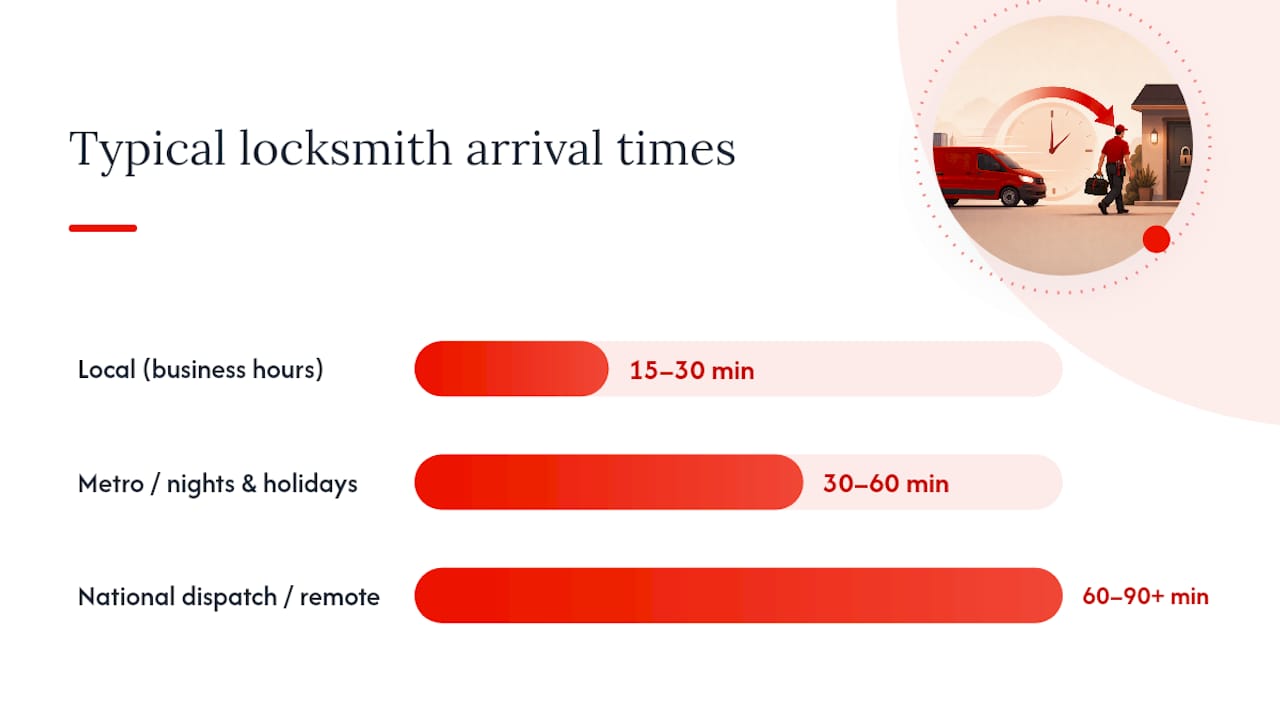
Then there’s the range nobody advertises: 60 to 90 minutes or more. This usually happens when your call gets routed through a national dispatch center rather than an actual neighborhood locksmith. The company on your screen may say “local,” but the technician driving to you could be coming from 40 minutes away.
A quick reality check: if a website promises “15 minutes, guaranteed” for every call, everywhere, at any hour, treat that as marketing copy rather than a schedule. Response time isn’t a fixed number. It’s a range shaped by:
Distance from the nearest available technician
Time of day and current staffing levels
Whether you’re talking to a local shop or a call center reselling your job to a subcontractor
How many other calls are already in the queue
Ask the dispatcher for a specific ETA tied to a specific technician, not a generic promise pulled from a homepage.
What Actually Changes Your Arrival Time
Six variables decide whether you wait 15 minutes or 90, a key consideration when trying to cut resident pickup wait time with on-site package management. Understanding them helps you read a quoted ETA correctly instead of just hoping it’s accurate.
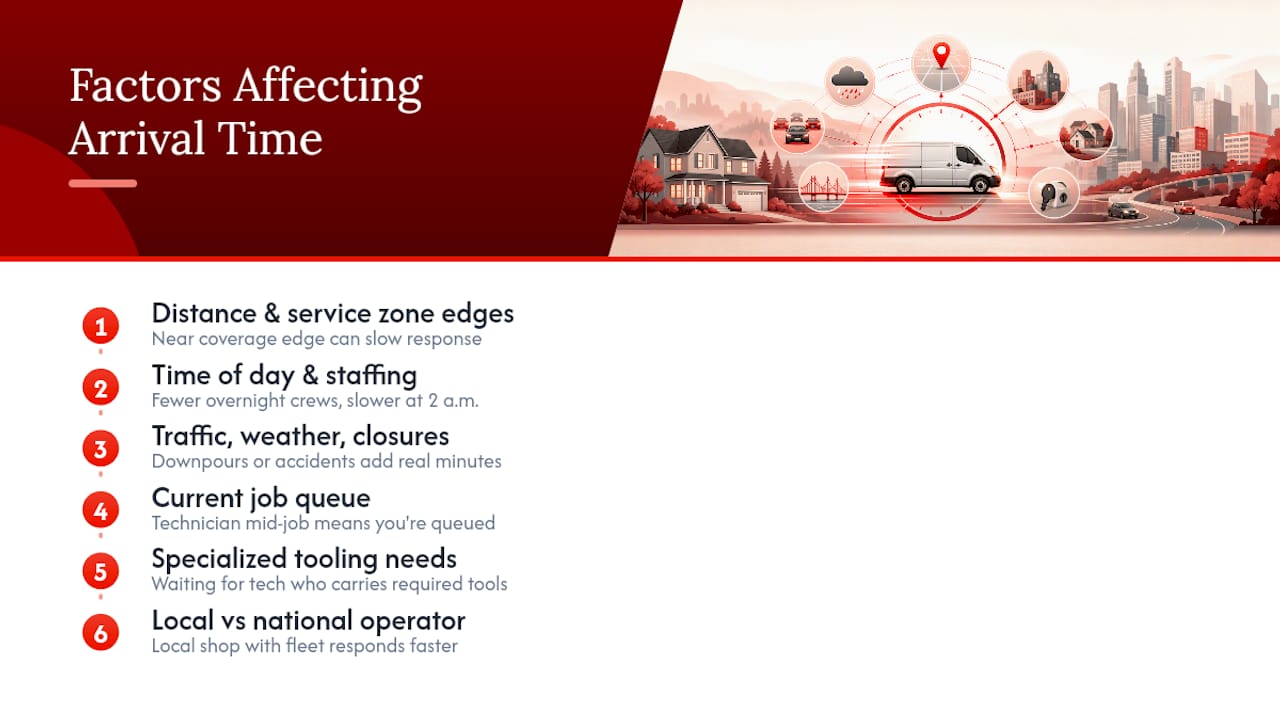
Distance and service zone edges. If you’re near the outer boundary of a company’s coverage area, you may get a slower response even though you’re technically “in the zone.” Ask how far the nearest technician actually is, not just whether your address is covered.
Time of day and staffing. A shop running three crews at 2 p.m. might run one on-call technician at 2 a.m. Overnight and early-morning calls almost always take longer to fill.
Traffic, weather, and road closures. A downpour or a stalled highway accident adds real minutes no dispatcher can promise around.
Current job queue. If a technician is mid-job when you call, you’re queued behind them. Holidays and big local events (concerts, sports games, festivals) compound this by spiking demand across an entire area at once.
Specialized tooling needs. Transponder key programming or safe work requires specific equipment that not every technician carries, which can mean waiting for the one who has it.
Local operator versus national aggregator. This is the biggest hidden factor. A shop with its own fleet nearby responds faster than a call center that resells your job to whichever subcontractor bids on it.
Pro Tip: Mention your exact situation when you call, lockout, broken key, car versus house, so dispatch can send a technician already equipped for the job instead of one who has to backtrack for tools.
What to Ask and Verify Before a Technician Is Sent
A two-minute phone conversation can save you an hour of uncertainty. Before you hang up, get answers to these:
Where is the nearest technician right now, and can they give you a specific arrival window rather than a vague “soon”?
What’s the technician’s name, and can they text you their photo, vehicle description, or a live tracking link before arrival?
What’s the total price, including any after-hours, holiday, or emergency surcharge, quoted as a fixed number before dispatch, not an estimate that changes on-site?
Does the company employ its own technicians in marked vehicles, or are they subcontracting your job to a third party you’ve never heard of?
Does the price and ETA match what was advertised online, or did it jump the moment you mentioned an emergency?
If a company refuses to give a fixed quote, won’t name or describe the technician coming to your home, or pressures you to pay a large deposit over the phone, treat that as a reason to call someone else. A BBB profile or a quick search of recent reviews takes thirty seconds and can spare you a bad experience.
What Happens Once the Locksmith Arrives
Response time is only half the wait. The other half is how long the job itself takes, and that varies by task more than people expect.
Residential lockout: 5 to 15 minutes for a standard pin-tumbler lock
Car lockout: 5 to 15 minutes for most modern vehicles
High-security locks: 15 to 30 minutes, since these are built specifically to resist fast entry
Broken-key extraction: 10 to 30 minutes depending on how deep the fragment sits
Key programming: 30 to 60 minutes, especially for transponder or fob-based systems
Lock change or rekey: 20 to 40 minutes per lock
Non-destructive techniques, picks, decoders, wedge-and-rod tools, often take a little longer than forcing entry, but they leave your lock intact instead of replacing it. That trade-off is almost always worth the extra few minutes. You can shorten the on-site time further by having your vehicle’s make and model, your lock brand, or a key’s serial number ready before the technician arrives. If dealer-level programming or a specific part is needed, factor in extra time for sourcing it.
What Reliable Dispatch Actually Looks Like
Speed means nothing if the company can’t back it up with real accountability. Look for these signals before you commit to a locksmith over the phone:
Real-time dispatch tracking, so you know your technician’s location instead of guessing
Technician ID sent by text before arrival, including name and often a photo
24/7 availability with transparent pricing, meaning after-hours and holiday fees are quoted upfront, not sprung on you at the door
Non-destructive entry as the default approach, with drilling reserved as a last resort
Background-checked technicians in marked vehicles, so you can confirm who’s pulling into your driveway
Progressive Locksmith - Cerrajero Miami applies these practices across its Homestead and Miami-Dade County coverage area, pairing 24/7 lockout response with fixed phone quotes and non-destructive entry so callers know both the price and the plan before a technician ever leaves the shop.
A Locksmith’s Honest Take on Waiting and Getting It Right
Patience and precise information both matter more than people assume. A caller who says “brass deadbolt, front door, house number visible from the street” gets served faster than one who just says “I’m locked out.” Speed and non-destructive work pull in opposite directions. Rushing a pick job to save five minutes risks a damaged cylinder you’ll pay more to replace. If anyone is trapped inside, injured, or in danger, call 911 first. A locksmith solves locks, not emergencies.
— Julio Borroto
Fast, Honest Dispatch When You’re Actually Locked Out
Waiting on hold with a national call center while you stand outside your own car is its own kind of frustrating, especially when the “local” number you dialed routes to a dispatcher three states away. You reach technicians who work in the local area, not a subcontractor bidding on your job from far away.
Calls are typically given a price quote before dispatch, so customers have an idea of the expected charge without surprise fees. Technicians arrive in marked vehicles and use non-destructive entry tools first, whether you’re locked out of your house or locked out of your car with the keys sitting on the seat. Some visits may also cover key programming services in addition to lockout assistance.
Call now for immediate dispatch, or check current lockout and key programming services before you’re stuck waiting on someone else’s ETA.
Where This Information Comes From
Response-time ranges and job-duration estimates draw on published locksmith service data. Safety context comes from the FBI, industry standards from ALOA, and consumer-verification guidance from the BBB and Consumer Reports.
Sources
FAQ
How long does a locksmith usually take to arrive?
Most local locksmiths arrive within 15 to 30 minutes in urban and suburban areas during normal hours, extending to 30 to 60 minutes during peak times or in larger metro regions.
How quickly can a locksmith come for an emergency?
An emergency call gets the same priority as any lockout, typically 15 to 30 minutes locally, though calls routed through a national dispatcher can take 60 to 90 minutes or longer since the technician may be coming from outside your immediate area.
Is it possible to tell if a lock has been picked?
Trained technicians can often spot fine scratch marks near the keyhole or slight damage to internal pins, but confirming it usually requires removing and inspecting the cylinder rather than a quick visual check.
Is it cheaper to call a locksmith or the dealer for a car key?
A locksmith is typically less expensive than a dealership for key duplication or programming, since dealers often charge more for the same transponder or fob work and may require an appointment days out.
What should I ask a locksmith to get an accurate ETA?
Ask exactly where the nearest technician is located and request a firm arrival window along with the technician’s name, so dispatch commits to a real estimate instead of a generic advertised time.
Recommended
Comments