

Master Key System Guide for Miami-Dade Property Managers

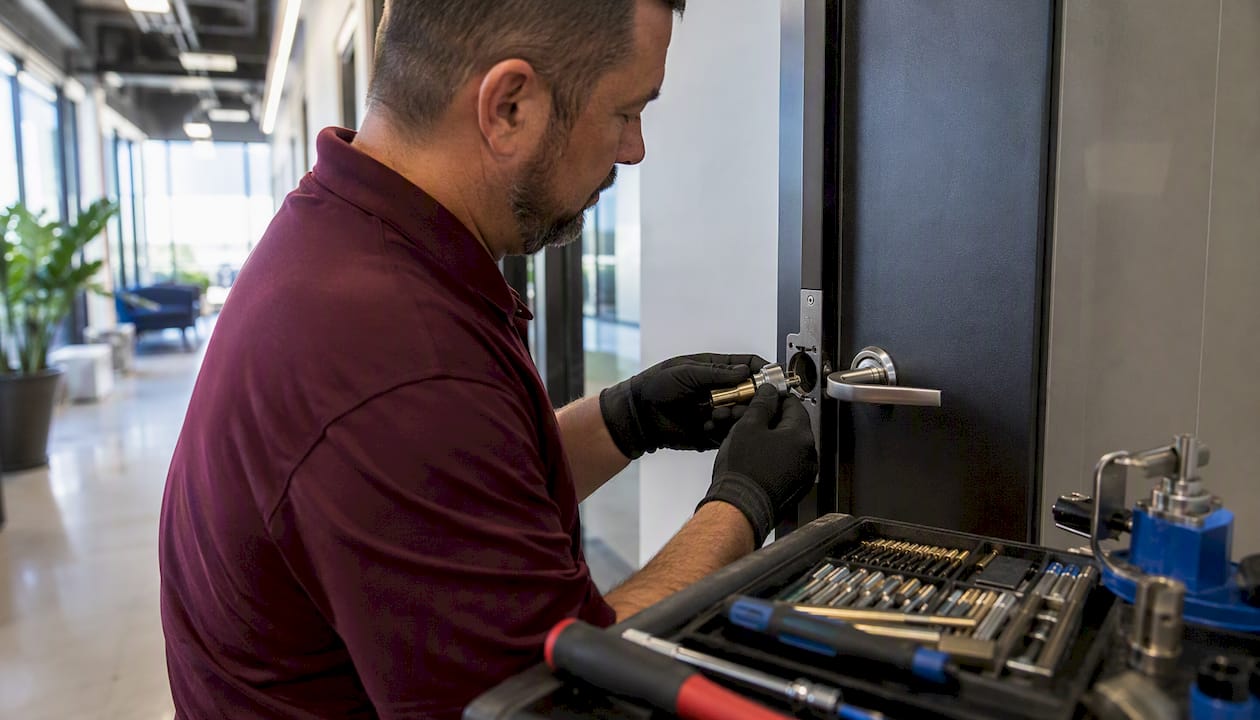
A master key system is a hierarchical arrangement of locks and keys where individual keys open specific doors and one or more master keys open multiple locks across a property. If you manage more than five doors, employ staff with different access needs, or operate a multi-tenant building, a master key system almost certainly makes sense. The next step is a site survey with a qualified locksmith who can map your doors before designing anything.
Key Takeaways
A master key system built on bottom-up design, restricted keyways, and documented bitting schedules gives Miami-Dade property managers durable, auditable access control that scales without full replacement.
Point | Details |
Keep the hierarchy flat | Two or three levels covers most properties; each added level reduces pick resistance. |
Design bottom-up | List every door and access need first, then assign the lowest key level that works. |
Protect the bitting schedule | Store it in two locations; losing it can force a full system replacement. |
Use restricted keyways for high-risk doors | Mechanical key control prevents unauthorized duplication without relying on policy alone. |
Locksmithfromiami installs and documents | Site survey, keying schedule, restricted keyway sourcing, and full documentation handover included. |
Table of Contents
What is a master key system and how does it work?
Every pin-tumbler lock has a set of spring-loaded pin stacks. A standard key lifts each stack to one precise height, aligning the shear line and allowing the cylinder to rotate. A master-keyed lock adds a small master wafer to each pin stack, creating a second shear line. That second line is what lets a master key open the lock even though it cuts to different depths than the change key. Each additional level of mastering adds another wafer and another shear line, which is why more levels means measurably lower pick resistance.
How many key levels do you actually need?
Most properties typically use two or three key levels, as additional levels increase complexity and reduce security.
Level | Key tiers | Typical application | Security/cost note |
Simple master | 2 (change + master) | Small office, single-floor retail | Highest mechanical security; lowest cost |
Grand master | 3 (change + master + grand) | Multi-floor building, school campus | Moderate security tradeoff |
Great grand master | 4 (change + master + grand + great grand) | Large campus, hospital, university | Significant security reduction; premium hardware required |
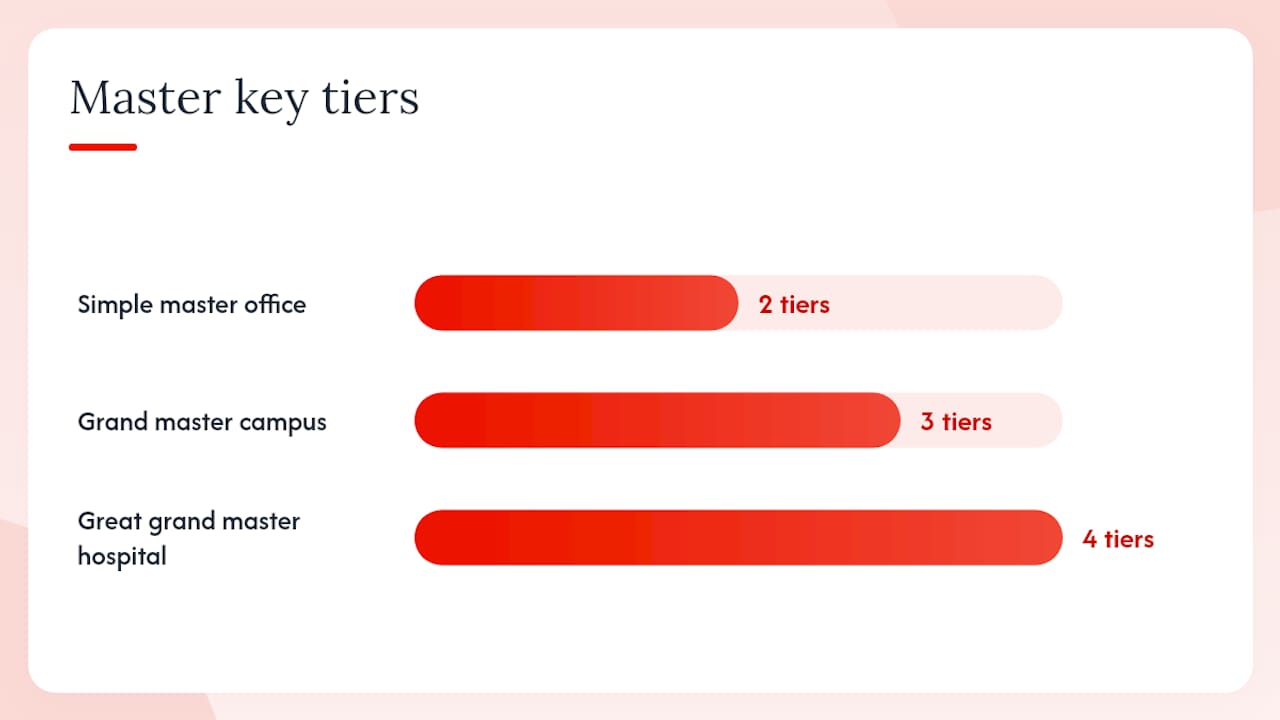
The Corbin Russwin master key guidance is direct: cylinder type, keyway, and master level must be planned together because higher levels reduce mechanical resistance. Hierarchies with more than three levels are generally discouraged on standard commercial cylinders due to security concerns.
Pro Tip: Follow the KISS principle. Keep the hierarchy as flat as possible. If a two-level system covers your access needs, stop there. Every unnecessary level you add is a security tradeoff you cannot undo without a full rekey.
How to design your keying plan before calling a locksmith
Start from the bottom up. ABLOY’s master key design guide recommends letting real door functions drive the hierarchy rather than starting with a grand master assumption. In practice, that means listing every door first.
Sample pre-survey workflow:
List every door with a unique ID (e.g., D-01, D-02).
Note the current hardware, door function, and who needs access.
Group doors by access need (all staff, management only, maintenance only).
Assign the lowest key level that satisfies each group.
Sketch a keying schedule showing door ID, hardware, change key code, and master assignment.
Hand the schedule to your locksmith before the site visit.
Capacity limits matter. The DHI keying systems guide explains the “multiples of 4” method: a five-pin cylinder with four active chambers gives 4 × 4 × 4 = 64 possible combinations. Once you account for master pins and cross-keying avoidance, that ceiling drops fast. Overly ambitious hierarchies simply run out of usable bitting space.
For properties with frequent tenant turnover, specify small-format interchangeable cores (SFIC). SFIC cores swap in 10–15 seconds with a control key, no cylinder removal needed. That speed matters when a tenant leaves and you need to rekey 20 doors before the next occupant arrives.
Also coordinate hardware choices with ADA door hardware requirements on any public-access door. Lever handles and accessible hardware must still be compatible with your chosen cylinder and keyway.
Key control policies that keep your system secure
A well-designed keying hierarchy means nothing if keys circulate without accountability. Operational key control is where most systems fail.
Key control policy checklist:
Designate no more than two or three people to hold top-level master keys.
Require a signed issuance form for every key, including change keys.
Log returns with date and condition; never assume a key came back.
Define a lost-key response procedure: who to call, which doors to rekey, and within what timeframe.
Store master keys in a locked key cabinet with restricted access.
Mark all keys “Do Not Duplicate” and use a restricted keyway to enforce it mechanically.
Review the key holder list at least once per year and after any staff departure.
Key management software adds a digital layer. Fields worth tracking include door ID, key code, key holder name, issue date, return date, and any duplication authorization. For small business access control in Miami-Dade, even a simple spreadsheet with those fields beats no record at all. A well-documented bitting schedule lets you rekey individual doors without touching the rest of the system. Without it, a single lost master key can force a full replacement.
Choosing the right cylinders and keyways
Not every door needs the same hardware. Match the cylinder and keyway to the risk level of the space it protects.
Conventional (open) keyways are widely available and inexpensive, but any locksmith can duplicate keys from them. They work for low-risk interior doors where convenience outweighs strict key control.
Restricted or patented keyways are controlled by the manufacturer. Duplication requires authorization, which gives you a mechanical enforcement layer on top of your policy. For multi-tenant offices, pharmacies, or server rooms, the premium is worth it.
High-security cylinders (rated to UL 437) add drill and pick resistance through hardened steel inserts, anti-rotation pins, and tighter tolerances. Use them on exterior entry points and any door protecting sensitive assets.
The practical rule: use a restricted keyway on any door covered by a master key, and upgrade to a high-security cylinder on doors where a breach would be costly. Standardize on one manufacturer’s product line across the property. Mixing brands creates compatibility headaches when you need to expand or replace cores.
What professional installation looks like, and what it costs
A professional master key installation follows a clear sequence:
Site survey: Locksmith walks every door, records hardware, and confirms the keying schedule.
Door schedule finalized: Change key codes and master assignments are confirmed in writing.
Prototype core: One or two sample cylinders are built and tested before full production.
Full installation: Cylinders are installed door by door; keys are cut and labeled.
Testing: Every key is tested at every door it should open and every door it should not.
Documentation handover: Bitting schedule, key holder list template, and spare keys/cores are delivered to the property manager.
Cost varies by hardware quality, cylinder count, and whether you specify restricted keyways or SFIC cores. Ballpark ranges for Miami-Dade projects:
These ranges reflect labor and standard commercial hardware. Restricted keyways and SFIC cores add cost but reduce long-term rekeying expense.
Maintenance, rekeying triggers, and planning for growth
Schedule a physical inspection of all cylinders once a year: check for wear, lubricate with a dry graphite lubricant (not WD-40), and update the key holder log. Rekeying is triggered by a lost master key, a staff departure with key access, tenant turnover, or any hardware failure.

Keep the bitting schedule in two places: one copy with the property manager and one offsite or in secure cloud storage. Poor documentation is the single most common reason a system has to be replaced entirely rather than expanded. A locksmith who inherits an undocumented system cannot add doors without risking cross-keying conflicts.
Stock at least two spare cores per lock type and a small supply of blank keys in the correct keyway. When you add doors, bring the original bitting schedule to the locksmith so new change keys are assigned from the remaining capacity rather than starting fresh.
How to choose a locksmith for master key work
Not every locksmith has commercial master key experience. Vet candidates carefully.
What to request before hiring:
Active Florida business license and proof of liability insurance.
References from at least two comparable master key installations.
Manufacturer certifications for any restricted keyway or high-security product they propose.
A sample bitting schedule from a past project (redacted is fine).
Questions to ask during the bid:
“Will you provide a complete bitting schedule at project completion?”
“Are you specifying restricted keyways, and from which manufacturer?”
“How do you track key distribution during and after installation?”
“What is your protocol if a master key is reported lost?”
Red flags to walk away from:
Reluctance to provide a bitting schedule or written key control policy.
Casual attitude toward key duplication (“just go to any hardware store”).
Pressure to add grand or great-grand master levels you did not ask for.
No written contract specifying deliverables and documentation.
The contract should specify: as-installed keying schedule, bitting data, spare keys and cores, and a key holder list template. Those four deliverables protect you long after the installer leaves.
Legal and liability considerations for master key systems
Holding a master key carries real legal exposure. If a master key is lost or stolen and a subsequent unauthorized entry causes harm or theft, the property owner or manager can face civil liability for negligent key control. In Florida, landlords have a general duty to maintain reasonable security for tenants, and that duty extends to key management practices.
Document everything. A signed issuance log showing who held which key, when it was issued, and when it was returned is your primary defense in a dispute. If a key is reported lost, rekey the affected doors promptly and document the response with dates. Delayed action after a known security breach weakens your legal position considerably.
For commercial properties in Miami-Dade, check whether your lease agreements or condo association rules address master key access and tenant privacy. Some associations require advance notice before a master key is used in a residential unit. Building on that, coordinate with your insurance carrier: some commercial property policies have specific requirements around key control documentation that, if unmet, can affect a claim.
Integrating a master key system with electronic access control
Mechanical master key systems and electronic access control are not mutually exclusive. Many Miami-Dade buildings use both: mechanical keys for everyday access and electronic credentials (key fobs, mobile credentials, or PIN codes) for high-security zones or after-hours entry.
The most practical integration point is the electrified mortise or cylindrical lock, which accepts both a mechanical key and an electronic credential. This lets you maintain a master key hierarchy for maintenance and emergency access while logging electronic entries for audit purposes. Smart lock platforms like those compatible with Allegion’s Schlage Control or ASSA ABLOY’s Aperio wireless cylinders can be added to existing door frames without replacing the entire lockset.
For multi-family buildings in Miami-Dade, a hybrid approach works well: mechanical master keys for property staff and maintenance, electronic fobs or app-based credentials for residents. The master key system handles the physical fallback; the electronic system handles the audit trail. Keep the two systems documented separately so a change in one does not inadvertently compromise the other.
A note from the field on Miami-Dade projects
Miami-Dade’s building stock is diverse. You will find 1970s concrete-block multi-family buildings in Hialeah with original hardware, newer mixed-use towers in Brickell with access control already wired in, and small retail strips in Homestead where the owner holds a single master key for six storefronts. Each situation calls for a different approach.
The most common mistake in local projects is scheduling installation during peak tenant hours. A mid-morning install in a busy office building means doors are in and out of service while people are trying to work. Schedule core swaps and cylinder replacements early morning or after hours when possible. If the property is governed by a condo association, confirm whether the association requires written notice before hardware changes on common-area doors. Some do, and skipping that step creates disputes.
Locksmithfromiami operates 24/7 across Miami-Dade and handles everything from SFIC core swaps on multi-family buildings to full commercial master key installations with restricted keyway sourcing. The workshop capabilities include on-site key cutting and core programming, which means prototype testing happens before the full install, not after.
Locksmithfromiami handles your master key installation end to end
When you need a master key system installed correctly the first time, Locksmithfromiami delivers the full package: site survey, keying schedule, restricted keyway sourcing, SFIC core swaps, and emergency rekeying when a key goes missing.

Every completed installation includes a bitting schedule, a key holder list template, spare keys and cores, and a recommended maintenance plan. You leave the project with documentation that protects you legally and makes future expansion straightforward. Before your first call, have a rough door count, a list of staff roles that need different access levels, and any existing hardware specs. That 15-minute prep cuts the site survey time in half. View the full service catalog or contact Locksmithfromiami directly to schedule your site survey.
Sources
Request copies of the bitting schedule and any manufacturer certificates from your installer at project completion. If they cannot provide them, that is a red flag worth acting on before you sign off.
Recommended
Comments