

Storefront Door Lock Repair: What Business Owners Need to Know

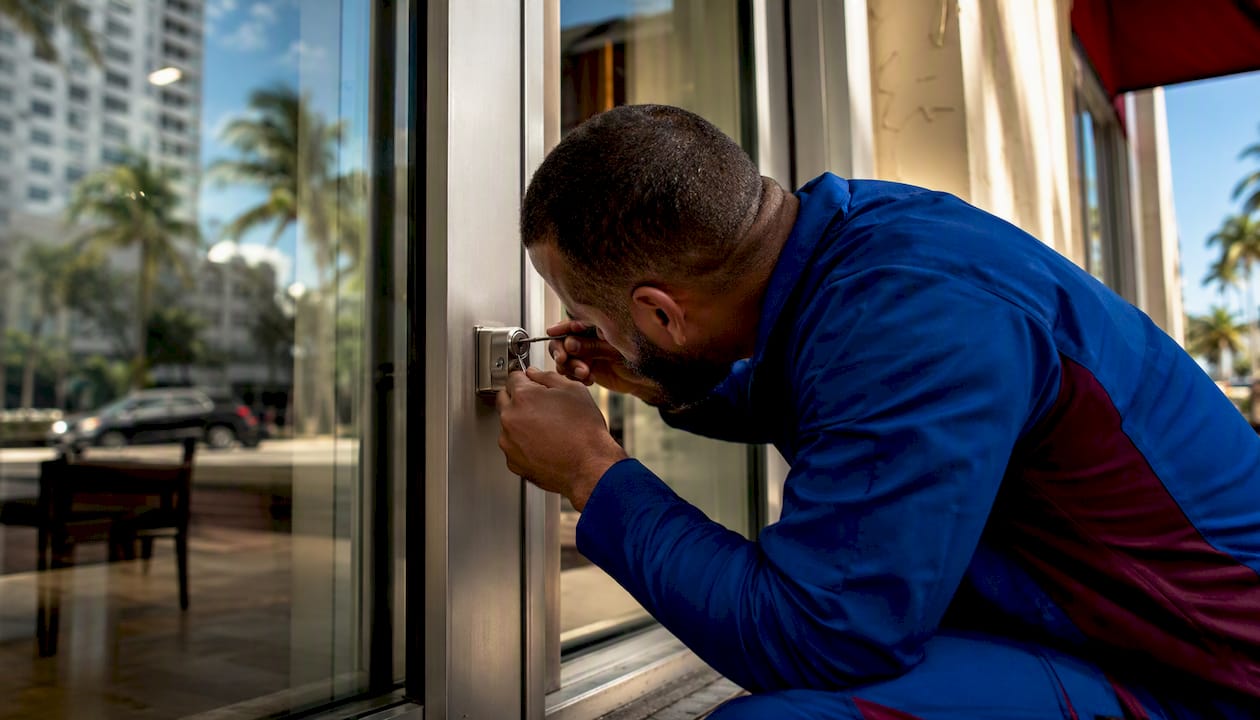
If your storefront lock is failing, the right call depends on one thing: whether security is compromised. Call a licensed commercial locksmith immediately when the door won’t secure after hours, when hardware is damaged from forced entry, when an electronic lock has failed, or when you’re dealing with a mortise or electrified strike that requires specialized tools. For everything else, a quick on-site check takes five minutes and can save you a service call.
Before you call, run these safe manager-level checks:
Visual damage check: Look for bent frames, cracked cylinders, or a strike plate that’s visibly shifted.
Loose hardware test: Grip the handle and check for wobble; tighten any visible screws with a Phillips head.
Lubrication test: Apply a graphite-based lubricant to the cylinder and work the key. If it turns smoothly, debris was the culprit.
5-minute alignment test: Open the door and manually push the latch. If it extends and retracts freely but won’t engage the strike when closed, the strike plate is likely misaligned, not the lock itself.
Battery check (electronic locks): Locate the battery panel and replace batteries before calling for service.
One safety note: a malfunctioning storefront lock can create ADA access violations and insurance liability. If you’re unsure, do not guess on ADA door hardware compliance.
Key Takeaways
Most storefront lock failures trace back to alignment or cylinder wear, and a qualified commercial locksmith can resolve the majority of them in a single visit with stocked parts.
Table of Contents
What your storefront lock symptoms are telling you
Field diagnostic data shows that roughly 60% of “door won’t lock” calls trace back to a strike plate just 1–3 mm out of position. That single fact changes how you should triage a problem.
Key won’t turn: Usually a worn or seized cylinder. Try lubrication first. If the key still binds, the cylinder needs service or replacement.
Door won’t latch: Most likely a misaligned strike plate or a latch spring that’s lost tension. Run the alignment test above.
Door drags or binds: Hinge wear, closer pressure set too high, or seasonal frame shift. Check closer tension and hinge screws before assuming the lock is at fault.
Handle is loose: A stripped set screw or a broken spindle. Tighten the set screw; if the handle still spins freely, the spindle is broken and needs replacement.
Electronic lock is unresponsive: Start with fresh batteries. If the keypad or card reader still won’t respond, the issue is likely a failed control board, a wiring fault, or a corrupted credential set.
A professional inspection covers the full door system: lock body, cylinder, latch, strike, hinges, closer, and frame alignment. That’s worth knowing before you describe the problem over the phone.
How to identify the storefront lock type you’re dealing with
Knowing what you have saves time when you call for service. Here’s how to identify the most common types:
Mortise lock: Recessed into a pocket cut into the door edge. You’ll see a rectangular faceplate flush with the door edge and a separate cylinder on the face. Common on aluminum-frame storefronts.
Tubular/rim cylinder: A round cylinder mounted through the door face, often paired with a surface-mounted deadbolt. Simpler to replace than a mortise.
Glass-door thumb-turn (slip-on): Clamps directly onto the glass edge with no cutout required. The 402 Series from FMF Glass Hardware is a common example, fitting 10–12 mm tempered glass with an aluminum body and three included keys.
Electric strike: Replaces the standard strike plate and releases the latch electronically. You’ll see wiring running to the frame.
Magnetic lock (mag lock): A plate mounted at the top of the door frame with a corresponding armature plate on the door. Requires constant power to hold; fails open during a power outage by design.
Panic/exit device (crash bar): A horizontal bar across the interior face. Required by fire code on many commercial exits.
Surface-mounted wireless glass lock: Mounts on the glass surface without drilling. The ASSA ABLOY G100 uses AES-128 encrypted wireless communication, an offline credential cache, and battery power, making it a practical upgrade for frameless glass doors.
Spotting electrified hardware: Look for visible wiring at the frame, a power supply box nearby, a keypad, or a card reader. Aluminum-frame doors handle electrified hardware differently than frameless glass, since the frame provides a channel for wiring. Frameless glass installations require surface-mounted conduit or wireless solutions.
C.R. Laurence’s commercial hardware catalog covers deadlatches, deadbolts, electric strikes, and flush bolts for glass and aluminum-frame applications, and is a useful reference when identifying what you have.
Repair or replace? A decision checklist for facility managers
Most hardware that’s structurally sound can be repaired. Replacement makes sense when the cost of repair approaches the cost of new hardware, or when the failure points to a systemic problem.
Repair is the right call when:
The cylinder is worn but the lock body is intact (rekey or cylinder swap)
The latch is seized due to debris or a weak spring
The strike plate is misaligned by a small margin
The issue is a loose handle or stripped set screw
Replace when:
The lock body is cracked or deformed from forced entry
Springs inside a mortise lock have failed and parts are no longer available
The hardware is obsolete and no longer compatible with your access-control system
You’ve had two or more failures on the same unit within 12 months
Decision checklist:
Is the lock body structurally intact?
Are replacement parts available from the manufacturer or a recognized supplier?
Does the current hardware meet your current security requirements?
Is the lock compatible with any access-control system you’re running or planning?
Note that some glass-door locks require a notch cut into the glass for installation. CRL’s swinging glass door lock specifies compatibility with 5/16" to 1/2" glass and requires notching for certain configurations. That’s a job for a glazier and a locksmith working together, not a solo repair.
Pro Tip: When a locksmith recommends replacement, ask them to show you the failed component. A broken spring or cracked cam is visible proof. If they can’t show you the damage, get a second opinion.
The iFixit glass door latch guide illustrates why DIY glass-door latch work carries real risk: internal components can fall inside the door cavity during removal, making retrieval difficult without the right tools.
What does storefront door lock repair typically cost?
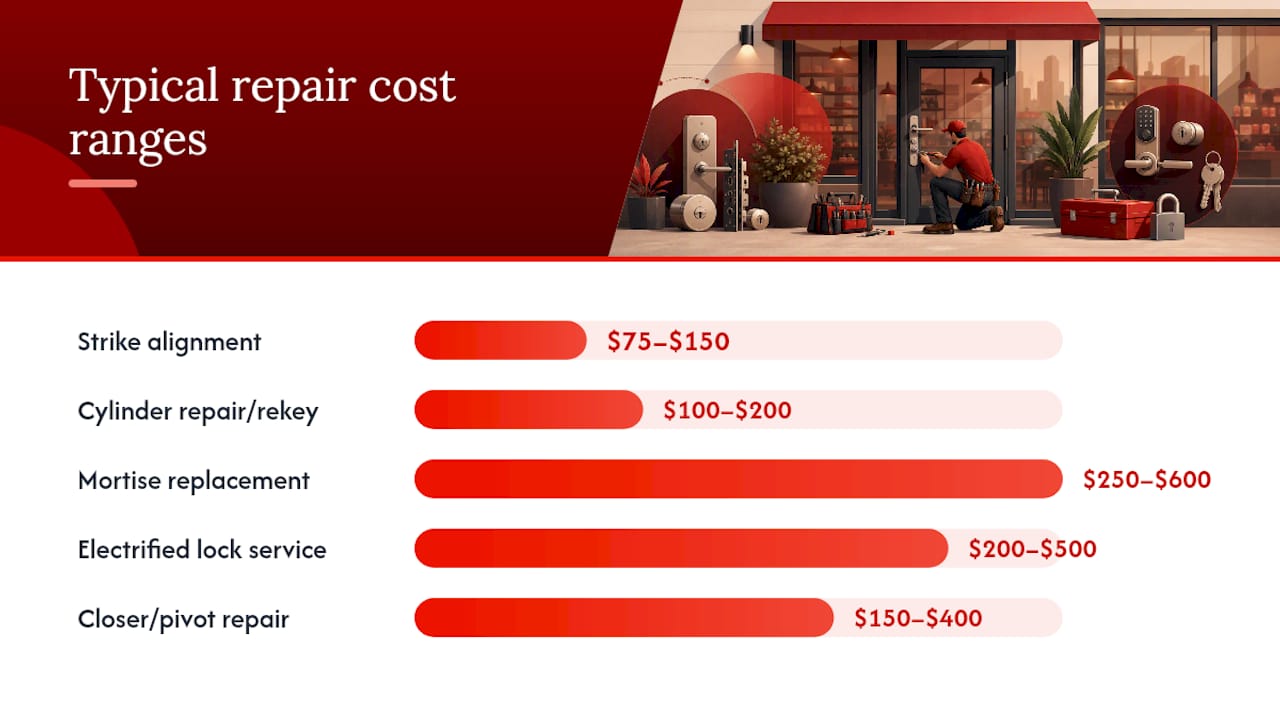
Costs vary by hardware type, parts availability, and whether the call is during business hours. Here are realistic ranges for common services:
Strike alignment or adjustment: $75–$150, often resolved in under 30 minutes
Cylinder repair or rekey: $100–$200 depending on cylinder type and key quantity
Mortise lock replacement: $250–$600 including parts and labor
Electric strike or magnetic lock service: $200–$500, more if wiring is involved
Closer or pivot repair: $150–$400 depending on closer model and parts
Emergency and after-hours calls typically add $50–$150 to any base rate. Same-day service is standard for most commercial locksmiths when common parts are stocked. Many providers carry the most common mortise and cylinder parts on their service vehicles, which makes single-visit resolution the norm rather than the exception.
Price drivers to watch: electrified hardware requires compatible replacement parts, impact-rated components cost more, and travel fees apply outside a provider’s primary service area.
What a qualified commercial locksmith does on a service call
A professional commercial door lock repair visit follows a clear sequence. Knowing what to expect helps you hold the technician accountable.
Arrival and safety check: The tech confirms the door is safe to work on and that the business can operate during the repair.
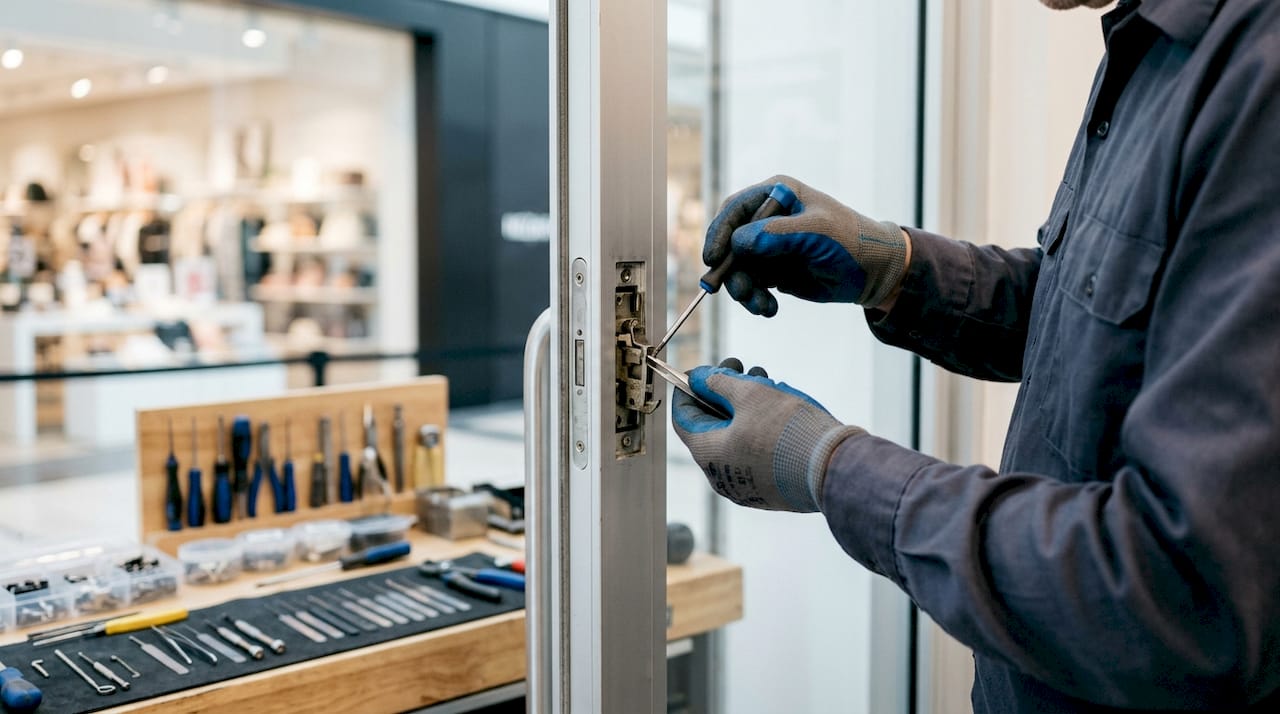
Full system inspection: Lock body, cylinder, latch, strike plate, hinges, closer tension, pivot hardware, and any electrified components.
Functional testing: The tech works the lock through its full range of motion before touching anything.
Diagnosis and written estimate: You receive a written breakdown of what’s wrong and what the repair or replacement will cost before any work begins.
Approved repair or scheduled replacement: Work proceeds only after you sign off on the estimate.
Final testing and sign-off: The tech tests the lock under load (door fully closed, key from both sides, electronic function if applicable) before leaving.
What to expect in writing: a parts list with manufacturer names, a labor warranty (typically 30–90 days on workmanship), proof of insurance or bonding, and photos of any damage found. A locksmith who skips the written estimate is a red flag, not a time-saver.
A thorough inspection covers the full door system before any recommendation is made, which is why a good tech rarely recommends replacement on the first visit without showing you why repair won’t hold.
How to vet a commercial locksmith for storefront work
Not every locksmith who handles residential deadbolts is equipped for commercial glass door lock repair or electrified hardware. Here’s how to screen before you hire:
Questions to ask:
Do you carry commercial mortise and electric strike parts on your vehicle?
Are you licensed, bonded, and insured for commercial work in Florida?
Will you provide a written inspection report and estimate before starting?
What’s your warranty on parts and labor?
What’s your response time for emergency calls?
Credentials and trust signals to require:
Active business license (Florida requires licensure for locksmith services)
Bonded and insured, with a certificate available on request
Demonstrated commercial experience, not just residential
Familiarity with recognized hardware brands (ASSA ABLOY, Schlage, Corbin Russwin, C.R. Laurence)
ALOA membership or equivalent as a signal of professional training standards
Red flags:
No written estimate offered
A quote significantly below market rate with no explanation of scope
Unmarked vehicle and no ID or business card
Refusal to show proof of insurance
Pressure to replace hardware before completing a full inspection
Preventive maintenance that cuts emergency calls
A short maintenance routine extends hardware life and catches problems before they become after-hours emergencies.
Monthly: Visual check of all storefront locks. Look for loose handles, visible corrosion, or strike plates that have shifted.
Quarterly: Test latch and deadbolt function on every door. Check closer tension (door should close fully in 3–5 seconds without slamming). Inspect electrified connections and battery panels.
Annually: Schedule a professional tune-up. A tech will lubricate cylinders, adjust closers, check pivot wear, and test electronic components under load.
For lubrication, use a dry graphite lubricant or a PTFE-based spray on cylinders. Avoid WD-40 on lock cylinders; it attracts dust and degrades internal components over time.
Pro Tip: In South Florida’s humidity, door frames expand and contract seasonally. Run your 5-minute alignment test every spring and fall. A strike plate that’s fine in January may be 2 mm off by August.
When upgrading makes more sense than repairing
If you’re replacing aging hardware anyway, it’s worth considering an upgrade rather than a like-for-like swap. Common upgrade paths for storefronts:
Electrified strike: Adds remote release capability to an existing mortise or cylindrical lock. Lower installation cost than a mag lock and fails secure by default.
Magnetic lock: Ideal for high-traffic glass doors where you need remote release and audit trail. Requires a power supply and a compliant egress button.
High-security mortise cylinder: Restricted keyways prevent unauthorized key duplication. Worth the cost if you have multiple keyholders or high staff turnover.
Surface-mounted wireless glass lock: The G100-style approach lets you add access control to frameless glass without drilling. Operates offline using cached credentials, communicates via AES-128 encryption, and runs on batteries.
Integrated access control: Connects door hardware to a central platform for remote monitoring, time-based access, and audit logs.
Upgrades make the most sense when you’re managing multiple locations, need an audit trail for compliance, or want to eliminate physical key distribution. Small business access control options in Miami-Dade range from simple keypad strikes to full cloud-managed systems. Always use manufacturer-authorized parts for electrified hardware; third-party components can void warranties and create compatibility failures.
Progressive Locksmith Cerrajero’s storefront lock services
When you’ve run the quick checks and the problem is beyond a screw tightening or a battery swap, Locksmithfromiami provides commercial storefront lock repair across Miami and Homestead with a process built around minimizing your downtime.
Services include:
On-site inspection with a written estimate before any work starts
Mortise lock repair and cylinder replacement
Electric strike and magnetic lock service
Glass door lock repair for aluminum-frame and frameless glass doors
Access-control upgrades and rekeying
24/7 emergency response for after-hours lockouts and break-in damage
Every job is backed by insurance, bonding, and a workmanship warranty. Locksmithfromiami carries common commercial parts on every service vehicle, which means most repairs are completed in a single visit.
To request a same-day inspection or emergency service, visit the commercial services page or call directly. If you need immediate help, 24/7 lockout response is available now.
A note from Julio
The most expensive storefront lock repair I see is the one that waited too long. A misaligned strike becomes a broken latch. A worn cylinder becomes a lockout at 6 AM on a Monday. The checklist in this article takes five minutes and catches most of those problems before they escalate. Use it. And when you do call a pro, insist on the written estimate and the warranty in writing. Those two documents tell you more about a locksmith’s professionalism than any review.
Locksmithfromiami: fast, local, and ready when you need it
When your storefront lock fails and the quick checks don’t fix it, you need a commercial locksmith who shows up with the right parts and the right experience. Locksmithfromiami serves Miami and Homestead with 24/7 emergency availability, written estimates on every job, and workmanship backed by insurance and bonding.
Schedule a storefront inspection or find your nearest service location to get a technician dispatched today.
Sources
Ask your locksmith: Always confirm that replacement parts are manufacturer-authorized. Third-party components on electrified or access-control hardware can void the manufacturer’s warranty and create liability if the hardware fails.
Recommended
Comments