

Types of Door Locks: A Practical Guide for Home and Business

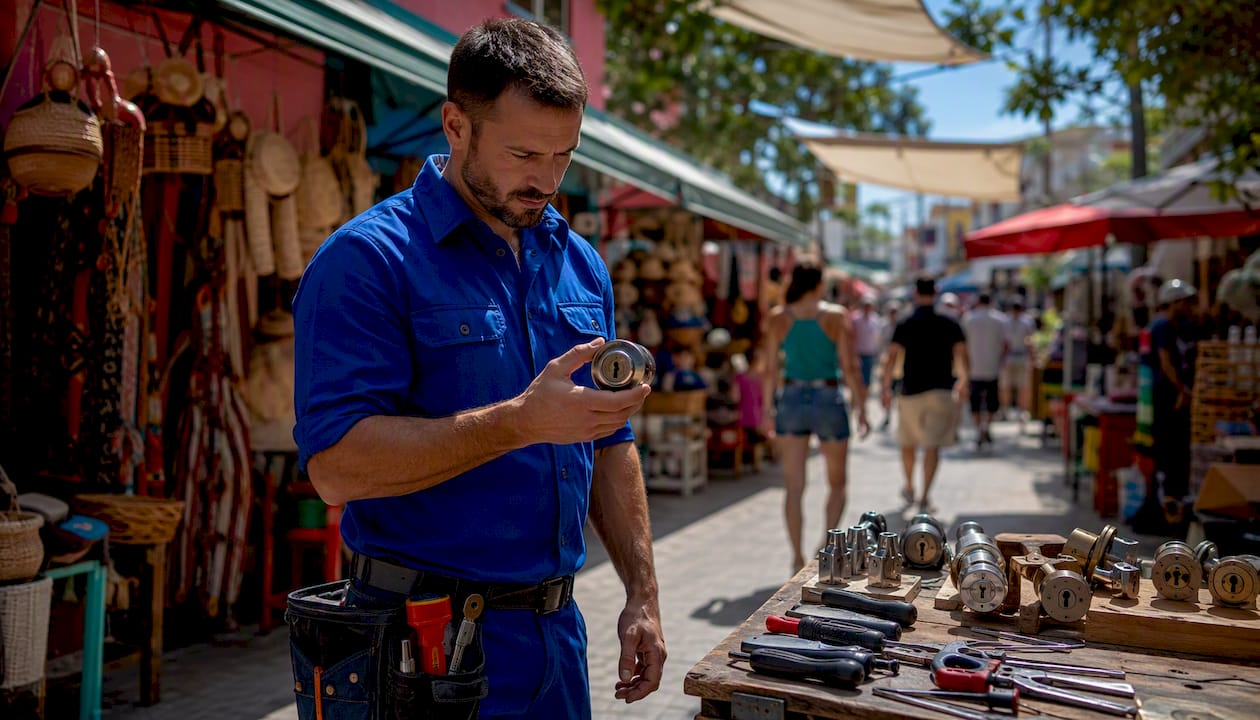
For most exterior doors, a Grade 1 or 2 deadbolt paired with a reinforced strike plate is the right starting point. Add a smart lock layer if you want keyless access or activity logs. Everything else follows from that foundation.
The lock types that matter most, matched to door function:
Exterior entry doors: Single-cylinder deadbolt (Grade 1 or 2) + knob or lever handleset
Interior privacy doors (bathrooms, bedrooms): Knob or lever with a privacy/turn-button function
Sliding glass doors: Sliding door bar lock or secondary pin lock
Cabinets, mailboxes, file drawers: Cam lock or barrel lock
Gates, sheds, storage units: Padlock (Grade 1 or 2 shackle)
Commercial or high-traffic entries: Mortise lock or electromechanical access control
When the install involves new door prep, frame reinforcement, egress compliance, or a commercial occupancy requirement, call a licensed locksmith. Some jobs look simple until the door edge tells a different story.
Table of Contents
What are the common types of door locks?
Door locks fall into three macro categories: conventional mechanical locks, electronic and smart locks, and specialized locks (cam, padlock, sliding, furniture). Every lock type below fits one of those three groups.
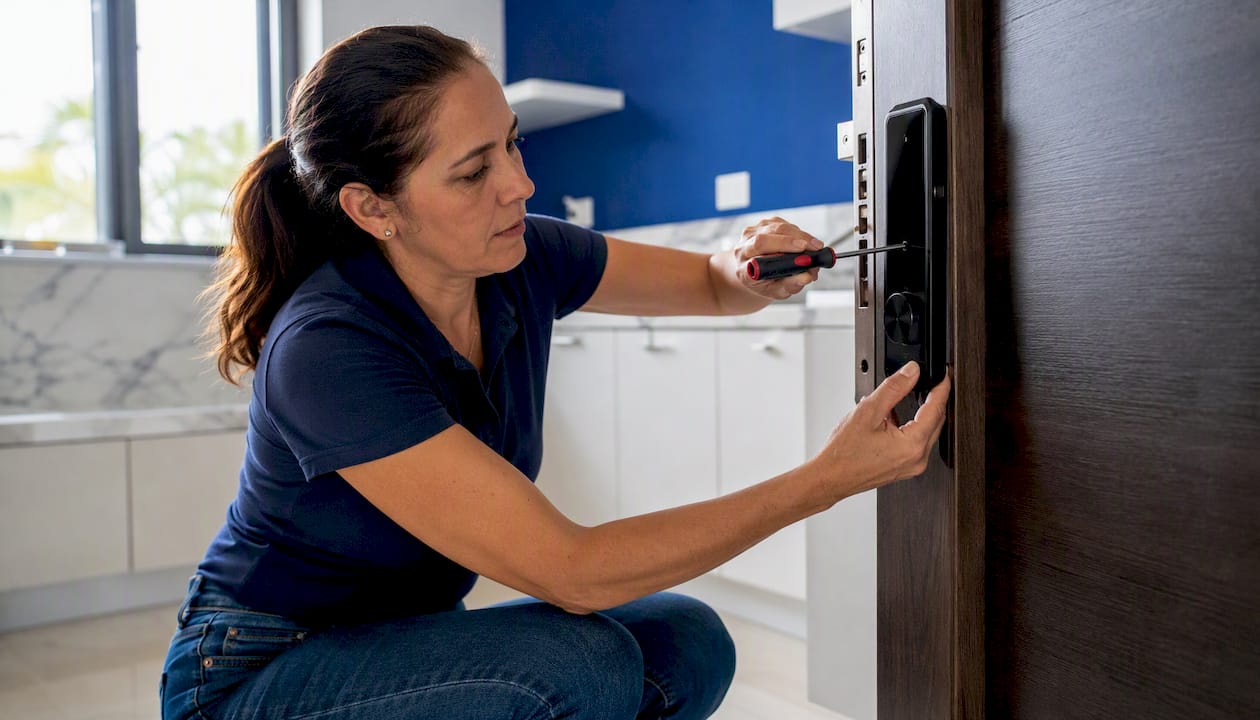
Deadbolt
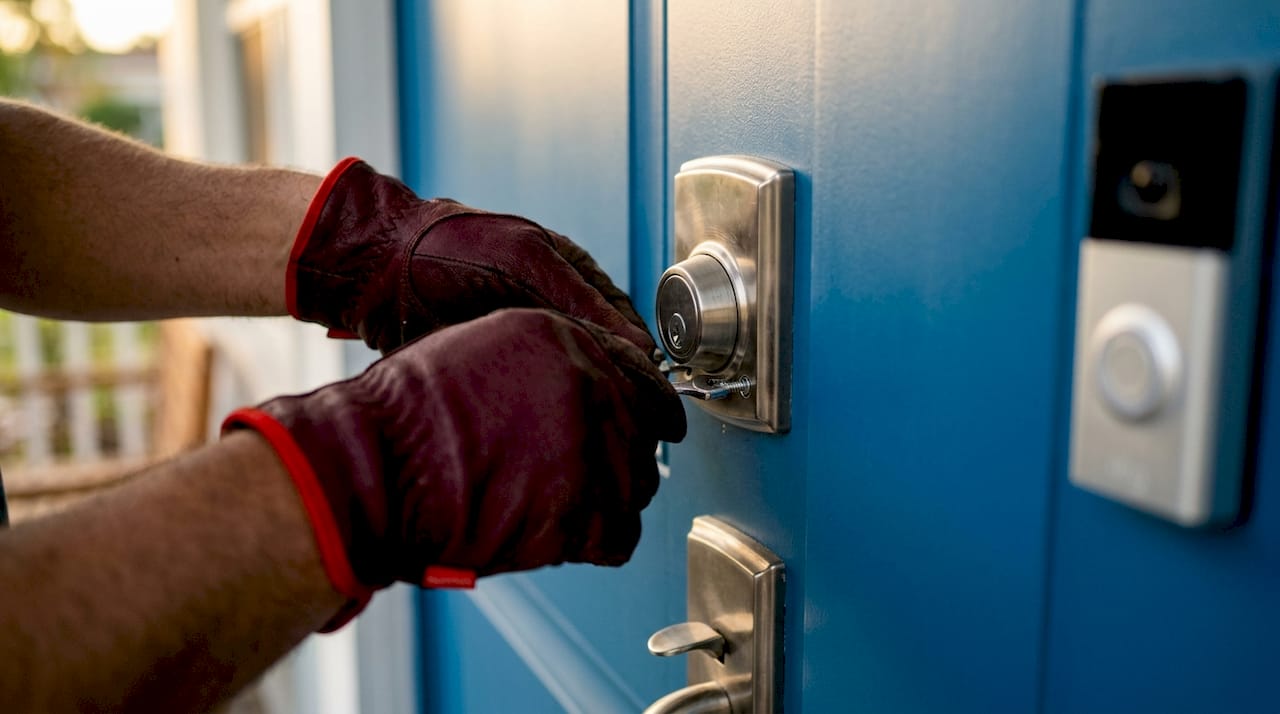
The deadbolt is the workhorse of residential security. A steel bolt extends into the door frame when locked, with no spring mechanism to push it back. Single-cylinder models use a key outside and a thumb-turn inside. Double-cylinder models require a key on both sides, which helps prevent “reach-in” attacks near glass panels but creates an emergency egress risk that can conflict with local fire codes.
Vertical deadbolts (also called rim deadbolts) mount on the door surface and interlock with a strike loop, making them harder to pry. Keyless deadbolts replace the cylinder with a keypad or smart module.
Pros: High forced-entry resistance, widely available in Grade 1 and 2, compatible with most door materials. Cons: Double-cylinder versions create egress hazards; requires proper frame and strike installation to perform. Door material: Works on wood, metal, and fiberglass. Hollow-core doors need reinforcement regardless of lock grade.
Knob lock (cylindrical lock)
Knob locks house the locking cylinder inside the knob itself. They are standard on interior passage and privacy doors. On an exterior door, a knob lock alone is not enough: the cylinder can be sheared or the knob twisted off with basic tools. Pair it with a deadbolt for any exterior application.
Pros: Inexpensive, easy to install, widely available. Cons: Vulnerable to forced entry on exterior doors when used alone; not ADA-compliant for commercial use.
Lever handle lock
Lever handles use the same cylindrical bored-hole prep as knob locks but offer a push-down operation that meets ADA door hardware requirements for commercial and accessible residential spaces. Common on office interiors, hotel rooms, and ADA-compliant entries.
Pros: ADA-compliant, easier to operate for people with limited grip strength, available in Grade 1–3. Cons: The lever can be forced down with a coat hanger or similar tool if the latch is spring-loaded only; pair with a deadbolt on exterior doors.
Mortise lock
A mortise lock sits inside a rectangular pocket (the mortise) cut into the door edge. It combines a latch bolt and a deadbolt in one unit, often with a cylinder on the exterior and a thumb-turn on the interior. Mortise locks require a pocketed mortise in the door edge, which means they are not a drop-in replacement for a cylindrical bored lock without additional door prep.
Common on older homes, commercial entries, and high-security residential applications. The multi-point engagement makes them significantly harder to kick in than a standard cylindrical lock.
Pros: High security, durable, combines latch and deadbolt functions. Cons: Requires professional installation, higher hardware cost, not compatible with thin or hollow doors. Door material: Best suited to solid wood and metal doors with sufficient edge thickness.
Rim lock / night latch
A rim lock (or night latch) mounts on the interior surface of the door rather than inside it. The latch snaps shut automatically when the door closes. Common on older apartment entry doors and as a secondary lock on exterior doors. Surface mounting makes installation straightforward, but the holding strength depends heavily on the quality of the strike plate and mounting screws.
Pros: Easy to retrofit, auto-latches on door close. Cons: Lower forced-entry resistance than a mortise or deadbolt; the surface-mounted case can be pried.
Padlock
Padlocks are portable and versatile: they secure gates, sheds, storage units, lockers, and chains. They come in keyed and combination versions, with open and closed shackles. A closed-shackle padlock exposes less of the shackle to bolt cutters, making it the better choice for outdoor security. Look for hardened steel shackles and ANSI/BHMA Grade 1 ratings for high-value applications.
Pros: No installation required, portable, available in a wide security range. Cons: Only as strong as the hasp or chain it secures; combination models can be vulnerable to observation attacks.
Cam lock
Cam locks are compact rotating locks used in cabinets, mailboxes, file drawers, vending machines, and furniture. A flat metal “cam” rotates when the key turns, engaging or releasing a catch. They are not designed for forced-entry resistance and should not be used on exterior doors.
Pros: Inexpensive, easy to install in thin panels, available in many cylinder lengths. Cons: Low security; primarily a deterrent, not a barrier.
Sliding door lock
Standard sliding glass doors often come with a flimsy latch that can be lifted or pried open. Dedicated sliding door lock repairs and upgrades typically involve a secondary bar lock (a metal rod in the track), a pin lock through the door frame, or a surface-mounted foot bolt. For higher security, a keyed sliding door lock with a hardened bolt is the right upgrade.
Pros: Prevents the door from being lifted or slid open; inexpensive secondary options. Cons: The door frame and track condition matter; a warped frame reduces effectiveness. Door material: Glass-framed aluminum or vinyl sliding doors.
Smart / electronic / keyless lock
Smart locks replace or retrofit onto a standard deadbolt and add digital access: PIN codes, smartphone apps, key fobs, biometrics, or geofencing. Retrofit smart locks add smart features without replacing the entire deadbolt, which keeps costs down. Full-replacement smart locks integrate the deadbolt and electronics in one unit.
The critical point: smart lock security depends on the physical deadbolt mechanism underneath. Verify the hardware carries an ANSI/BHMA Grade 1 or 2 rating before adding any digital layer.
Pros: Keyless entry, access logs, remote locking, temporary codes for guests or contractors. Cons: Battery dependency, potential Wi-Fi or Bluetooth vulnerabilities, higher cost.
Chain lock / door guard
A chain lock or door guard mounts on the door and frame, allowing the door to open a few inches while keeping the chain engaged. It is a secondary device, not a primary lock. Useful for verifying visitors before fully opening the door.
Pros: Inexpensive, easy to install, adds a verification layer. Cons: Easily defeated by a hard kick; provides no real forced-entry resistance.
Double-cylinder deadbolt
Covered briefly under deadbolts above, the double-cylinder variant deserves its own note. It requires a key to unlock from both sides, which prevents someone from breaking a nearby glass panel and reaching the thumb-turn. However, this creates a serious egress problem: in a fire or emergency, occupants need a key to exit. Many local fire codes restrict or prohibit double-cylinder deadbolts in residential sleeping areas. Always verify local code before installing one.
Furniture / barrel lock
Barrel locks (also called bolt locks or cabinet locks) are small cylindrical locks used in furniture, display cases, and interior cabinet doors. They offer minimal security but keep drawers and panels closed against casual access. Not rated for exterior or high-security use.
Comparison at a glance:
Lock type | Best for | Security level | Typical hardware cost | Install difficulty |
Single-cylinder deadbolt | Exterior entry doors | Grade 1–2 (high) | $40–$200 | Low–moderate (30 min) |
Knob / cylindrical | Interior privacy/passage | Grade 2–3 (low–moderate) | $15–$80 | Low (15–30 min) |
Lever handle | Interior / ADA-compliant entry | Grade 1–3 | $30–$150 | Low (15–30 min) |
Mortise lock | Commercial / high-security residential | Grade 1 (high) | $150–$300 | High (1–3 hours) |
Rim / night latch | Secondary exterior, apartment entry | Moderate | $25–$80 | Low–moderate |
Padlock | Gates, sheds, storage | Grade 1–3 (varies) | $10–$100 | None |
Cam lock | Cabinets, mailboxes, furniture | Low (deterrent) | $5–$30 | Low |
Sliding door lock | Sliding glass doors | Low–moderate | $10–$60 | Low |
Smart / electronic | Exterior entry with digital access | Grade 1–2 (hardware dependent) | $100–$300 | Moderate (30 min) |
Chain / door guard | Secondary verification | Very low | $5–$20 | Low |
Double-cylinder deadbolt | Exterior near glass panels | Grade 1–2 (high, with egress risk) | $50–$200 | Moderate |
Layer your locks for best results. A Grade 1 deadbolt on a weak frame with short screws is not a secure door. Combine a high-grade deadbolt with a reinforced strike plate, 3-inch screws into the stud, and a solid door core. Smart features add convenience and visibility; they do not substitute for solid mechanical hardware.
How to tell what kind of lock you currently have
Identifying your existing lock before shopping or calling a locksmith saves time and prevents ordering the wrong hardware. Work through these steps:
Look at the door edge. A rectangular pocket with a multi-component bolt assembly indicates a mortise lock. A round latch bolt in a round faceplate indicates a cylindrical (knob or lever) lock. A bolt-only faceplate with no latch suggests a deadbolt.
Check the interior side. A thumb-turn on the inside means a single-cylinder lock. A keyhole on both sides means double-cylinder. A keypad or app-connected module means smart/electronic.
Examine the cylinder shape. A round cylinder in the knob or a separate cylinder above the latch is a standard pin-tumbler cylinder. An oval or euro-profile cylinder (common in European-style locks) is a euro cylinder.
Look for surface-mounted hardware. A lock case mounted on the door surface (not recessed) is a rim lock or surface-mounted deadbolt.
Check sliding doors separately. A hook or claw bolt in the door edge is a sliding door lock. A simple latch with no key is the factory latch, which typically needs upgrading.
Look for visible electronics. A keypad, fingerprint reader, or Bluetooth indicator means a smart or electronic lock.
Measurements to take before shopping or calling:
Backset: Distance from the door edge to the center of the borehole (standard US sizes are 2-3/8 inches and 2-3/4 inches).
Bore diameter: The hole diameter for the lock body (standard is 2-1/8 inches for cylindrical locks).
Door thickness: Most residential doors are 1-3/8 to 1-3/4 inches thick; commercial doors vary.
Number and position of mounting screws: Relevant for rim locks and surface-mounted hardware.
For sliding glass doors, also measure the door frame thickness and the distance from the door edge to the latch center. Cam locks require the panel thickness and the cam length.
Pro Tip: Photograph both sides of the lock and the door edge in good lighting, then bring those photos to a hardware store or send them to your locksmith before ordering parts. A clear photo of the faceplate and the interior thumb-turn typically tells a professional everything needed to identify the lock and quote a replacement.
How to choose the right lock for your door and needs
Start with door function, then layer in material, security needs, and budget.
Exterior entry doors get the most abuse and the most attention from intruders. The industry-standard recommendation is a Grade 1 or 2 deadbolt paired with a lever or knob handleset. A knob lock alone on an exterior door is not adequate security. If you want keyless access or remote monitoring, add a smart lock that operates a Grade 1 deadbolt, not one that replaces it with a lighter mechanism.
Interior privacy doors (bathrooms, bedrooms) need a turn-button or push-button privacy function. For bathrooms specifically, choose a lock with an emergency release feature accessible from the outside, so a child or elderly person who accidentally locks themselves in can be reached without destroying the door.
Sliding glass doors need a secondary lock beyond the factory latch. A bar lock in the track is the fastest and cheapest upgrade. A keyed pin lock through the door frame adds a second layer.
Commercial offices and high-traffic entries often require Grade 1 mortise locks or electromechanical access control. Occupancies over 50 persons typically require panic hardware (exit devices) under life-safety codes, which affects lock selection entirely. For small-business access control in Miami-Dade, the commercial access control guide covers the relevant considerations.
Rental properties benefit from smart locks with temporary or rotating PIN codes, so you can change access between tenants without rekeying. Verify the underlying deadbolt grade before choosing the smart module.
Gates and sheds call for a closed-shackle padlock in Grade 1 or 2 with a hardened steel shackle. The hasp quality matters as much as the padlock.
When the job involves cutting a new mortise pocket, reinforcing a frame, installing panic hardware, or navigating egress code requirements, professional installation is the right call. A miscut mortise or a strike plate held by half-inch screws into drywall will undermine even the best lock hardware.
Door material compatibility in brief:
Solid wood: Compatible with all lock types; mortise requires sufficient edge thickness (typically 1-3/4 inches minimum).
Metal (steel/aluminum): Works well with cylindrical and mortise locks; requires appropriate drill bits and may need a professional for mortise prep.
Hollow-core wood: Not suitable for high-security locks without a solid wood insert or door replacement; deadbolts can pull through under kick-in force.
Glass-framed doors: Use surface-mounted or sliding-specific hardware; avoid mortise prep on thin aluminum frames.
In coastal and humid environments like Miami, look for corrosion-resistant finishes (stainless steel internals, marine-grade brass, or powder-coated exteriors) to prevent cylinder seizure and bolt corrosion over time.
What do ANSI/BHMA grades actually mean for your security?
The American National Standards Institute (ANSI) and the Builders Hardware Manufacturers Association (BHMA) jointly test and grade door hardware on cycle life, strength, and finish durability. Three grades cover the residential and light-commercial range:
Grade 1: Highest residential and commercial rating. Tested to 250,000 cycles, with the highest resistance to forced entry, picking, and drilling. Required for most commercial applications; strongly recommended for all exterior residential doors.
Grade 2: Mid-range residential rating. Tested to 150,000 cycles. Acceptable for exterior residential doors when Grade 1 is not available or budget is a constraint; not recommended for high-traffic commercial entries.
Grade 3: Light residential use only. Tested to 82,500 cycles. Grade 3 is typically insufficient to resist forced entry on exterior doors and should be limited to interior privacy and passage hardware.
UL listings (from Underwriters Laboratories) cover fire-rated door assemblies and some high-security lock products. If a door is in a fire-rated assembly, the lock must carry a UL fire label to maintain the assembly’s rating.
Why grades affect insurance and building codes:
Some homeowner insurance policies and commercial building codes reference ANSI/BHMA grades or equivalent standards when defining acceptable security hardware. A commercial lease may specify Grade 1 hardware on entry doors. An insurance claim after a break-in can be affected if the installed hardware did not meet the policy’s stated minimum. Always check your policy language and local building department requirements before selecting hardware for a commercial space.
How to spot certification marks: Look for the BHMA certification mark on the lock packaging or the lock body itself. Reputable retailers list the grade in the product specifications. When in doubt, ask your locksmith or retailer to confirm the grade before purchase.
Typical price ranges and installation time by lock type
Budgeting for a lock upgrade means accounting for both hardware and labor. The table below covers typical ranges for common lock categories in the US market.
Lock type | Typical hardware cost | Installation time (pro) | DIY difficulty |
Single-cylinder deadbolt | $40–$200 | 30 minutes | Low |
Knob / lever (interior) | $15–$150 | 15–30 minutes | Very low |
Mortise lock | $150–$300 | 1–3 hours | High (not recommended DIY) |
Smart / electronic lock | $100–$300 | 30 minutes | Moderate |
Rim / night latch | $25–$80 | 20 minutes | Low |
Padlock | $10–$100 | None | None |
Cam lock | $5–$30 | 10 minutes | Very low |
Sliding door lock (secondary) | $10–$60 | 10–30 minutes | Very low |
Double-cylinder deadbolt | $50–$200 | 30 minutes | Low–moderate |
Additional costs to plan for:
Reinforced strike plates: $10–$40 in hardware; add 15–30 minutes of labor. Worth it on every exterior door.
Longer screws (3-inch): Minimal cost, significant security improvement by anchoring into the door stud rather than just the frame.
Electronic bridges or Wi-Fi modules for smart locks that do not include them: $30–$80 additional.
Frame repair or door prep for a new mortise pocket: labor varies widely depending on door condition and material.
Emergency service calls typically cost more than scheduled installations. A locksmith dispatched at 2 AM for an emergency lockout or urgent lock replacement will charge an after-hours rate on top of the standard service fee. Scheduling a non-urgent lock upgrade during business hours is consistently the more cost-effective option.
Maintenance tips and what causes locks to fail
Most lock failures are not the lock’s fault. They trace back to the frame, the strike plate, or neglected maintenance.
Common failure points:
Loose strike plates are the most frequent problem. A strike plate held by short screws into the door jamb (not the stud behind it) can be kicked free with minimal force, regardless of the deadbolt grade. Check the screws annually and replace them with 3-inch screws that reach the stud.
Misaligned doors cause the bolt or latch to bind against the strike, which leads to worn components and, eventually, a lock that is hard to operate or fails to engage fully. If you notice resistance when turning the key or the thumb-turn, check the door alignment before assuming the lock is faulty.
Corroded cylinders are common in coastal environments. Salt air and humidity work into the cylinder, causing the pins to stick or the plug to seize. Annual lubrication with a dry graphite lubricant (not WD-40, which attracts dirt) keeps the cylinder operating smoothly.
Dead batteries in smart locks are the electronic equivalent of a seized cylinder. Most smart locks warn you with a low-battery indicator, but if you ignore it, you will find yourself locked out. Keep a spare set of batteries on hand and replace them at least once a year.
The most common security failure in homes is not a sophisticated attack. It is weak hardware or poor installation. A Grade 1 deadbolt installed with short screws into a soft-wood jamb, or a smart lock sitting on top of a Grade 3 deadbolt, gives a false sense of security. Prioritize the physical foundation: solid door, reinforced frame, Grade 1 or 2 deadbolt, 3-inch strike plate screws, and then add smart features on top.
Practical maintenance routine:
Check all exterior locks annually. Tighten the mounting screws on the lock body and the strike plate. Test the deadbolt travel: it should extend and retract smoothly with no binding. Lubricate the cylinder with graphite powder or a Teflon-based dry lubricant. For smart locks, test the keypad or app function, replace batteries, and verify the Wi-Fi or Bluetooth connection is stable.
Pro Tip: If you have a double-cylinder deadbolt on any door that serves as a primary exit route, verify your local fire code before keeping it. Many jurisdictions restrict them in residential sleeping areas. If you need the security benefit near glass panels, consult a locksmith about alternative solutions such as laminated glass or a vertical deadbolt.
Key Takeaways
A Grade 1 or 2 deadbolt with a reinforced strike plate is the single most effective security upgrade for any exterior residential door.
Point | Details |
Prioritize Grade 1 or 2 deadbolts | Use ANSI/BHMA Grade 1 or 2 hardware on all exterior doors; Grade 3 is for interior use only. |
Never rely on a knob lock alone | Pair any knob or lever on an exterior door with a deadbolt for real forced-entry resistance. |
Reinforce the frame, not just the lock | A Grade 1 deadbolt with short screws into a soft jamb fails under a kick; use 3-inch screws into the stud. |
Smart locks need solid hardware underneath | Verify the underlying deadbolt grade before adding any digital or keyless layer. |
Locksmithfromiami for professional installs | For mortise prep, frame reinforcement, or code-related commercial installs, Locksmithfromiami provides professional installation and 24/7 emergency service in Miami and Homestead. |
A locksmith’s honest take on what homeowners get wrong
The most common mistake I see is treating the lock as the whole security system. Homeowners spend $200 on a smart deadbolt, then it gets installed on a hollow-core door with a factory strike plate held by three-quarter-inch screws. The lock is fine. The door is not. A determined person does not pick a deadbolt; they kick the frame until the strike gives way.
The second mistake is ignoring the environment. In South Florida, salt air and humidity are relentless. A lock that performs well in a dry climate can seize within a year in a coastal setting if it is not rated for corrosion resistance and not maintained. Stainless steel internals and annual lubrication are not optional here; they are part of the cost of ownership.
Professional installation is worth the cost when the job involves anything beyond swapping one cylindrical lock for another. Mortise prep, frame reinforcement, panic hardware for a commercial door, or any situation where egress compliance is in play: those are jobs where a mistake costs more to fix than the installation would have cost in the first place.
Locksmithfromiami: professional lock installation and emergency service in Miami
When you know which lock type you need but want it installed correctly the first time, Locksmithfromiami handles residential and commercial lock installation, frame reinforcement, and lock repair across Miami and Homestead, FL. The team is available 24/7 for emergency lockouts and scheduled upgrades alike, with competitive pricing and no surprise fees.
Whether you are upgrading to a Grade 1 deadbolt, installing a mortise lock on a commercial entry, or need a same-day sliding door lock repair, the team brings the right tools and hardware knowledge to get it done without the guesswork. For immediate help or to schedule an installation, visit the services page or call for a same-day appointment.
Useful sources and standards references
Local codes and insurance requirements often reference these standards directly. Verify current requirements with your local building department or insurance provider before finalizing hardware selections.
Recommended
Comments