

Broken Key in a Lock: Safe DIY Steps and When to Call

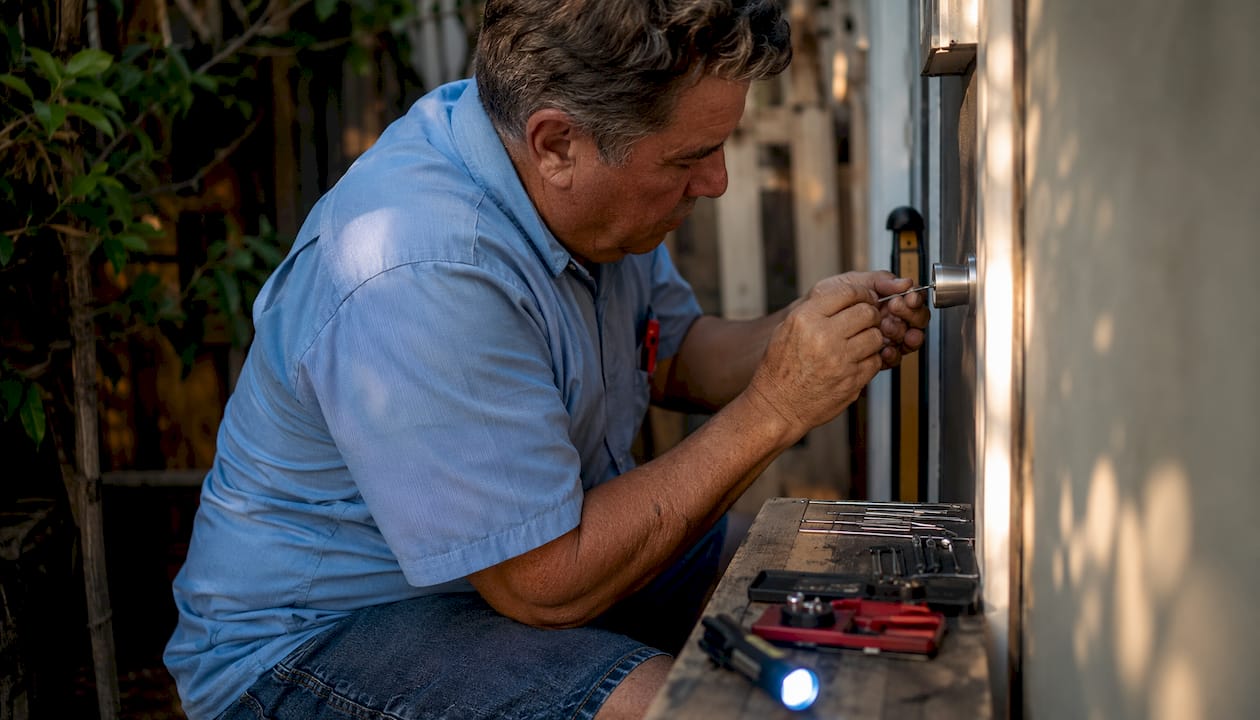
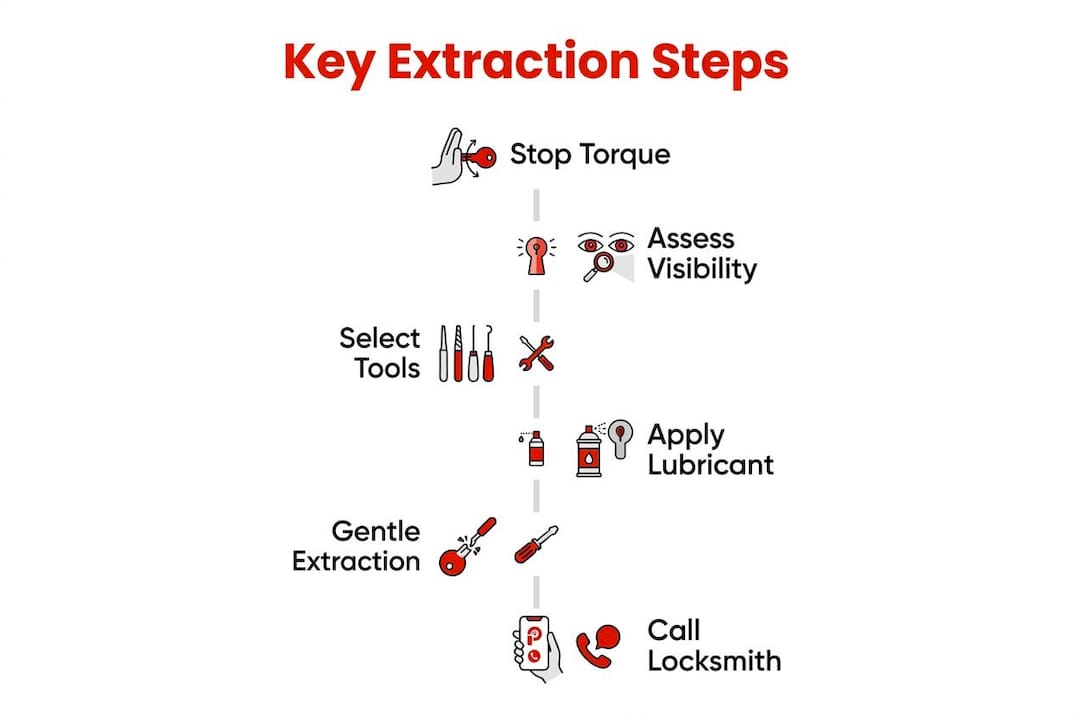
Stop turning the key. That single action is the most important thing you can do the moment a key snaps in your lock. Continued torque wedges the fragment deeper against the internal pins or wafers, turning what could be a quick fix into a damaged cylinder. If you can see any part of the broken piece sticking out of the keyway, gentle extraction with household tools is often possible. If the break is flush, the fragment is in a vehicle ignition, or you cannot catch the tip in two careful tries, stop and call a locksmith.
Your immediate checklist:
Stop applying any turning force right now.
Secure the door or vehicle: if the door is unlocked, prop it open; if the car is in gear, set the brake.
Pocket the half still in your hand. You will need it to cut a replacement.
Shine a flashlight into the keyway and assess: is any metal visible?
The three rules every locksmith agrees on: stop torque, preserve both key halves, and never use glue or oil. Everything else follows from those three.
Table of Contents
How to remove a broken key when part of the fragment is visible
What to do when the fragment is flush, deep, or stuck in an ignition
Which lubricants actually help, and which ones make things worse
A locksmith’s perspective on why stopping early is the right call
Locked out right now? Here is how Locksmithfromiami can help
What tools do you actually need for key extraction?
Having the right tool before you start saves you from making things worse. Here is what works, what helps in a pinch, and what to skip entirely.
Tool | Best for | Notes |
Fine-tip tweezers or hemostats | Fragment visibly protruding | Grip the exposed ridge and pull straight out |
Needle-nose pliers | Fragment sticking out at least 2–3 mm | Only if there is enough to grip; do not force |
Broken-key extractor hook | Flush or slightly recessed breaks | Thin hooked metal rides the key bitting to catch and pull |
Spiral extractor pick | Deeper flush breaks | Threads into the keyway alongside the fragment |
Straightened paperclip with tiny hook | Light backup when no extractor is available | Bend a small hook; use minimal pressure only |
Small flathead screwdriver | Returning plug to neutral position | Gently only; never use to pry the fragment |
Flashlight or phone light | All situations | Non-negotiable for seeing what you are working with |
Specialty broken-key extractor kits are inexpensive and available at most hardware stores. If you do any DIY work around the house, a basic extractor set is worth keeping in your toolbox before you ever need it.
What to avoid: large screwdrivers, thick pliers that cannot fit the keyway cleanly, and any improvised glue approach. Super glue wicks into wafer chambers through capillary action and can permanently immobilize the cylinder’s moving parts, converting a simple extraction into a full lock replacement.
Pro Tip: Before touching any tool to the lock, take a photo of the keyway with your phone flashlight. It helps you see the fragment’s position and gives a locksmith useful information if you end up calling one.
How to remove a broken key when part of the fragment is visible
This procedure applies when you can see any portion of the broken piece at or near the keyway opening. Work slowly and stop the moment you feel resistance.
Neutralize torque first. If the key snapped while turning, the plug may be rotated slightly. Use a small flathead screwdriver placed very gently at the keyway edge to ease the plug back to the vertical (neutral) position. If you feel hard resistance, stop immediately. Also relieve any door or steering pressure: push or pull the door to take load off the latch, or center the steering wheel if it is a vehicle.
Add dry lubricant only if the lock is dry or gritty. A tiny puff of graphite powder or a brief spray of dry PTFE into the keyway reduces friction without leaving residue. Wait 30–60 seconds before proceeding. Skip this step if the lock already feels smooth.
Try fine tweezers or hemostats first. Grip the exposed edge of the fragment straight on. Pull directly along the insertion path, no twisting, no rocking. Small, steady tension is what works. A sharp yank usually pushes the piece deeper.
If tweezers cannot grip, switch to a hooked extractor or shaped paperclip. Insert the hook along the top edge of the keyway so it rides the key bitting (the cut grooves along the blade). Once you feel the hook catch a tooth, apply slow, steady outward pressure. Maintain the pull along the key’s own path.
Two-blade pinch as a last household option. Slide two thin, flat pieces of metal (two straightened paperclips work) along either side of the fragment, pinch inward, and pull out together. This works only when there is enough fragment to pinch.
Stop immediately if: your tool slips and you feel it scrape metal, the fragment moves deeper rather than outward, or you see metal shavings. Repeated unsuccessful attempts cause mushrooming, where the soft brass edge folds and creates a wider profile that jams behind pins. Two gentle tries is the limit.
What to do when the fragment is flush, deep, or stuck in an ignition
A flush break, where the key snapped level with or below the face of the cylinder, changes the situation significantly. So does a break inside a vehicle ignition.
How to tell what you are dealing with:
Situation | What you see/feel | Recommended action |
Fragment visibly protruding | Metal visible at keyway opening | Proceed with tweezers or extractor (see above) |
Fragment flush with cylinder face | No metal visible; lock may feel slightly bound | Try extractor strip once or twice, then call a pro |
Fragment recessed or deep | Nothing visible even with flashlight | Call a locksmith; DIY risk is high |
Vehicle ignition break | Key snapped while turning ignition | Stop; do not force steering wheel or drill |
High-security or mortice lock | Deeper keyway, anti-tamper features | Specialist handling required |
For a flush break, one brief attempt with a thin extractor strip is reasonable. Insert it along the top of the keyway, feel for a groove in the key blade, and apply gentle outward pressure. A small magnet held near the keyway face occasionally draws a fragment that is very close to the opening, though most key blanks are brass and respond weakly to magnets.
Vehicle ignitions need special care. The steering wheel lock creates column pressure that binds the cylinder. Center the steering wheel and lightly wiggle it left and right to release that pressure before attempting anything. If the fragment is not near the front of the ignition barrel, stop. Forcing tools deep into an ignition cylinder can damage internal wafers and turn a $150 extraction into a full ignition replacement.
Decision point: if you cannot catch the tip in two tries, the break is flush, the lock is an ignition, or the keyway is high-security, call a professional. Flush, ignition, and high-security cases typically require specialized extractors, cylinder removal, or on-site key cutting that go beyond what household tools can safely accomplish.
Which lubricants actually help, and which ones make things worse
The type of lubricant you use matters as much as whether you use one at all.
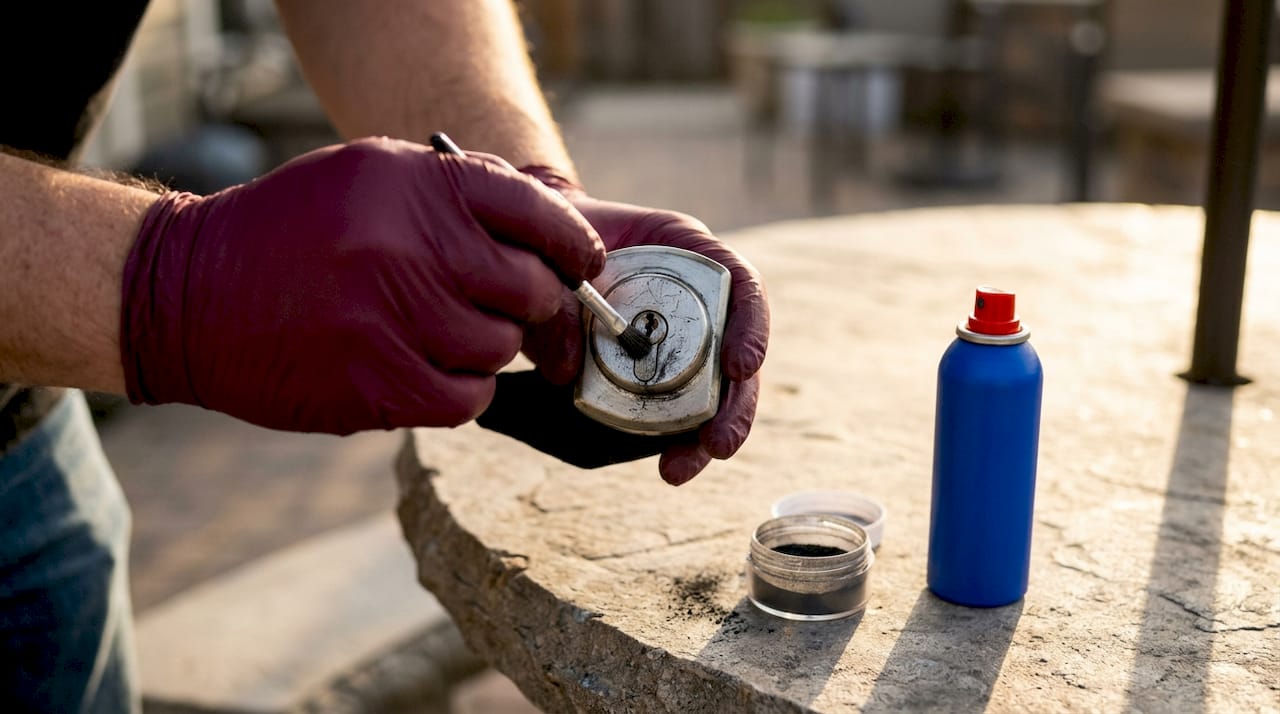
Dry lubricants, specifically graphite powder and dry PTFE or dry silicone sprays, are the professional standard. They reduce friction inside the cylinder without leaving an oily residue that later traps dust and grit. A tiny puff is genuinely all you need. Over-applying even a good dry lubricant attracts debris over time.
Avoid WD-40 and any liquid machine oil. Oil-based sprays attract dust, and in a lock cylinder that is already under stress, that combination creates a gummy paste that makes future extractions harder. The same logic applies to penetrating oils and solvents.
Application: one small puff of graphite or a half-second spray of dry PTFE directly into the keyway. Wait 30–60 seconds for it to settle, then make one more extraction attempt.
Pro Tip: Graphite from a standard pencil (rub the tip inside the keyway) works in a pinch if you have no dry lubricant on hand. It is not as effective as powdered graphite, but it is far better than any liquid oil.
When should you stop and call a locksmith?
Some situations call for a professional from the start. Others reach that point after one or two failed attempts. Knowing the difference saves your lock.
Stop immediately and call a locksmith if:
The break is flush with the cylinder face and you cannot catch it in two tries.
The lock feels rough, crunchy, or gritty when you try to turn it with a spare key.
The fragment is inside a vehicle ignition.
The lock is a high-security cylinder (brands like Medeco or Mul-T-Lock use tighter tolerances that make DIY extraction risky).
Your tool slipped and you suspect you scratched the internal pins or wafers.
You are in a time-sensitive situation, such as a late-night lockout or a vehicle you need immediately.
Two gentle, unsuccessful attempts is the limit. Every additional try increases the chance of mushrooming the fragment or pushing it deeper, which can turn a non-destructive extraction into a cylinder replacement.
When you call, have this ready: your location, whether it is a door or vehicle, whether any fragment is visible, and for vehicle work, your photo ID and proof of ownership. Mobile locksmith services dispatch to your location, attempt non-destructive extraction first, and typically carry key-cutting equipment to finish the job in one visit.
What to do after you successfully remove the fragment
Getting the piece out is not quite the finish line. A few quick steps protect the lock and make replacement easier.
Save both halves of the key. Together, they contain the full cut pattern. A locksmith can decode the cuts from both pieces and machine an accurate replacement, often during the same visit, without needing to disassemble the lock.
Test the lock with a spare key. If it turns smoothly, the cylinder is likely fine. If it feels gritty or catches, apply a light puff of dry lubricant and retest.
Plan for rekeying if the lock was already stiff. A key often snaps because the cylinder was already worn or dry. Extraction fixes the immediate problem; a worn cylinder remains. If the lock was rough before the break, schedule a rekey or cylinder replacement.
For vehicles, confirm transponder status. If the key had a chip in the plastic head, that half may be reusable or clonable. Have your ID, registration, and the year, make, and model ready when you contact an automotive locksmith.
How to prevent a key from breaking in the first place
Most broken keys give warning signs before they fail. Catching those signs early costs almost nothing.
Replace visibly worn keys before they snap. Thinning, visible bending, or rough edges on the teeth are clear signals. A key that has been copied multiple times from increasingly worn originals loses accuracy with each generation; always have new copies cut from the original or from factory code.
Lubricate locks every few months. A dry or gritty cylinder drags on the key, which means you apply more torque, which fatigues the brass faster. A small amount of dry PTFE or graphite every few months keeps the action smooth.
Address a stiff lock immediately. A lock that needs jiggling or extra force is a warning, not a quirk. Door misalignment, a worn strike plate, or a dry cylinder are all fixable before they cause a break.
Never use your key as a tool. Opening boxes, prying lids, or scraping surfaces creates stress cracks in the brass that are invisible until the key snaps under normal use.
Carry a spare once a key looks tired. If a key is visibly worn, keep a fresh spare in your wallet or on a second ring. Use the worn key as little as possible until you replace it.
Pro Tip: Have a spare cut from the original key, not from a worn copy. Hardware store duplicates traced from a heavily used key inherit every worn edge, and those imperfections cause the new key to bind in the lock.
What a locksmith actually does on-site during an extraction
Understanding the professional process helps you know what to expect and why calling a pro is often the fastest path to a working lock.
A technician’s first step is diagnostic: assess the break position, check whether the plug is bound, and identify the lock type. Deadbolts and commercial locks have deeper keyways than standard residential cylinders; mortice locks and high-security keyways often require cylinder removal before extraction is even possible.
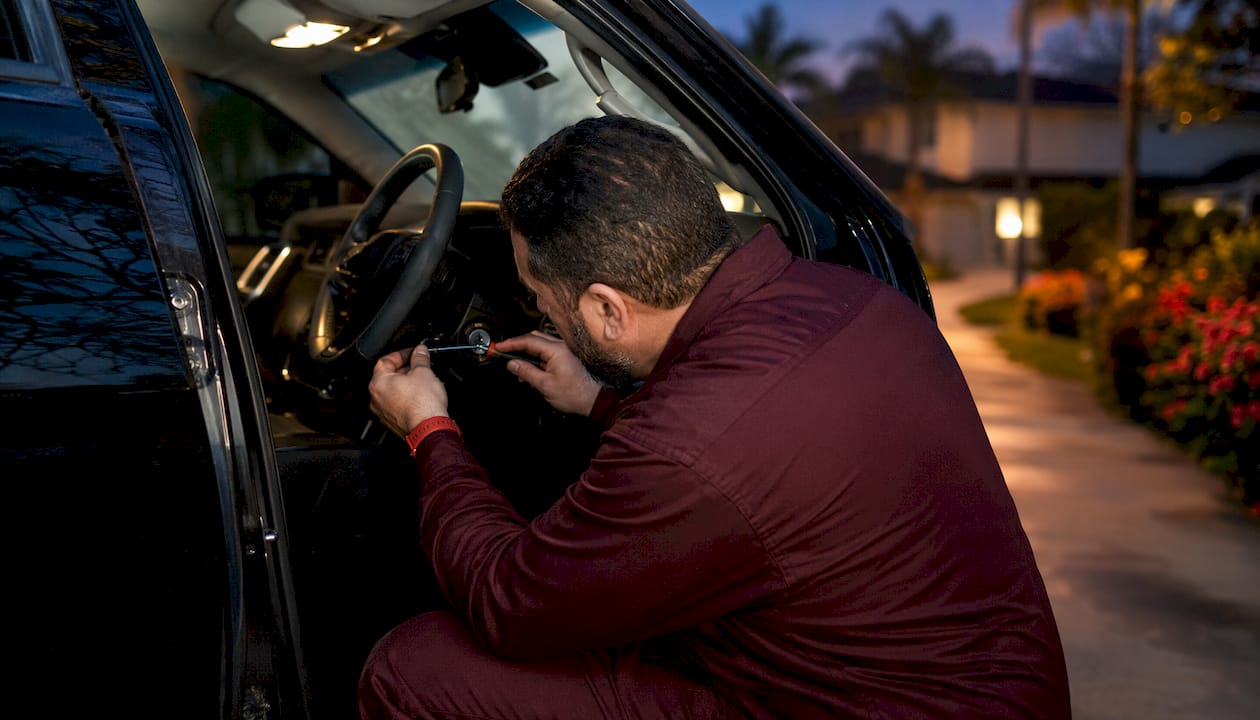
From there, the technician neutralizes any torque on the plug, then inserts thin hooked or spiral extractors alongside the fragment. These tools are made of spring steel, narrow enough to fit the keyway without disturbing the pins, and barbed to catch the key bitting. The fragment comes out along the same path it went in. A touch of dry lubricant helps everything move cleanly.
For vehicle ignitions, the process often includes centering the steering wheel to release column pressure before any tool enters the cylinder. If the fragment is deep, the technician may remove the cylinder from the steering column to work on it directly. Mobile automotive services carry on-site key-cutting and programming equipment, so extraction and replacement typically finish in one visit.
Why professionals avoid force: internal pins and wafers are small, precisely machined parts. A tool that slips under pressure can bend a wafer or crack the plug, and glue or drilling almost always results in a full cylinder replacement. Non-destructive extraction, done with the right tools and no excess force, leaves the cylinder exactly as it was.
Progressive Locksmith Cerrajero (Locksmithfromiami) handles mobile extraction for both residential and automotive locks in the Miami and Homestead area, with on-site key cutting available for most vehicle and door lock situations.
Key Takeaways
A broken key in a lock is manageable when you stop turning immediately, assess visibility, and limit DIY attempts to two gentle tries before calling a professional.
Point | Details |
Stop torque first | Continued turning wedges the fragment deeper and risks cylinder damage. |
Visible tip only for DIY | Only attempt extraction if you can see part of the fragment; flush or deep breaks need a pro. |
Use dry lubricant sparingly | Graphite or dry PTFE reduces friction; oil-based sprays attract grit and worsen the problem. |
Two tries maximum | More than two gentle attempts risks mushrooming the brass and pushing the fragment deeper. |
Locksmithfromiami for urgent cases | Progressive Locksmith Cerrajero provides mobile extraction and on-site key cutting in Miami and Homestead, 24/7. |
A locksmith’s perspective on why stopping early is the right call
The customers who end up with the simplest, cheapest outcomes are almost always the ones who stopped early. They tried tweezers once, felt resistance, and called. The customers who end up with cylinder replacements are usually the ones who spent an hour trying different tools, pushed the fragment deeper, and then reached for glue.
What most people underestimate is how little margin there is inside a lock cylinder. The gap between the fragment and the surrounding pins is measured in fractions of a millimeter. A tool that slips even slightly can scratch a wafer, and a scratched wafer changes how the lock responds to a key. That is why locksmiths use spring-steel extractors that are thinner than the key itself, not paperclips, not screwdrivers, and certainly not glue.
When a technician arrives, the first thing they check is whether the plug is bound and whether any prior DIY attempts have caused secondary damage. The best-case scenario is a clean break with no additional damage, which usually means a fast, non-destructive extraction and a new key cut on the spot. For vehicles, having your ID, registration, and both key halves ready speeds the process considerably. Many clean extractions leave the cylinder fully functional, and a single visit covers extraction plus a fresh key cut to factory specification.
The honest truth: a key often snaps because the lock was already worn or dry. Extraction fixes the immediate problem, but if the cylinder was dragging before the break, it will drag again. A good technician will tell you plainly after extraction whether the cylinder is healthy or due for service.
Locked out right now? Here is how Locksmithfromiami can help
When the fragment is flush, the lock is an ignition, or two careful tries have not worked, the fastest resolution is a mobile locksmith who carries the right tools and can finish the job in one stop.

Locksmithfromiami (Progressive Locksmith Cerrajero) serves Miami-Dade County and the Homestead area with 24/7 mobile extraction for both residential and automotive locks. The approach is non-destructive first: specialized extractors before any drilling or cylinder removal. For vehicle work, the team carries on-site key programming equipment, so a snapped car key typically resolves in a single visit, extraction and replacement included. For home lockouts, the residential lockout service dispatches quickly with clear, upfront pricing.
When you call, have your location, a description of the lock or vehicle, whether any fragment is visible, and your photo ID ready. That information lets the dispatcher give you an accurate quote before the technician rolls. Contact Locksmithfromiami now to get a mobile technician on the way.
Recommended
Comments